flaw in Microsoft Office 2016 and older versions that could allow
an attacker to embed malicious code inside a document file,
tricking users into running malware onto their computers.
Discovered by researchers at Cymulate, the bug abuses the
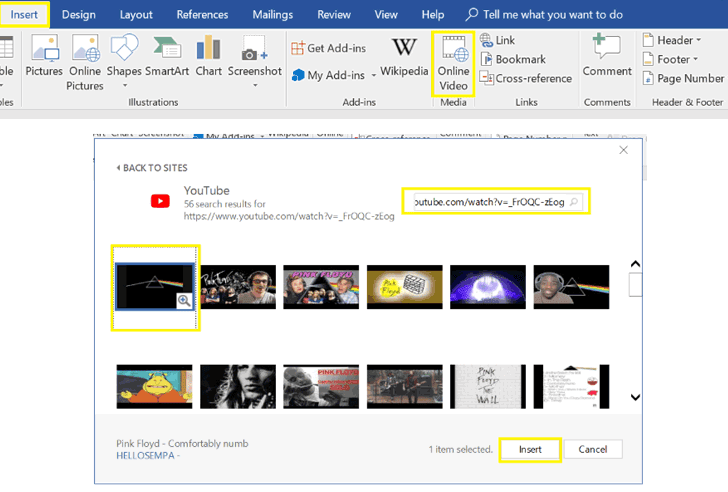
‘Online Video‘ option in Word documents, a feature that
allows users to embedded an online video with a link to YouTube, as
shown.
When a user adds an online video link to an MS Word document,
the Online Video feature automatically generates an HTML embed
script, which is executed when the thumbnail inside the document is
clicked by the viewer.
Researchers decided to go public with their findings three
months after Microsoft refused to acknowledge the reported issue as
a security vulnerability.
How Does the New MS Word Attack Works?
Since the Word Doc files (.docx) are actually zip packages of its
media and configuration files, it can easily be opened and
edited.
‘document.xml,’ which is a default XML file used by Word and
contains the generated embedded-video code, can be edited to
replace the current video iFrame code with any HTML or javascript
code that would run in the background.
In simple words, an attacker can exploit the bug by replacing
the actual YouTube video with a malicious one that would get
executed by the Internet Explorer Download Manager.
“Inside the .xml file, look for the embeddedHtml parameter (under
WebVideoPr) which contains the Youtube iframe code,” the
researchers said.
“Save the changes in the document.xml file, update the docx package
with the modified XML and open the document. No security warning is
presented while opening this document with Microsoft Word.”
Video Demonstration: MS Word Online Video Flaw
To prove the extent of the vulnerability, Cymulate researchers
created a , demonstrating how a maliciously crafted document with
an embed video, which if clicked, would prompt user to run an
embedded executable (as a blob of a base64)–without downloading
anything from the internet or displaying any security warning when
the victim clicks on the video thumbnail.

a document and then clicking on an embedded video link.
Cymulate researchers responsibly reported this bug, which
impacts all users with MS Office 2016 and older versions of the
productivity suite, three months ago to Microsoft, but the company
refused to acknowledge it as a security vulnerability.
Apparently, Microsoft has no plans to fix the issue and says its
software is “properly interpreting HTML as designed.”
Meanwhile, researchers recommended enterprise administrators to
block Word documents containing the embedded video tag:
“embeddedHtml” in the Document.xml file, and end users are advised
not to open uninvited email attachments from unknown or suspicious
sources.
Read more http://feedproxy.google.com/~r/TheHackersNews/~3/_tz2_SoPYEs/microsoft-office-online-video.html