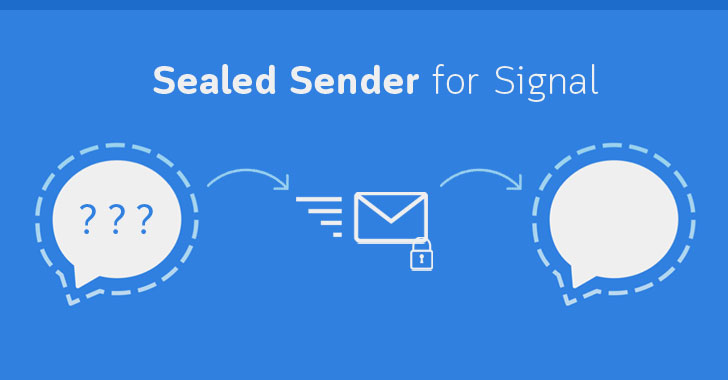
planning to roll out a new feature that aims to hide the sender’s
identity from potential attackers trying to intercept the
communication.
Although messages send via secure messaging services, like
Signal[1], WhatsApp[2], and Telegram[3], are fully end-to-end
encrypted as they transmit across their servers, each message
leaves behind some of the metadata information that reveals who
sent the message to whom and when.
The new feature, dubbed “Sealed Sender,” announced by
Signal is going to further reduce the amount of information that is
accessible to the company itself.
However, you should note that Signal never stores metadata or logs
of information on its users like who sends messages to each other
and when, but the new feature would protect the sender’s identity
in case the communication is somehow intercepted.
How Does the Signal’s Sealed Sender Feature Protect
Metadata?
According to a blog post published by Signal on Monday,
the Sealed Sender feature uses an encrypted “envelope” containing
the sender’s identity and the message ciphertext, which is then
decrypted at the end of the recipient with their own identity keys.
“While the service always needs to know where a message should be
delivered, ideally it shouldn’t need to know who the sender is,”
Signal developer Joshua Lund said. “It would be better if the
service could handle packages where only the destination is written
on the outside, with a blank space where the ‘from’ address used to
be.”
- The app encrypts the message using Signal Protocol, as
usual. - Include the sender certificate and encrypted message in an
envelope. - Encrypt the envelope using the sender and recipient identity
keys. - Without authenticating, send the encrypted envelope to the
Signal server along with the recipient’s delivery token. - The message recipient can then decrypt the envelope by
validating the identity key to know the sender of the message.
It should be noted that since the new technique eliminates the
company’s ability to validate sender’s certificate that was being
used to prevent abuse and spoofing, the service has introduced
additional workarounds that still allow users to verify who sent
the incoming messages.

app, so beta users can enable the feature via Settings →
Sealed Sender, and enable “Allow from Anyone” toggle,
to receive ‘sealed sender’ messages from non-contacts and people
with whom they haven’t shared their profile or delivery token.
Besides protecting the Sender’s identity, the company is also
finding ways to encrypt IP addresses and other sensitive metadata
information that could be revealed by analyzing users’ network
traffic.
The Sealed Sender feature will be enabled by default in the
upcoming version of Signal.
References
Read more http://feedproxy.google.com/~r/TheHackersNews/~3/TgDQdeFNdOo/signal-secure-messaging-metadata.html