Risk = Threat x Vulnerability. Impact – Can at times be added to give a more full picture. Risk = Threat x Vulnerability x Impact (How bad is it?). Total Risk = Threat x Vulnerability x Asset Value. Residual Risk = Total Risk – Countermeasures.
whaling attack (whaling phishing)
5 ways to protect against whaling phishing
Defending against whaling attacks involves a mix of employee security awareness, data detection policy and infrastructure. Some best practices for preventing whaling include the following:
- Employee awareness. Preventing any type of cybersecurity threat requires every employee to take responsibility for protecting the company’s assets. In the case of whaling phishing, all employees — not just high-level executives — must be trained about these attacks and how to identify them. Although high-level executives are the targets, lower-level employees could indirectly expose an executive to an attack through a security lapse. Employees should know what social engineering tactics to look for, such as fake email addresses that mimic a trusted email address. For example, if an employee regularly corresponds with an email address that reads “bill@gmail.com,” then the hacker might send a malicious email from “bil1@gmail.com” to mimic the trusted correspondent and gain the victim’s trust. Employees should also be wary of requests for money through email.
- Multistep verification. All requests for wire transfers and access to confidential or sensitive data should pass through several levels of verification before being permitted. Check all emails and attachments from outside of the organization for malware, viruses and other issues to identify potentially malicious traffic.
- Data protection policies. Introduce data security policies to ensure emails and files are monitored for suspicious network activity. These policies should provide a layered defense against whale phishing and phishing in general to decrease the chances of a breach occurring at the last line of defense. One such policy might involve monitoring emails for indicators of phishing attacks and automatically blocking those emails from reaching potential victims.Indicators of a potential phishing email include the following:
- The display or domain name differs slightly from the trusted address.
- The email body contains requests for money or information.
- The domain age does not match the domain age of the trusted correspondent.
- Social media education. As an extension of employee awareness, make high-level executives aware of social media’s potential role in enabling a whaling breach. Social media contains a wealth of information that cybercriminals can use to craft social engineering attacks like whale phishing. Executives can limit access to this information by setting privacy restrictions on their personal social media accounts. CEOs are often visible on social media in ways that telegraph behavioral data that criminals can mimic and exploit.
- Anti-phishing tools and organizations. Many vendors offer anti-phishing software and managed security services to help prevent whaling and other phishing attacks. Social engineering tactics remain prevalent, however, because they focus on exploiting human error, which exists with or without cybersecurity technology.The Anti-Phishing Working Group (APWG) is an organization dedicated to cybersecurity and phishing research and prevention. It provides resources for companies affected by phishing and conducts research to provide information on the latest threats. Companies can also report a suspected threat to APWG for analysis.
Differences among phishing, whaling phishing and spear phishing
Phishing attacks, whaling phishing attacks and spear phishing attacks are often confused. All are online attacks targeting users to gain sensitive information or to social engineer the victim into taking some harmful action.
A whaling attack is a special form of spear phishing that targets specific high-ranking victims within a company. Spear phishing attacks can target any specific individual. Both types of attack generally require more time and effort on the part of the attacker than ordinary phishing attacks.
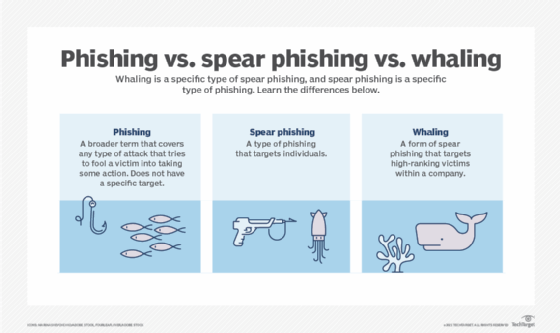
Phishing is a broader term that covers any type of attack that tries to fool a victim into taking some action, including sharing sensitive information, such as usernames, passwords and financial records for malicious purposes; installing malware; or completing a fraudulent financial payment or wire transfer.
While ordinary phishing email attacks usually involve sending emails to a large number of individuals without knowing how many will be successful, whaling email attacks usually target one specific individual at a time — typically a high-ranking individual — with highly personalized information.
Examples of whaling attacks
One notable whaling attack occurred in 2016 when a high-ranking employee at Snapchat received an email from an attacker pretending to be the CEO. The employee was tricked into giving the attacker employee payroll information; ultimately, the Federal Bureau of Investigation (FBI) looked into the attack.
Another whaling attack from 2016 involved a Seagate employee who unknowingly emailed the income tax data of several current and former company employees to an unauthorized third party. After reporting the phishing scam to the Internal Revenue Service (IRS) and the FBI, it was announced that thousands of people’s personal data was exposed in that attack.
A third notable example of whaling occurred in 2018 when the European cinema company Pathé was attacked and lost $21.5 million in the wake of the attack. The attackers, posing as high-ranking employees, emailed the CEO and chief financial officer (CFO) with a fraudulent request for a highly confidential financial transaction. Despite red flags, the CEO and CFO transferred roughly $800,000 to the attackers, which was only the beginning of the company’s losses from the incident.
HP has predicted that 2021 will likely see an increase in whaling attacks, along with other cybersecurity threats, such as ransomware, phishing emails and thread hijacking. The massive shift to remote work in response to the COVID-19 pandemic is, in part, responsible for exposing organizations to new vulnerabilities, HP said.