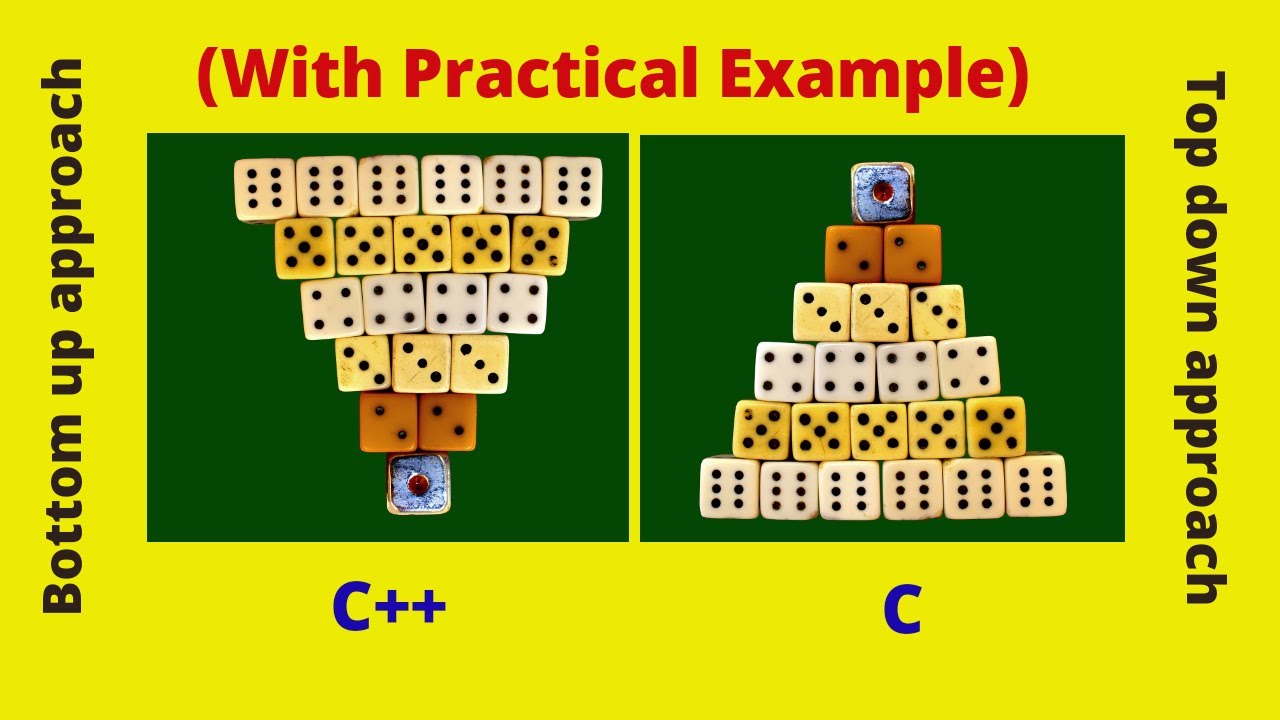
In Top-Down development you start out with your main function, and then think of the main steps you need to take, then you break up each of those steps into their subparts, and so on.
In Bottom-Up programming you think of the basic functionality and the parts you’re going to need and build them up. You develop the actors and their methods, and then you tie them together to make a coherent whole.
OOP naturally tends toward Bottom-Up as you develop your objects, while procedural programming tends toward Top-Down as you start out with one function and slowly add to it.
I’ve never heard that classification applied to specific languages, rather it’s a programming paradigm – do you first fill out the details (i.e. build full implementation methods) and then put them together (e.g. call them from them main() method), or start with the logical flow and then flesh out the implementation?
You can really do either with both types of lanugages… But I would say it’s typically the opposite, in current OOP languages you’ll first define the interfaces, forming the logical structure, and only afterwards worry about the implementation, whereas straight procedural languages like C, you need to actually implement some methods before you call them.
In top-down approach the system is first formulated specifying but not detailing any subsystem at the beginning, and then each system and its subsystem is defined in great detail until specifying it to the base.
e.g.- In a C program one needs to declare functions at the top of the program and then through the main entry to every subsystem/subroutine is defined in great detail.
In bottom-up approach first designing, beginning from the base level to the abstract level is done.
e.g.-In c++/java starts designing from class from basic level of the programming features and then goes to the main part of the program.
Top-down and bottom-up: What’s the difference?
In the world of programming, algorithms take the prime spotlight. These complex mathematical and computational designs are used to find solutions to even more complex programming issues. But that’s something we’re all aware of. However, do you know how these algorithms are designed and created?
That’s precisely the topic of our conversation today!
Table of Contents
How Are Algorithms Designed – The Top-Down And The Bottom-Up Approach
Basically, the top-down approach, as the name suggests, is all about breaking a bigger problem into smaller chunks, whereas, the bottom-up approach focuses on amalgamating smaller chunks to paint the complete and bigger picture. Get it? Now, let’s take a closer look at these two methodologies.
The Top-Down Approach
In the top-down approach, a complex algorithm is broken down into smaller fragments, better known as ‘modules.’ These modules are then further broken down into more smaller fragments until they can no longer be fragmented. This process is called ‘modularization.’ However, during the modularization process, you must always maintain the integrity and originality of the algorithm.
By breaking a bigger problem into smaller fragments, the top-down approach minimizes the complications usually incurred while designing algorithms. Furthermore, in this approach, each function in a code is unique and works independently of other functions. The top-down approach is heavily used in the C programming language.
The Bottom-Up Approach
Contrary to the top-down approach, the bottom-up approach focuses on designing an algorithm by beginning at the very basic level and building up as it goes. In this approach, the modules are designed individually and are then integrated together to form a complete algorithmic design.
So, in this method, each and every module is built and tested at an individual level (unit testing) prior to integrating them to build a concrete solution. The unit testing is performed by leveraging specific low-level functions.
What Are The Key Differences Between The Top-Down And The Bottom-Up Approaches?
Based on the core preferences and values of each methodology, we can chalk out certain basic differences between the two. They are:
- While the top-down approach focuses on breaking down a big problem into smaller and understandable chunks, the bottom-up approach first focuses on solving the smaller problems at the fundamental level and then integrating them into a whole and complete solution.
- The top-down approach is primarily used by structured programming languages such as C, COBOL, Fortran. On the contrary, the bottom-up approach is preferred by OOP languages such as C++, C#, Python, Java, and Perl.
- In the top-down approach, each module and submodule are processed separately, and hence, they might contain redundant information. However, the bottom-up approach relies on data encapsulation and data-hiding, thereby, minimizing redundancy.
- The top-down approach doesn’t require the modules to have a well-established line of communication among them, whereas, in the bottom-up approach, the modules must have a certain degree of interaction and communication among them.
- While the top-down approach can be used in module documentation, debugging, and code implementation, the bottom-up approach is primarily used in testing.
Thus, in conclusion, we can say that the top-down approach is rather the conventional method that seeks to decompose a complex problem into smaller fragments (from high-level specification to low-level specification), the bottom-up approach works is just the opposite – it first concentrates on designing the fundamental components of an algorithm and then moves up to a higher level to achieve a complete result.
We hope this helps! Happy coding!