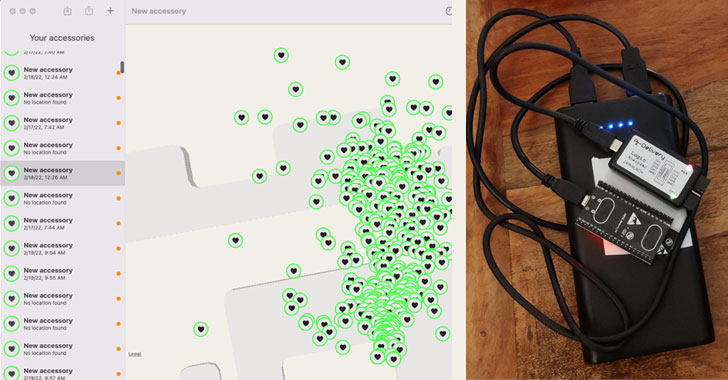
Cybersecurity researchers have managed to build a clone of Apple
Airtag that circumvents the anti-stalking protection technology
built into its Find My Bluetooth-based tracking protocol.
The result is a stealth AirTag that can successfully track an
iPhone user for over five days without triggering a tracking
notification, Positive Security’s co-founder Fabian Bräunlein
said[1]
in a deep-dive published last week.
Find My is Apple’s asset tracking app that allows users to track
the GPS location of iOS, iPadOS, macOS, watchOS devices, AirPods,
AirTags as well as other supported third-party accessories through
a connected iCloud account. It also enables users to view the
location of others who have opted to share their location.
This is far from the first time weaknesses have been uncovered
in Apple’s Find My system. In March 2021, the Secure Mobile
Networking Lab at the Technical University of Darmstadt, Germany
(SEEMO) disclosed[2]
design and implementation flaws in the protocol that can lead to a
location correlation attack and unauthorized access to users’
location histories
Then in May 2021, Bräunlein followed it up by sharing details of
a communication protocol[3]
built on top of Find My that enables arbitrary data to be uploaded
from non-internet-connected devices by sending “Find My” Bluetooth
broadcasts to nearby Apple devices that can carry out the data
upload.
The development also comes as Apple, earlier this month,
introduced[4]
a raft of new anti-stalking measures to AirTags to prevent their
misuse associated with tracking unsuspecting individuals without
their consent, inserting a warning notifying users that doing so
has criminal repercussions.
“If an AirTag, set of AirPods, or Find My network accessory is
discovered to be unlawfully tracking a person, law enforcement can
request any available information from Apple to support their
investigation,” Apple spells
out[5] in an updated support
article.
But the “Find You[6]” AirTag clone devised by
Positive Security aims to get around “every current and upcoming
protection measure.” It’s also built using OpenHaystack[7], an open-source
framework developed by SEEMO researchers for tracking personal
Bluetooth devices via Apple’s crowdsourced Find My network.
By broadcasting new, never-seen-before public keys every 30
seconds from a list of 2,000 preloaded public keys through the
proof-of-concept (PoC) device, it was found that the mechanism
renders the tracking device undetectable, raising no alerts in iOS
and Apple’s own Tracker Detect[8]
Android app even when unwanted AirTags are present.
Interestingly, AirGuard[9], which was developed by
SEEMO as a third-party alternative to Tracker Detect, is capable of
discovering the clone in “manual scan” mode, calling into question
the effectiveness of the safety and security barriers implemented
by Apple to safeguard users from the malicious use of AirTags.
“The ubiquitous nature of the Find My network, combined with its
high accuracy and low entry cost, lowers the bar for abuse,” SEEMO
researchers Alexander Heinrich, Niklas Bittner, and Matthias
Hollick said[10] in a new paper,
pointing out how “AirGuard found more actual trackers in different
scenarios compared to the iOS tracking detection.”
“Apple needs to incorporate non-genuine AirTags into their
threat model, thus implementing security and anti-stalking features
into the Find My protocol and ecosystem instead of in the AirTag
itself, which can run modified firmware or not be an AirTag at
all,” Bräunlein said.
References
- ^
said
(positive.security) - ^
disclosed
(thehackernews.com) - ^
communication protocol
(thehackernews.com) - ^
introduced
(www.apple.com) - ^
spells
out (support.apple.com) - ^
Find
You (github.com) - ^
OpenHaystack
(github.com) - ^
Tracker
Detect (play.google.com) - ^
AirGuard
(github.com) - ^
said
(arxiv.org)
Read more https://thehackernews.com/2022/02/experts-create-apple-airtag-clone-that.html