
A nation-state actor known for its cyber espionage campaigns
since 2012 is now using coin miner techniques to stay under the
radar and establish persistence on victim systems, according to new
research.
Attributing the shift to a threat actor tracked as Bismuth,
Microsoft’s Microsoft 365 Defender Threat Intelligence Team said
the group deployed Monero coin miners in attacks that targeted both
the private sector and government institutions in France and
Vietnam between July and August earlier this year.
“The coin miners also allowed Bismuth to hide its more nefarious
activities behind threats that may be perceived to be less alarming
because they’re ‘commodity’ malware,” the researchers said[1]
in an analysis published yesterday.
The primary victims of the attack have been traced to
state-owned enterprises in Vietnam and entities with ties to a
Vietnamese government agency.
The Windows maker likened Bismuth to OceanLotus[2]
(or APT32), linking it to spyware attacks using both custom and
open-source toolsets to target large multinational corporations,
governments, financial services, educational institutions, and
human and civil rights organizations.
The development comes as OceanLotus was found leveraging a
new macOS backdoor[3]
that enables the attackers to snoop on and steals confidential
information and sensitive business documents from infected
machines.
Using Coin Miners to Blend In
Although the group’s espionage and exfiltration tactics have
essentially remained the same, the inclusion of coin miners in
their arsenal points to a fresh way to monetize compromised
networks, not to mention a crafty means of blending in and evading
detection for as long as possible.
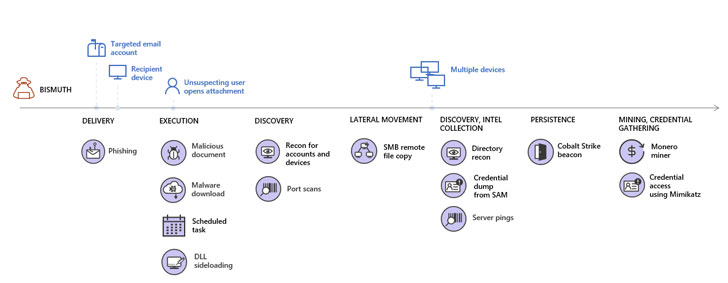
The idea is to buy time to move laterally and infect high-value
targets like servers for further propagation.
To achieve this, tailored spear-phishing emails written in
Vietnamese were crafted to specific recipients in a target
organization, and in some cases, the threat actor even established
correspondence with the targets in a bid to increase the chances of
opening the malicious document embedded in the emails and trigger
the infection chain.
A separate technique involved the use of DLL side-loading[4], wherein a legitimate
library is replaced with a malicious variant, utilizing outdated
versions of legitimate software such as Microsoft Defender
Antivirus, Sysinternals DebugView, and Microsoft Word 2007 to load
rogue DLL files and establish a persistent command-and-control (C2)
channel to the compromised device and the network.
The newly established channel was then used to drop a number of
next-stage payloads, including tools for network scanning,
credential theft, Monero coin mining, and conducting
reconnaissance, the results of which were transmitted back to the
server in the form of a “.csv” file.
Hiding in Plain Sight
“Bismuth attacks put strong emphasis on hiding in plain sight by
blending in with normal network activity or common threats that
attackers anticipate will get low-priority attention,” Microsoft
said.
“The combination of social engineering and use of legitimate
applications to sideload malicious DLLs entail multiple layers of
protection focused on stopping threats at the earliest possible
stage and mitigating the progression of attacks if they manage to
slip through.”
It’s recommended that businesses limit the attack surface used
to gain initial access by beefing up email filtering and firewall
settings, enforce credential hygiene, and turn on multi-factor
authentication.
References
- ^
said
(www.microsoft.com) - ^
OceanLotus
(malpedia.caad.fkie.fraunhofer.de) - ^
new
macOS backdoor (www.trendmicro.com) - ^
DLL
side-loading (attack.mitre.org)
Read more http://feedproxy.google.com/~r/TheHackersNews/~3/pnZL0J-vWqY/nation-state-hackers-caught-hiding.html