VULNERABILITY DISCLOSURE: A NEW BUSINESS MODEL?
We all see in the mass media every day that software is vulnerable and that this is bad. But, few know what is happening behind the scene, until the news get out.
There are two ways to disclosure a vulnerability: the most common one is to make a “full disclosure”, but there is also the “limited disclosure”.
A full disclosure means that the details of a security vulnerability are disclosed to the large public, including details of the vulnerability and how to detect and exploit it. [Wikipedia]
A limited disclosure is an alternative approach where full details of the vulnerability are provided to a restricted community of developers and vendors while the public is only informed of a potential security issue. Advocates of this approach also claim the term “responsible disclosure” [Wikipedia].
The hope and theory behind a full disclosure is that once that a vulnerability is released to the public, the company affected will issue a fix immediately in order to reduce the damage in image and not only. So, the intention is obviously good because it ideally results in a better security for the users. But, as very often in real life, the theory doesn’t always work in practice. On one side, due to the pressure created to release the fix, the security is improved because the amount of time the vulnerability is open to attack is reduced. On the other side, very often the time to react is so short that companies intentionally reduce the range of the fix to a minimum so that they can release it earlier. Those who develop software know that few things work well when software is developed in a hurry and under a lot of pressure. As you can expect, with these fast fixes even more bugs are introduced in the software.
In the computer vulnerabilities, disclosure is often achieved via mailing lists such as a full disclosure mailing list, by publishing it in online magazines, Facebook, Twitter, or by other means.
There are many companies out there which have as business model to buy and sell vulnerabilities. Even though this sounds like a decent job, you will think differently if you are the one who is offered to buy the vulnerability. That is, your software is vulnerable and your users will potentially become victims of the vulnerability once it becomes public. If it will ever become public. Very often, but not always, these companies come with the offer: pay or we disclose that your software is vulnerable. Even if it makes sense to sell to the highest bidder, I’ve never heard or seen any proof that these companies sell the vulnerabilities to cybercriminals. However, according to various sources (see Sources at the end of the article) the trend is to sell indeed to the highest bidder, but that bidder is rather represented by governments than, as we would expect, by cybercriminals.
In order to avoid such a blackmailing, big companies who can afford [1], organize regularly hacking sessions of their software. They pay per vulnerability between $100 and $10000 for a zero-day exploit. This means that many people, especially IT students, come to make a decent revenue out of this.
These companies have officially created a market for finding vulnerabilities. However, as in any free market, there are many vendors with various offers and even more buyers.
This is how companies which buy the vulnerabilities for much more money appeared. Companies like ZeroDayInitiative, iDefense, SecuriTeam VUPEN, FinFisher, HackingTeam and others pay up to $250.000 for zero-day exploits in various products[2].
Handling vulnerabilities can be a very risky job: legally and professionally. There are news about people who got sued or threatened[3]. Things will become much more complicated if any government gets involved. According to these sources, governments are very interested in this business because they might use a zero-day exploit to get into the computers of various suspects. Some say that governments directly or through military organizations they control are even trying to use such vulnerabilities to create cyber-weapons (like Stuxnet).
As security professionals, it is our every-day work to detect, report, patch and sometimes fix such problems. All is simple if the problem is in your own software, but most of the time it is not in your own software.
Should we find such vulnerabilities in other software, it is our duty as software security professionals to report them. But we should do it properly, considering all ethical and legal responsibilities.
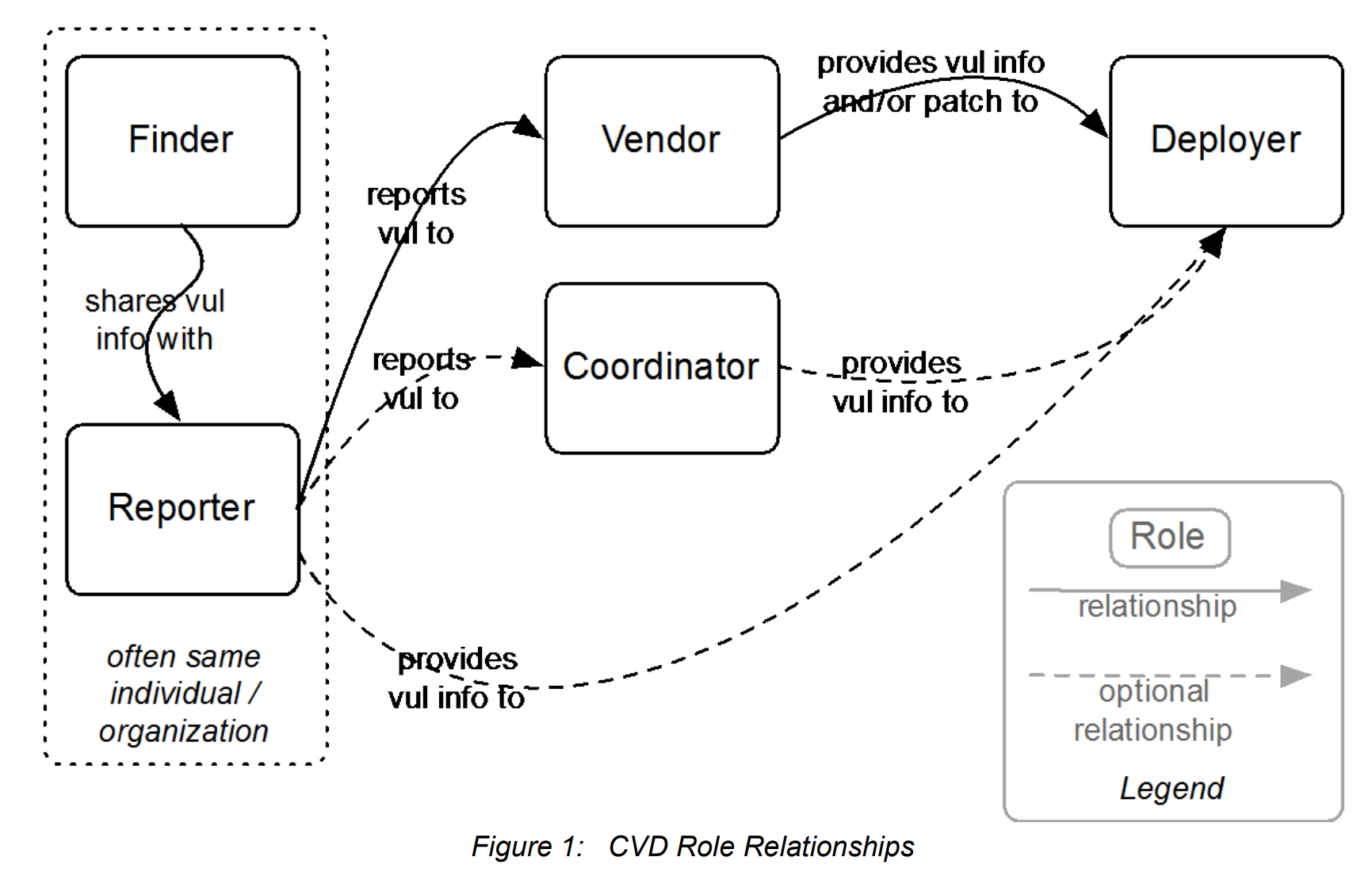
It is imperative that vulnerabilities are reported first only to the vendor of the affected software and that enough time is given to the vendor to properly fix the problems. Do not forget that only reporting the problem is usually not enough as the vendor might need additional details, code and scenarios where the bug is reproducible. In some cases, it might prove that fixing the bug requires a big change in the architecture of the software. Be prepared to negotiate compromises. It sounds complicated, but it will be easier if you put the end user in front and you negotiate for his/her security and usability.
Shopping For Zero-Days: A Price List For Hackers’ Secret Software Exploits

This article is more than 8 years old.
 This story accompanies a profile of the French exploit-selling firm Vupen in the April 9th issue of Forbes magazine.
A clever hacker today has to make tough choices. Find a previously unknown method for dismantling the defenses of a device like an iPhone or iPad, for instance, and you can report it to Apple and present it at a security conference to win fame and lucrative consulting gigs. Share it with HP’s Zero Day Initiative instead and earn as much as $10,000 for helping the firm shore up its security gear. Both options also allow Apple to fix its bugs and make the hundreds of millions of iPhone and iPad users more secure.
But any hacker who happens to know one Bangkok-based security researcher who goes by the handle “the Grugq”–or someone like him–has a third option: arrange a deal through the pseudonymous exploit broker to hand the exploit information over to a government agency, don’t ask too many questions, and get paid a quarter of a million dollars–minus the Grugq’s 15% commission.
That iOS exploit price represents just one of the dozens of deals the Grugq (pictured above) has arranged in his year-old side career as a middle man for so-called “zero-day” exploits, hacking techniques that take advantage of secret vulnerabilities in software. Since he began hooking up his hacker friends with contacts in government a year ago, the Grugq says he’s on track to earn a million in revenue this year. He arranged the iOS deal last month, for instance, between a developer and a U.S. government contractor. In that case, as with all of his exploit sales, he won’t offer any other details about the buyer or the seller.
-
Apple’s Massive iPhone 12 Upgrade Suddenly Confirmed
-
Stimulus Update: $2.2 Trillion Stimulus Package Proposal Unveiled, Includes $1,200 Stimulus Checks And $600 Unemployment Benefits
-
New Apple Accident Exposes iPhone 12 Release Details
Even with the $250,000 payout he elicited for that deal, he wonders if he could have gotten more. “I think I lowballed it,” he wrote to me at one point in the dealmaking process. “The client was too happy.”
A six-figure price for a single hacking technique may sound extravagant, but it’s hardly unique. Based on speaking with sources in this secretive but legal trade, I’ve assembled a rough price list for zero-day exploits below.

Each price assumes an exclusive sale, the most modern version of the software, and, of course, not alerting the software’s vendor. Some fees might even be paid in installments, with each subsequent payment depending on the vendor not patching the security vulnerabilities used by the exploit. In some cases the techniques would need to be used in combination to be effective.
An exploit’s price factors in both how widely the target software is used as well as the difficulty of cracking it. A technique that allows a hacker to gain control of a Mac OSX machine after hacking an application might earn only a fraction of one that targets Windows, for instance, because of Windows’ greater market share. But an iOS exploit pays more than one that targets Android devices partly because it requires defeating Apple’s significantly tougher security features. That means most agencies can simply develop their own Android attacks, the Grugq says, while ones that can penetrate the iPhone are rare and pricey. For the Jailbreakme 3 iOS exploit created by the hacker Comex last year, the Grugq says he heard agencies would have been eager to pay $250,000 for exclusive use of the attack.
Who’s paying these prices? Western governments, and specifically the U.S., says the Grugq, who himself is a native of South Africa. He limits his sales to the American and European agencies and contractors not merely out of ethical concerns, but also because they pay more. “Selling a bug to the Russian mafia guarantees it will be dead in no time, and they pay very little money,” he says, explaining that he has no contacts in the Russian government. “Russia is flooded with criminals. They monetize exploits in the most brutal and mediocre way possible, and they cheat each other heavily.”
As for China, he says that the country has too many hackers who sell only to the Chinese government, pushing down prices. “The market is very depressed,” he says. Other regions like the Middle East and the rest of Asia can’t match Western prices either.
As a result, the Grugq earns 80% of his revenue from the U.S., though occasionally the developers who work with him have asked that he sell only to Europeans. Over more than a decade in the hacker scene, he’s met enough federal agents to have contacts at multiple U.S. agencies, and he knows how to package his developer’s exploits for sale to those buyers, with professional marketing and support. “You’re basically selling commercial software, like anything else. It needs to be polished and come with documentation,” he says. “The only difference is that you only sell one license, ever, and everyone calls you evil.”
One of the most vocal of those critics is Chris Soghoian, a privacy activist with the Open Society Foundations, who has described the firms and individuals who sell software exploits as “the modern-day merchants of death” selling “the bullets of cyberwar.”
“As soon as one of these weaponized zero-days sold to governments is obtained by a ‘bad guy’ and used to attack critical U.S. infrastructure, the shit will hit the fan,” Soghoian warned in a talk at the Kaspersky analyst summit in February. “Security researchers should not be selling zero-days to middle man firms…These firms are cowboys and if we do nothing to stop them, they will drag the entire security industry into a world of pain.”
The Grugq sees no ethical compromise in his work. “The Chinese are conducting espionage on a massive scale. [Soghoian] wants to ban sales of software–sorry, exploits–to the U.S. and European allies?” he asks. “The only possible outcome is that the Chinese will increase their internal production and skills and the…West will fall behind.”
Anyway, he adds, he doesn’t believe banning the sale of exploit code would make users more secure. “That’ll work just as well at eliminating exploits as the war on drugs has worked at eliminating drugs,” he says.
The Grugq is hardly alone in his industry. Small firms like Vupen, Endgame and Netragard buy and sell exploits, as do major defense contractors like Northrop Grumman and Raytheon.
Netragard’s founder Adriel Desautels says he’s been in the exploit-selling game for a decade, and describes how the market has “exploded” in just the last year. He says there are now “more buyers, deeper pockets,” that the time for a purchase has accelerated from months to weeks, and he’s being approached by sellers with around 12 to 14 zero-day exploits every month compared to just four to six a few years ago.
Desautels won’t offer much about exactly who his customers are. But he says not every buyer aims to use his zero-days for spying. He claims to have recently sold a browser exploit for $125,000 to a private sector client for who aimed to use it merely as a proof-of-concept for marketing purposes. Other buyers use Netragard’s exploits for penetration testing, he says. “If you test a bullet proof vest, you use a bullet, not a squirt gun,” says Desautels.
Nonetheless, he says that the firm is “extremely careful” about choosing its customers. “We reject a lot more people than we accept,” he says. “Realistically, we’re selling cyberweaponry.”
And what about the option of selling the exploits to the software vendor itself, so that it can patch the targeted program? Firms like Mozilla and Facebook offer developers a few thousand dollars for reporting bugs. Google typically offers a maximum of $3,133.70 for information about the most complex flaws in its software, a number that’s meant to spell out “elite” in hacker slang.
But a four-figure price is hardly elite enough for the Grugq. “If they want their bugs fixed, they can buy them at market rates like everyone else,” he says. “From each according to their ability, to each according to their needs? That’s communism. If they want the output, they can pay for it like anyone else. They have my email.”