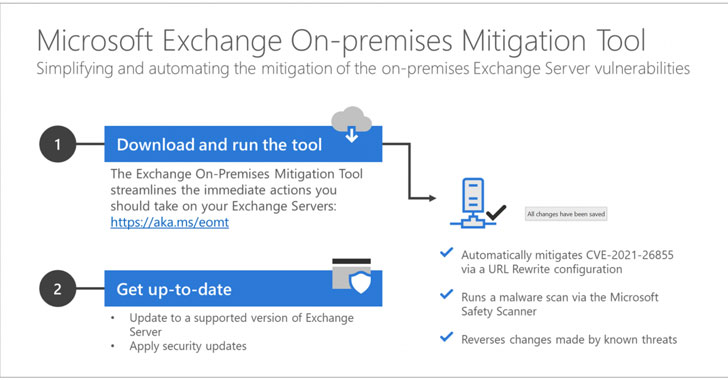
Microsoft on Monday released a one-click mitigation software
that applies all the necessary countermeasures to secure vulnerable
environments against the ongoing widespread ProxyLogon Exchange Server[1] cyberattacks.
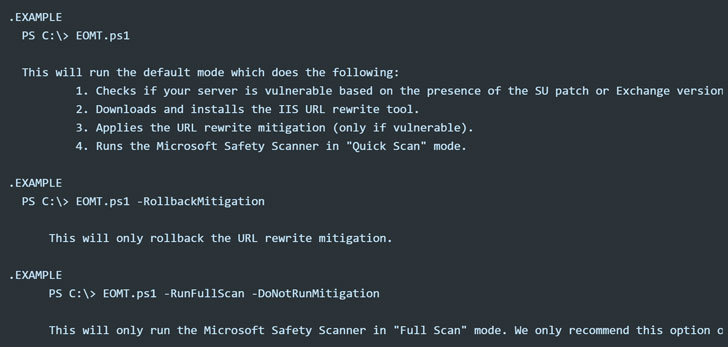
Called Exchange On-premises Mitigation Tool (EOMT[2]), the PowerShell-based
script serves to mitigate against current known attacks using
CVE-2021-26855, scan the Exchange Server using the Microsoft Safety Scanner[3] for any deployed web
shells, and attempt to remediate the detected compromises.
“This new tool is designed as an interim mitigation for
customers who are unfamiliar with the patch/update process or who
have not yet applied the on-premises Exchange security update,”
Microsoft said[4].
The development comes in the wake of indiscriminate attacks
against unpatched Exchange Servers across the world by more than
ten advanced persistent threat actors — most of the
government-backed cyberespionage groups — to plant backdoors, coin
miners, and ransomware[5], with the release of
proof-of-concept[6]
(PoC) fueling the hacking spree even further.
Based on telemetry from RiskIQ[7], 317,269 out of 400,000
on-premises Exchange Servers globally have been patched as of March
12, with the U.S., Germany, Great Britain, France, and Italy
leading the countries with vulnerable servers.
Additionally, the U.S. Cybersecurity and Infrastructure Security
Agency (CISA) has updated[8]
its guidance to detail as many as seven variants of the China Chopper[9]
web shell that are being leveraged by malicious actors.
Taking up just four kilobytes, the web shell has been a popular
post-exploitation tool[10] of choice for cyber
attackers for nearly a decade.
While the breadth of the intrusions is being assessed, Microsoft
is also reportedly investigating how the “limited and targeted”
attacks it detected in early January picked up steam to quickly
morph into a widespread mass exploitation campaign, forcing it to
release the security fixes a week before it was due.
The Wall Street Journal on Friday reported[11] that investigators are
focused on whether a Microsoft partner, with whom the company
shared information about the vulnerabilities through its Microsoft
Active Protections Program (MAPP[12]), either accidentally
or purposefully leaked it to other groups.
It is also being claimed that some tools used in the “second
wave” of attacks towards the end of February are similar to
proof-of-concept attack code that Microsoft shared with antivirus
companies and other security partners on February 23, raising the
possibility that threat actors may have gotten their hands on
private disclosure that Microsoft shared with its security
partners.
The other theory is that the threat actors independently
discovered the same set of vulnerabilities, which were then
exploited to stealthily conduct reconnaissance of target networks
and steal mailboxes before ramping up the attacks once the hackers
figured out Microsoft was readying a patch.
“This is the second time[13] in the last four months
that nation-state actors have engaged in cyberattacks with the
potential to affect businesses and organizations of all sizes,”
Microsoft said[14]. “While this began as a
nation-state attack, the vulnerabilities are being exploited by
other criminal organizations, including new ransomware attacks,
with the potential for other malicious activities.”
References
- ^
ProxyLogon Exchange Server
(thehackernews.com) - ^
EOMT
(github.com) - ^
Microsoft Safety Scanner
(docs.microsoft.com) - ^
said
(msrc-blog.microsoft.com) - ^
ransomware
(thehackernews.com) - ^
proof-of-concept
(thehackernews.com) - ^
RiskIQ
(www.riskiq.com) - ^
updated
(us-cert.cisa.gov) - ^
China
Chopper (www.fireeye.com) - ^
post-exploitation tool
(www.trustwave.com) - ^
reported
(www.wsj.com) - ^
MAPP
(www.microsoft.com) - ^
second
time (thehackernews.com) - ^
said
(www.microsoft.com)