Mar 07, 2023Ravie Lakshmanan
Cybersecurity researchers have discovered a new information
stealer dubbed SYS01stealer targeting critical government
infrastructure employees, manufacturing companies, and other
sectors.
“The threat actors behind the campaign are targeting Facebook
business accounts by using Google ads and fake Facebook profiles
that promote things like games, adult content, and cracked
software, etc. to lure victims into downloading a malicious file,”
Morphisec said in a report[1]
shared with The Hacker News.
“The attack is designed to steal sensitive information,
including login data, cookies, and Facebook ad and business account
information.”
The Israeli cybersecurity company said the campaign was
initially tied to a financially motivated cybercriminal operation
dubbed Ducktail[2]
by Zscaler.
However, WithSecure, which first documented[3]
the Ducktail activity cluster in July 2022, said the two intrusion sets[4]
are different from one another, indicating how the threat actors
managed to confuse attribution efforts and evade detection.
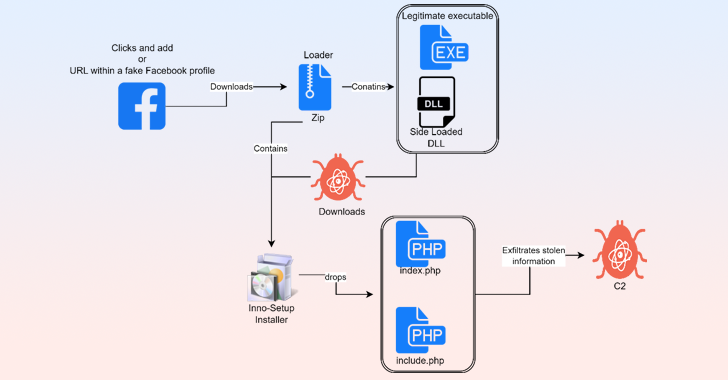
The attack chain, per Morphisec, commences when a victim is
successfully lured into clicking on a URL from a fake Facebook
profile or advertisement to download a ZIP archive that purports to
be cracked software or adult-themed content.
Opening the ZIP file launches a based loader – typically a
legitimate C# application – that’s vulnerable to DLL side-loading[5], thereby making it
possible to load a malicious dynamic link library (DLL) file
alongside the app.
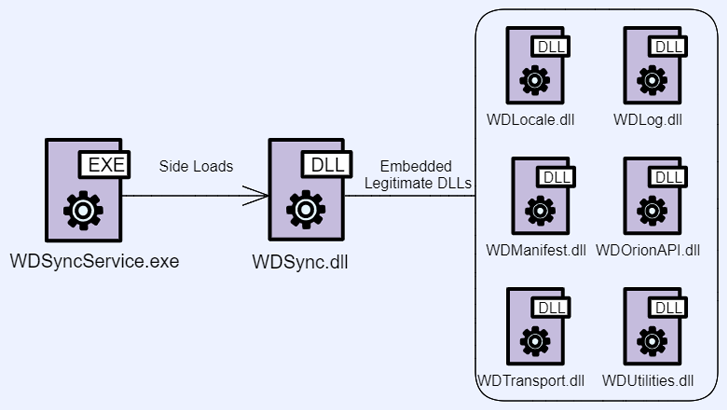
Some of the applications abused to side-load the rogue DLL are
Western Digital’s WDSyncService.exe and Garmin’s
ElevatedInstaller.exe. In some instances, the side-loaded DLL acts
as a means to deploy Python and Rust-based intermediate
executables.
Irrespective of the approach employed, all roads lead to the
delivery of an installer that drops and executes the PHP-based
SYS01stealer malware.
The stealer is engineered to harvest Facebook cookies from
Chromium-based web browsers (e.g., Google Chrome, Microsoft Edge,
Brave, Opera, and Vivaldi), exfiltrate the victim’s Facebook
information to a remote server, and download and run arbitrary
files.
Discover the Latest Malware Evasion Tactics and Prevention
Strategies
Ready to bust the 9 most dangerous myths about file-based
attacks? Join our upcoming webinar and become a hero in the fight
against patient zero infections and zero-day security events!
It’s also equipped to upload files from the infected host to the
command-and-control (C2) server, run commands sent by the server,
and update itself when a new version is available.
The development comes as Bitdefender revealed a similar stealer
campaign known as S1deload[7]
that’s designed to hijack users’ Facebook and YouTube accounts and
leverage the compromised systems to mine cryptocurrency.
“DLL side-loading is a highly effective technique for tricking
Windows systems into loading malicious code,” Morphisec said.
“When an application loads in memory and search order is not
enforced, the application loads the malicious file instead of the
legitimate one, allowing threat actors to hijack legitimate,
trusted, and even signed applications to load and execute malicious
payloads.”
Found this article interesting? Follow us on Twitter [8]
and LinkedIn[9]
to read more exclusive content we post.
References
- ^
report
(blog.morphisec.com) - ^
dubbed
Ducktail (thehackernews.com) - ^
first
documented (thehackernews.com) - ^
two
intrusion sets (thehackernews.com) - ^
DLL
side-loading (attack.mitre.org) - ^
RESERVE YOUR SEAT
(thn.news) - ^
S1deload
(thehackernews.com) - ^
Twitter
(twitter.com) - ^
LinkedIn
(www.linkedin.com)
Read more https://thehackernews.com/2023/03/sys01stealer-new-threat-using-facebook.html