
A group of academics at South Korea’s Gwangju Institute of
Science and Technology (GIST) have utilized natural silk fibers
from domesticated silkworms to build an environmentally friendly
digital security system that they say is “practically
unbreachable.”
“The first natural physical unclonable function (PUF) […] takes
advantage of the diffraction of light through natural microholes in
native silk to create a secure and unique digital key for future
security solutions,” the researchers said[1].
Physical unclonable functions or PUFs[2]
refer to devices that leverage inherent randomness and microscopic
differences in electronics introduced during manufacturing to
generate a unique identifier (e.g., cryptographic keys) for a given
set of inputs and conditions.
In other words, PUFs are non-algorithmic one-way functions
derived from uncopiable elements to create unbreakable identifiers
for strong authentication. Over the years, PUFs have been widely
used in smartcards to provide “silicon fingerprints” as a means of
uniquely identifying cardholders based on a challenge-response authentication[3] scheme.
The newly proposed method from GIST employs native silk fibers
produced by silkworms to create PUF-based tags that are then used
to devise a PUF module. This mechanism banks on the underlying
principle that a light beam experiences diffraction[4]
when it hits an obstacle, in this case, the silk fiber.
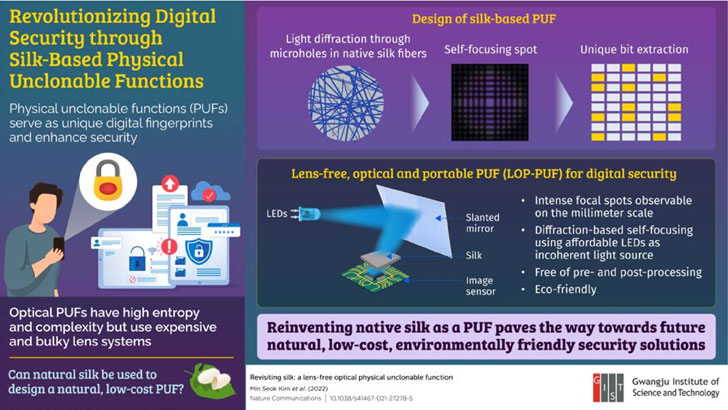
“In addition, the nanofibrillar structures in each microfiber
significantly improves the light intensity contrast between the
background and focal spots owing to the strong scattering,” the
researchers noted in a paper[5]
published in Nature Communications. “These novel optical features
could easily implement the module of a lens-free optical PUF by
placing a silk ID card on the image sensor.”
The captured diffracted light is unique, “giving rise to a
unique pattern of light,” that is subsequently converted into a
digital format and fed into the system as input, researcher and the
study’s author Young Min Song said.
Should such a system be deployed for user authentication using a
smart card, the researchers said that faking an authentication key
generated from the module via a brute-force attack would take as
long as 5 x 1041 years to crack it
open, making it cryptographically unbreakable.
“To our knowledge, this is the first PUF module designed using
silk, a naturally abundant biomaterial,” Prof. Yong said in a
statement. “It means that we don’t need to invest time in
developing complicated security keys, nature has already done this
for us.”
References
- ^
said
(www.gist.ac.kr) - ^
PUFs
(en.wikipedia.org) - ^
challenge-response authentication
(en.wikipedia.org) - ^
diffraction
(en.wikipedia.org) - ^
paper
(www.nature.com)
Read more https://thehackernews.com/2022/01/researchers-use-natural-silk-fibers-to.html