
Cybersecurity researchers disclosed details of what they say is
the “largest botnet” observed in the wild in the last six years,
infecting over 1.6 million devices primarily located in China, with
the goal of launching distributed denial-of-service (DDoS) attacks
and inserting advertisements into HTTP websites visited by
unsuspecting users.
Qihoo 360’s Netlab security team dubbed the botnet “Pink[1]” based on a sample
obtained on November 21, 2019, owing to a large number of function
names starting with “pink.”
Mainly targeting MIPS-based fiber routers, the botnet leverages
a combination of third-party services such as GitHub, peer-to-peer
(P2P) networks, and central command-and-control (C2) servers for
its bots to controller communications, not to mention completely
encrypting the transmission channels to prevent the victimized
devices from being taken over.
“Pink raced with the vendor to retain control over the infected
devices, while vendor made repeated attempts to fix the problem,
the bot master noticed the vendor’s action also in real time, and
made multiple firmware updates on the fiber routers
correspondingly,” the researchers said in an analysis published
last week following coordinated action taken by the unspecified
vendor and China’s Computer Network Emergency Response Technical
Team/Coordination Center (CNCERT/CC).
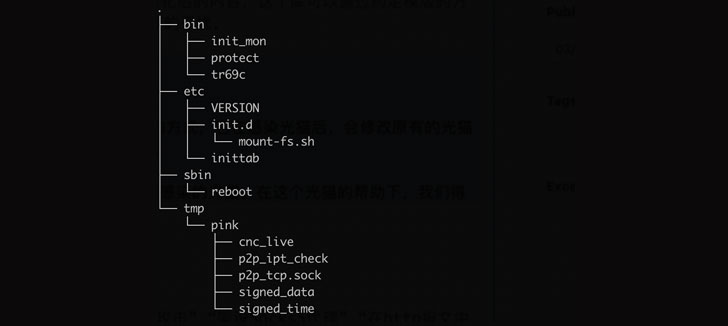
Interestingly, Pink has also been found adopting DNS-Over-HTTPS
(DoH[2]), a protocol used for
performing remote Domain Name System resolution via the HTTPS
protocol, to connect to the controller specified in a configuration
file that’s delivered either via a GitHub or Baidu Tieba as well as
a built-in domain name hard-coded into some of the samples.
More than 96% of the zombie nodes part of the “super-large-scale
bot network” were located in China, Beijing-based cybersecurity
company NSFOCUS noted[3]
in an independent report, with the threat actor breaking into the
devices to install malicious programs by taking advantage of
zero-day vulnerabilities in the network gateway devices. Although a
significant chunk of the infected devices has since been repaired
and restored to their previous state as of July 2020, the botnet is
still said to be active, comprising about 100,000 nodes.
With nearly 100 DDoS attacks having been launched by the botnet
to date, the findings are yet another indication as to how botnets
can offer a powerful infrastructure for bad actors to mount a
variety of intrusions. “Internet of Things devices have become an
important goal for black production organizations and even advanced
persistent threats (APT) organizations,” NSFOCUS researchers said.
“Although Pink is the largest botnet ever discovered, it will never
be the last one.”