Jan 31, 2023Ravie Lakshmanan
A shellcode-based packer[1]
dubbed TrickGate has been successfully operating
without attracting notice for over six years, while enabling threat
actors to deploy a wide range of malware such as TrickBot, Emotet,
AZORult, Agent Tesla, FormBook, Cerber, Maze, and REvil over the
years.
“TrickGate managed to stay under the radar for years because it
is transformative – it undergoes changes periodically,” Check Point
Research’s Arie Olshtein said[2], calling it a “master of
disguises.”
Offered as a service to other threat actors since at least late
2016, TrickGate helps conceal payloads behind a layer of wrapper
code in an attempt to get past security solutions installed on a
host. Packers can also function as crypters by encrypting the
malware as an obfuscation mechanism.
“Packers have different features that allow them to circumvent
detection mechanisms by appearing as benign files, being difficult
to reverse engineer, or incorporating sandbox evasion techniques,”
Proofpoint noted[3]
in December 2020.
But the frequent updates to the commercial packer-as-a-service
meant TrickGate has been tracked under various names such as
new loader[4], Loncom[5], and NSIS-based crypter[6]
since 2019.
Telemetry data gathered by Check Point indicates that the threat
actors leveraging TrickGate have primarily singled out the
manufacturing sector, and to a lesser extent, education,
healthcare, government, and finance verticals.
The most popular malware families used in the attacks in the
past two months include FormBook, LokiBot, Agent Tesla, Remcos, and
Nanocore, with significant concentrations reported in Taiwan,
Turkey, Germany, Russia, and China.
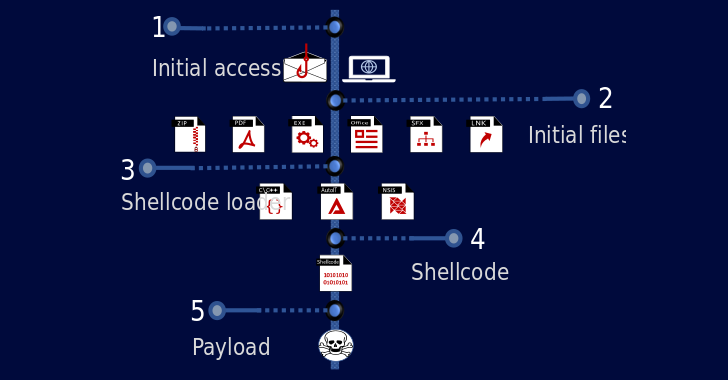
The infection chain involves sending phishing emails with
malicious attachments or booby-trapped links that lead to the
download of a shellcode loader that’s responsible for decrypting
and launching the actual payload into memory.
The Israeli cybersecurity firm’s analysis of the shellcode shows
that it “has been constantly updated, but the main functionalities
exist on all the samples since 2016,” Olshtein noted. “The
injection module has been the most consistent part over the years
and has been observed in all TrickGate shellcodes.”
Found this article interesting? Follow us on Twitter [7]
and LinkedIn[8]
to read more exclusive content we post.
References
Read more https://thehackernews.com/2023/01/researchers-uncover-packer-that-helped.html