Cybersecurity researchers have unwrapped an “interesting email
campaign” undertaken by a threat actor that has taken to
distributing a new malware written in Nim[1]
programming language.
Dubbed “NimzaLoader[2]” by Proofpoint
researchers, the development marks one of the rare instances of Nim
malware discovered in the threat landscape.
“Malware developers may choose to use a rare programming
language to avoid detection, as reverse engineers may not be
familiar with Nim’s implementation, or focused on developing
detection for it, and therefore tools and sandboxes may struggle to
analyze samples of it,” the researchers said.
Proofpoint is tracking the operators of the campaign under the
moniker “TA800,” who, they say, started distributing NimzaLoader
starting February 3, 2021. Prior to the latest raft of activity,
TA800 is known to have predominantly used BazaLoader since April
2020.
While APT28 has been previously linked to delivering Zebrocy[3]
malware using Nim-based loaders[4], the appearance of
NimzaLoader is yet another sign that malicious actors are
constantly retooling their malware arsenal to avoid detection.
Proofpoint’s findings have also been independently corroborated
by researchers from Walmart’s threat intelligence team, who named
the malware “Nimar Loader[5].”
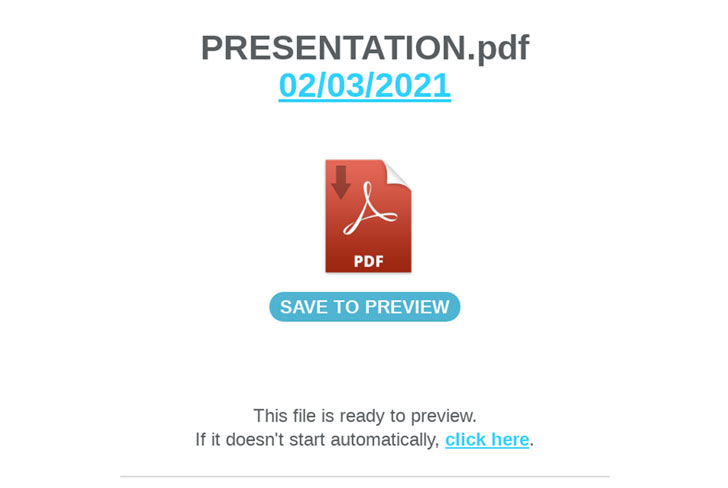
Like with the case of BazaLoader, the campaign spotted on
February 3 made use of personalized email phishing lures containing
a link to a supposed PDF document that redirected the recipient to
a NimzaLoader executable hosted on Slack, which used a fake Adobe
icon as part of its social engineering tricks.
Once opened, the malware is designed to provide the attackers
with access to the victim’s Windows systems, alongside capabilities
to execute arbitrary commands retrieved from a command-and-control
server — including executing PowerShell commands, injecting
shellcode into running processes, and even deploy additional
malware.
Additional evidence gathered by Proofpoint and Walmart show that
NimzaLoader is also being used to download and execute Cobalt
Strike as its secondary payload, suggesting that threat actors
integrate different tactics into their campaigns.
“It is […] unclear if Nimzaloader is just a blip on the radar
for TA800 — and the wider threat landscape — or if Nimzaloader will
be adopted by other threat actors in the same way BazaLaoder has
gained wide adoption,” the researchers concluded.
References
- ^
Nim
(nim-lang.org) - ^
NimzaLoader
(www.proofpoint.com) - ^
Zebrocy
(thehackernews.com) - ^
Nim-based loaders
(twitter.com) - ^
Nimar
Loader (medium.com)