‘when.’ There are security products and procedures that were
implemented to optimize the IR process, so from the
‘security-professional’ angle, things are taken care of.
However, many security pros who are doing an excellent job in
handling incidents find effectively communicating the ongoing
process with their management a much more challenging task.
It’s a little surprise — managements are typically not security
savvy and don’t really care about the bits and bytes in which the
security pro masters. Cynet addresses this gap with the IR Reporting for
Management PPT template[1], providing CISOs and
CIOs with a clear and intuitive tool to report both the ongoing IR
process and its conclusion.
The IR for Management template enables CISOs and CIOs to
communicate with the two key points that management cares
about—assurance that the incident is under control and a clear
understanding of implications and root cause.
Control is a key aspect of IR processes, in the sense that at
any given moment, there is full transparency of what is addressed,
what is known and needs to be remediated, and what further
investigation is needed to unveil parts of the attack that are yet
unknown.
Management doesn’t think in terms of trojans, exploits, and
lateral movement, but rather it thinks in terms of business
productivity — downtime, man-hours, loss of sensitive data.
Mapping a high-level description of the attack route to resulted
damage is paramount to get the management’s understanding and
involvement, especially if the IR process entails additional
spending.
The Template follows the SANS\NIST IR framework and comprises
the following stages:
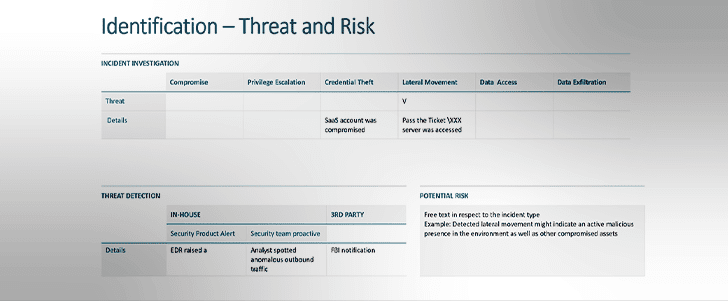
Identification
Attacker presence is detected beyond doubt. Was the detection made
in house or by a 3rd party, how mature the attack is (in terms of
its progress along the kill chain), what is the estimated risk, and
will the following steps be taken with internal resources or is
there a need to engage a service provider?
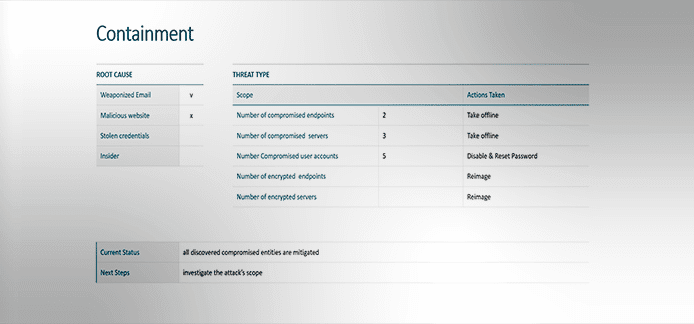
Containment
First aid to stop the immediate bleeding before any further
investigation, the attack root cause, the number of entities taken
offline (endpoints, servers, user accounts), current status, and
onward steps.
Eradication
Full clean up of all malicious infrastructure and activities, a
complete report on the attack’s route and assumed objectives,
overall business impact (man-hours, lost data, regulatory
implications and others per the varying context)
Recovery
Recovery rate in terms of endpoints, servers, applications, cloud
workloads, and data.
Lessons Learned
What were the attack’s enablers (lack of adequate security
technology in place, insecure workforce practices, etc.) and how
they can be mended, and reflection on the previous stages across
the IR process timeline searching for what to preserve and what to
improve.
Naturally, there is no one-size-fits-all in a security incident.
For example, there might be cases in which the identification and
containment will take place almost instantly together, while in
other events, the containment might take longer, requiring several
presentations on its interim status. That’s why the template is
modular and can be easily adjustable to any variant.
Communication to management is not a nice-to-have but a critical
part of the IR process itself. The definitive IR Reporting to
Management PPT template enables all who work hard to conduct
professional and efficient IR processes in their organizations to
make their efforts and results crystal clear to their
management.
Download the
Definitive IR Reporting to Management PPT template here[2].
References
- ^
IR Reporting for Management PPT
template (go.cynet.com) - ^
Download the Definitive IR Reporting to
Management PPT template here (go.cynet.com)
Read more http://feedproxy.google.com/~r/TheHackersNews/~3/eZzNkCqljXE/cybersecurity-incident-response.html