
450,000 computers worldwide has recently shifted its operations
from infecting machines with ransomware or crypto miners to abusing
them for sending out sextortion emails to millions of innocent
people.
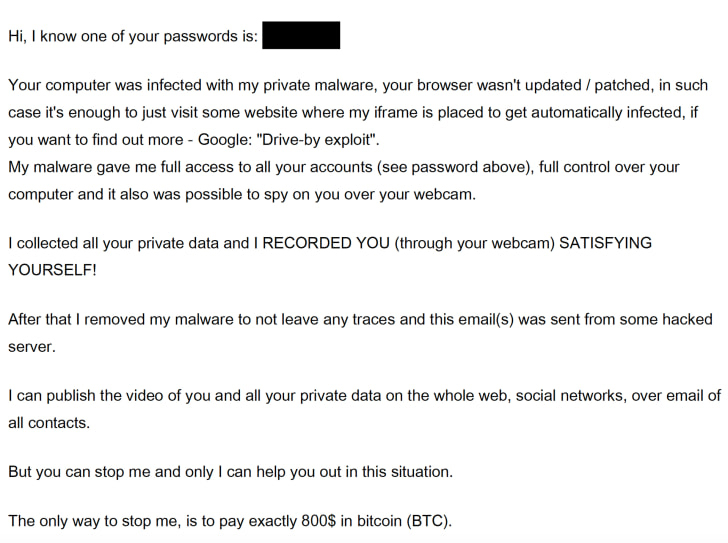
Extortion by email is growing significantly, with a large number
of users recently complaining about receiving sextortion emails
that attempt to extort money from individuals by blackmailing them
into exposing their sexual content.
Though until now, it wasn’t clear how scammers were sending such
massive amounts of emails without getting blacklisted by the email
providers, security researchers from CheckPoint finally found the
missing block in this puzzle.
In its latest report shared with The Hacker News prior to the
release, Tel Aviv-based security firm CheckPoint reveals
that a botnet, called Phorpiex, has recently been updated to
include a spam bot designed to use compromised computers as proxies
to send out over 30,000 sextortion emails per hour—without the
knowledge of the infected computers’ owners.
How Does Phorpiex Spam Bot Work?
The spambot module of Phorpiex downloads the list of its
targets/receipts’ email addresses from a remote command-and-control
server and uses a simple implementation of the SMTP protocol to
send sextortion emails.
“Then, an email address is randomly selected from the downloaded
database, and a message is composed from several hardcoded strings.
The spam bot can produce a large amount of spam emails – up to
30,000 per hour. Each individual spam campaign can cover up to 27
million potential victims,” researchers explain.
“The spam bot creates a total of 15,000 threads to send spam
messages from one database. Each thread takes a random line from
the downloaded file. The next database file is downloaded when all
spam threads finish. If we consider the delays, we can estimate
that bot is able to send about 30,000 emails in an hour.”
sextortion campaigns also add one of the victims’ online passwords
in the subject line or content of the sextortion email, making it
more convincing that hacker knows their passwords and might have
access to their private content.
recipients were curated from various previously compromised
databases. So, the passwords displayed to the victims don’t
necessarily belong to their email accounts; it could be old and
related to any online service.
“The downloaded database is a text file, which contains up to
20,000 email addresses. In various campaigns, we observed from 325
to 1363 email databases on a C&C server. Therefore, one spam
campaign covers up to 27 million potential victims. Each line of
this file contains email and password delimited by colons,”
researchers say.
has also been named as “Save
Yourself[1]” malware attacks by
other teams of researchers.
In over five months, cybercriminals behind this campaign have
made more than 11 BTC, equivalent to approximately $88,000. Though
the figure is not huge, researchers say the actual revenue made by
the hackers could be larger, as they did not monitor the sextortion
campaigns in the years before.
References
- ^
Save Yourself
(blog.reasonsecurity.com)
Read more http://feedproxy.google.com/~r/TheHackersNews/~3/G-jfp3pw-Mw/phorpiex-botnet-sextortion-emails.html