
A new campaign leveraging an exploit kit has been observed
abusing an Internet Explorer flaw patched by Microsoft last year to
deliver the RedLine Stealer trojan.
“When executed, RedLine Stealer performs recon against the
target system (including username, hardware, browsers installed,
anti-virus software) and then exfiltrates data (including
passwords, saved credit cards, crypto wallets, VPN logins) to a
remote command and control server,” Bitdefender said[1]
in a new report shared with The Hacker News.
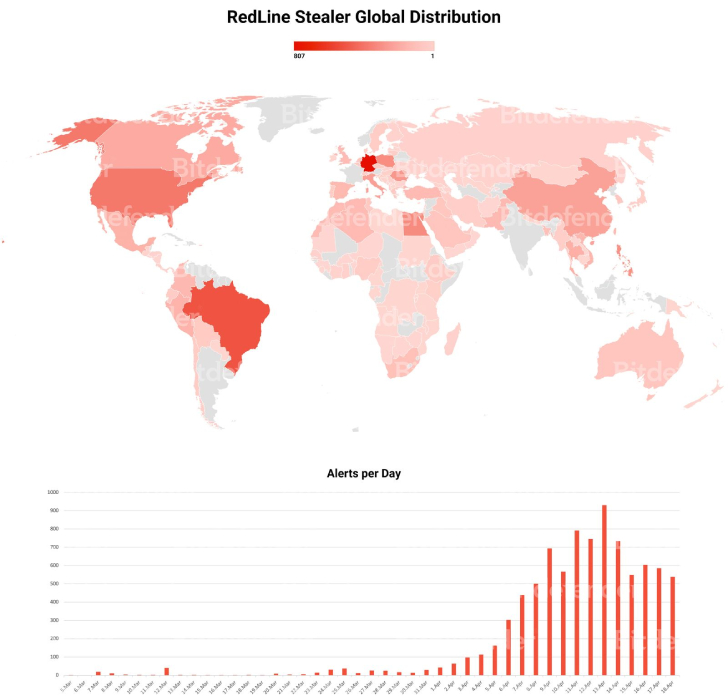
Most of the infections are located in Brazil and Germany,
followed by the U.S., Egypt, Canada, China, and Poland, among
others.
Exploit kits or exploit packs are comprehensive tools that
contain a collection of exploits designed to take advantage of
vulnerabilities in commonly-used software by scanning infected
systems for different kinds of flaws and deploying additional
malware.
The primary infection method used by attackers to distribute
exploit kits, in this case the Rig Exploit Kit[2], is through compromised
websites that, when visited, drops the exploit code to ultimately
send the RedLine Stealer payload to carry out follow-on
attacks.
The flaw in question is CVE-2021-26411[3]
(CVSS score: 8.8), a memory corruption vulnerability impacting
Internet Explorer that has been previously[4]
weaponized[5]
by North Korea-linked threat actors. It was addressed by Microsoft
as part of its Patch Tuesday updates for March 2021.
“The RedLine Stealer sample delivered by RIG EK comes packed in
multiple encryption layers […] to avoid detection,” the Romanian
cybersecurity firm noted, with the unpacking of the malware
progressing through as many as six stages.
RedLine Stealer, an information-stealing malware sold on
underground forums, comes with features to exfiltrate passwords,
cookies and credit card data saved in browsers, as well as crypto
wallets, chat logs, VPN login credentials and text from files as
per commands received from a remote server.
This is far from the only campaign that involves the
distribution of RedLine Stealer. In February 2022, HP detailed[6]
a social engineering attack using fake Windows 11 upgrade
installers to trick Windows 10 users into downloading and executing
the malware.
References
- ^
said
(www.bitdefender.com) - ^
Rig
Exploit Kit (blog.talosintelligence.com) - ^
CVE-2021-26411
(thehackernews.com) - ^
previously
(thehackernews.com) - ^
weaponized
(thehackernews.com) - ^
detailed
(threatresearch.ext.hp.com)
Read more https://thehackernews.com/2022/04/new-rig-exploit-kit-campaign-infecting.html