
Researchers have disclosed what they say is the first-ever
Python-based ransomware strain specifically designed to target
exposed Jupyter notebooks, a web-based interactive computing
platform that allows editing and running programs via a
browser.
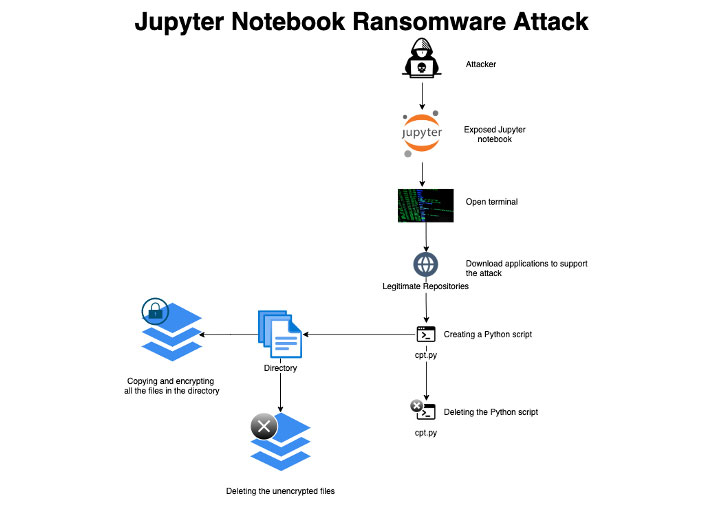
“The attackers gained initial access via misconfigured
environments, then ran a ransomware script that encrypts every file
on a given path on the server and deletes itself after execution to
conceal the attack,” Assaf Morag, a data analyst at Aqua Security,
said[1]
in a report.
The new ransomware sample, which the cloud security firm
detected after it was trapped in one of its honeypot servers, is
said to have been executed after the unnamed adversary gained
access to the server and downloaded the necessary tools required to
carry out the encryption process by opening a terminal.
Aqua Security characterized the attack as “simple and
straightforward,” unlike other traditional ransomware-as-a-service
(RaaS) schemes, adding that no ransom note was presented on the
system, raising the possibility that the threat actor may have been
experimenting with the modus operandi, or that the honeypot timed
out before it could be complete.
The identity of the attacker remains unclear, although evidence
unearthed during the incident analysis points to an actor of
Russian origin, citing similarities with previous cryptomining
attacks aimed at Jupyter notebooks.
“Since Jupyter notebooks are used to analyze data and build data
models, this attack can lead to significant damage to organizations
if these environments aren’t properly backed up,” Morag said.
Read more https://thehackernews.com/2022/03/new-python-based-ransomware-targeting.html