skimmer known as Baka[1], cybersecurity
researchers have uncovered a new flaw in the company’s EMV enabled
cards that enable cybercriminals to obtain funds and defraud
cardholders as well as merchants illicitly.
The research[2], published by a group of
academics from the ETH Zurich, is a PIN bypass attack[3]
that allows the adversaries to leverage a victim’s stolen or lost
credit card for making high-value purchases without knowledge of
the card’s PIN, and even trick a point of sale (PoS) terminal into
accepting an unauthentic offline card transaction.
All modern contactless cards that make use of the Visa protocol,
including Visa Credit, Visa Debit, Visa Electron, and V Pay cards,
are affected by the security flaw, but the researchers posited it
could apply to EMV protocols implemented by Discover and UnionPay
as well. The loophole, however, doesn’t impact Mastercard, American
Express, and JCB.
Security and
Privacy[4] to be held in San
Francisco next May.
Modifying Card Transaction Qualifiers Via MitM Attack
EMV[5]
(short for Europay, Mastercard, and Visa), the widely used
international protocol standard for smartcard payment, necessitates
that larger amounts can only be debited from credit cards with a
PIN code.
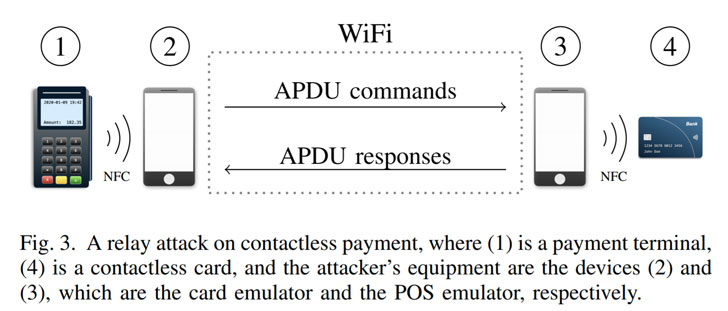
in the protocol to mount a man-in-the-middle (MitM) attack via an
Android app that “instructs the terminal that PIN verification is
not required because the cardholder verification was performed on
the consumer’s device.”
The issue stems from the fact the Cardholder verification method
(CVM), which is used to verify whether an individual attempting a
transaction with a credit or debit card is the legitimate
cardholder, is not cryptographically protected from
modification.
As a result, the Card Transaction Qualifiers (CTQ) used to
determine what CVM check, if any, is required for the transaction
can be modified to inform the PoS terminal to override the PIN
verification and that the verification was carried out using the
cardholder’s device such as a smartwatch or smartphone (called
Consumer Device Cardholder Verification Method or CDCVM).
Exploiting Offline Transactions Without Being Charged
Furthermore, the researchers uncovered a second vulnerability,
which involves offline contactless transactions carried out by
either a Visa or an old Mastercard card, allowing the attacker to
alter a specific piece of data called “Application Cryptogram” (AC)
before it is delivered to the terminal.
Offline cards are typically used to directly pay for goods and
services from a cardholder’s bank account without requiring a PIN
number. But since these transactions are not connected to an online
system, there is a delay of 24 to 72 hours before the bank confirms
the transaction’s legitimacy using the cryptogram, and the amount
of the purchase is debited from the account.
A criminal can leverage this delayed processing mechanism to use
their card to complete a low-value and offline transaction without
being charged, in addition to making away with purchases by the
time the issuing bank declines the transaction due to the wrong
cryptogram.
“This constitutes a ‘free lunch’ attack in that the criminal can
purchase low-value goods or services without actually being charged
at all,” the researchers said, adding the low-value nature of these
transactions is unlikely to be an “attractive business model for
criminals.”
Mitigating PIN bypass and offline attacks
Aside from notifying Visa of the flaws, the researchers have also
proposed three software fixes to the protocol to prevent PIN bypass
and offline attacks, including using Dynamic Data Authentication
(DDA) to secure high-value online transactions and requiring the
use of online
cryptogram[6] in all PoS terminals,
which causes offline transactions to be processed online.
“Our attack show[ed] that the PIN is useless for Visa
contactless transactions [and] revealed surprising differences
between the security of the contactless payment protocols of
Mastercard and Visa, showing that Mastercard is more secure than
Visa,” the researchers concluded. “These flaws violate fundamental
security properties such as authentication and other guarantees
about accepted transactions.”
References
- ^
Baka
(usa.visa.com) - ^
research
(emvrace.github.io) - ^
PIN bypass attack
(arxiv.org) - ^
Security and Privacy
(www.ieee-security.org) - ^
EMV
(en.wikipedia.org) - ^
use of online cryptogram
(www.emvco.com)
Read more http://feedproxy.google.com/~r/TheHackersNews/~3/2FDGcEtP3Yg/emv-payment-card-pin-hacking.html