
A social engineering campaign leveraging job-themed lures is
weaponizing a years-old remote code execution flaw in Microsoft
Office to deploy Cobalt Strike beacons on compromised hosts.
“The payload discovered is a leaked version of a Cobalt Strike
beacon,” Cisco Talos researchers Chetan Raghuprasad and Vanja
Svajcer said[1]
in a new analysis published Wednesday.
“The beacon configuration contains commands to perform targeted
process injection of arbitrary binaries and has a high reputation
domain configured, exhibiting the redirection technique to
masquerade the beacon’s traffic.”
The malicious activity, discovered in August 2022, attempts to
exploit the vulnerability CVE-2017-0199[2], a remote code execution
issue in Microsoft Office, that allows an attacker to take control
of an affected system.
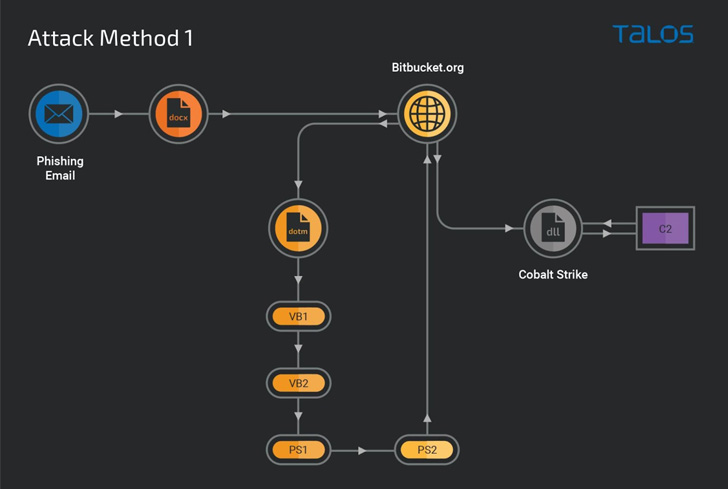
The entry vector for the attack is a phishing email containing a
Microsoft Word attachment that employs job-themed lures for roles
in the U.S. government and Public Service Association, a trade
union based in New Zealand.
Cobalt Strike beacons are far from the only malware samples
deployed, for Cisco Talos said it has also observed the usage of
the Redline Stealer[3]
and Amadey botnet[4]
executables as payloads at the other end of the attack chain.
Calling the attack methodology “highly modularized,” the
cybersecurity company said the attack also stands out for its use
of Bitbucket repositories to host malicious content that serves as
a starting point for downloading a Windows executable responsible
for deploying the Cobalt Strike DLL beacon.
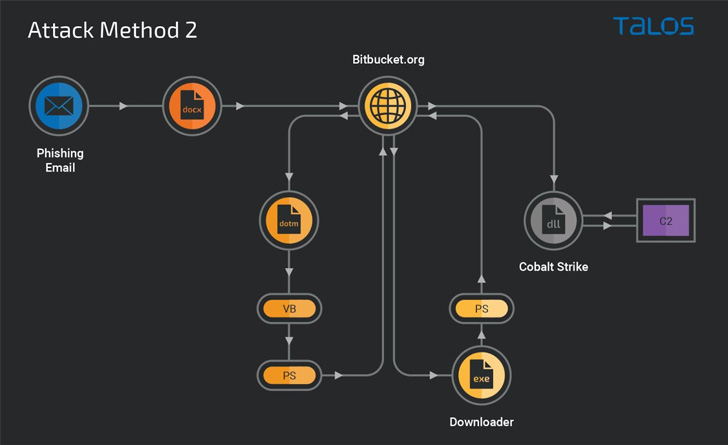
In an alternative attack sequence, the Bitbucket repository
functions as a conduit to deliver obfuscated VB and PowerShell
downloader scripts to install the beacon hosted on a different
Bitbucket account.
“This campaign is a typical example of a threat actor using the
technique of generating and executing malicious scripts in the
victim’s system memory,” the researchers said.
“Organizations should be constantly vigilant on the Cobalt
Strike beacons and implement layered defense capabilities to thwart
the attacker’s attempts in the earlier stage of the attack’s
infection chain.”
References
- ^
said
(blog.talosintelligence.com) - ^
CVE-2017-0199
(msrc.microsoft.com) - ^
Redline
Stealer (thehackernews.com) - ^
Amadey
botnet (thehackernews.com)
Read more https://thehackernews.com/2022/09/new-malware-campaign-targeting-job.html