
If organizations want to get serious about software security,
they need to empower their engineers to play a defensive role
against cyberattacks as they craft their code.
The problem is, developers haven’t had the most inspiring
introduction to security training over the years, and anything that
can be done to make their experience more engaging, productive, and
fun is going to be a powerful motivator in helping them gain
valuable secure coding skills.
And after dedicating precious time to mastering new abilities
that can help beat attackers at their own game, the opportunity to
test these new powers is not easily found in a safe
environment.
So, what is a battle-hardened, security-aware engineer to
do?
A new feature released on the Secure Code Warrior platform,
named ‘Missions,’ is a challenge category that elevates
users from the recall of learned security knowledge to the
application of it in a real-world simulation environment.
This scaffolded, microlearning approach builds strong, secure
coding skills that are job-relevant and much more entertaining than
(vertically) watching endless training videos in the background of
a workday.
The first available ‘Mission’ is a simulation of the GitHub
Unicode breach. It’s not as simple as it might appear on the
surface, and it’s a really clever vulnerability that is fun to
dissect. Security researcher 0xsha did a comprehensive case study[1] on how this same bug can
be used to exploit Django by way of case transformations while also
showing how vulnerability behavior can change between programming
languages.
There’s a lot more to discover about this security issue, and
here is a great place to start.
GitHub’s Head-On (Case Mapping) Collision
In a blog post[2]
from November 28, 2019, security research group Wisdom reported on
a security bug they discovered on GitHub. They outlined how they
were able to utilize a Case Mapping Collision in Unicode to trigger
a password reset email delivery to the wrong email address (or if
you were thinking like an attacker, an email address of the threat
actor’s choosing).
While a security vulnerability is never good news, security
researchers who rock a whitehat do provide some mercy — not to
mention the opportunity to avert disaster — if they discover
potentially exploitable errors in a codebase. Their blogs and
reports often make for great reading, and it’s kind of cool to
learn about a new vulnerability and how it works.
In order to move to the next level of secure coding prowess, it
is super powerful not just to find common vulnerabilities, but also
have a safe, hands-on environment to understand how to exploit them
as well.
Keep reading to discover how a Case Mapping Collision in Unicode
can be exploited, how it looks in real-time, and how you can take
on the mindset of a security researcher and try it out for
yourself.

Unicode: More Than Just Emojis
“Unicode” may not be on the radar of the average person, but the
chances are good that most people use it in some form every day. If
you’ve used a web browser, any Microsoft software, or sent an
emoji, then you’ve been up close and personal with Unicode.
It’s a standard for consistent encoding and handling of text
from most of the world’s writing systems, ensuring that everybody
can (digitally) express themselves using a single character
set.
As it stands, there are over 143,000 characters, so you’re
covered whether you’re using the Icelandic þ, or the Turkish
dotless ı, or anything in between.
Due to the sheer volume of characters Unicode has in its set, a
way of converting characters to another “equivalent” character is
needed in many cases. For instance, it seems sensible that if you
convert a Unicode string with a dotless “ı” to ASCII, that it
should simply turn into an “i,” right?
With a great volume of character, encoding comes great
responsibility potential for disaster.
A case mapping collision in Unicode is a business logic flaw and
can lead to an account takeover of accounts not protected by 2FA.
Check out an example of this bug in a real code snippet:
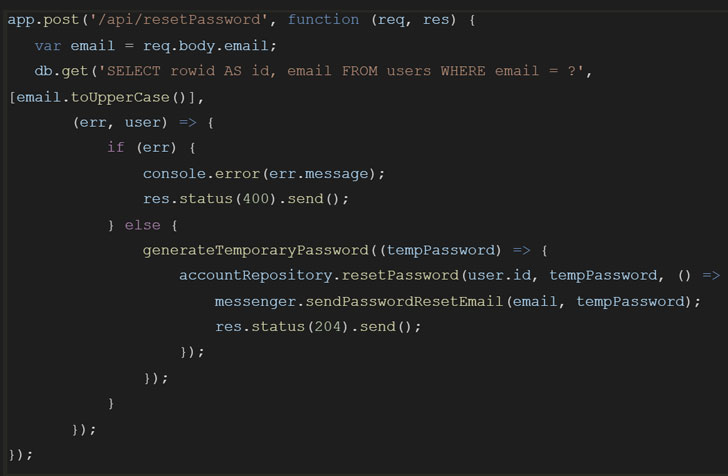
The logic goes something like this:
- It accepts the user-provided email address and uppercases it
for consistency. - It checks if the email address already exists in the
database. - If it does, then it will set a new temporary password (this
isn’t best practice, by the way. Instead, use a link with a token
that enables a password reset) - It then sends an email to the address fetched in step 1,
containing the temporary password (this is very poor practice, for
so many reasons. Yikes.)
Let’s see what happens with the example provided in the original blog post[3], where a user requests a
password reset for the email John@GıtHub.com (note the Turkish
dotless i):
- The logic converts John@Gıthub.com to JOHN@GITHUB.COM
- It looks that up in the database and finds the user
JOHN@GITHUB.COM - It generates a new password and sends it to
John@Gıthub.com
Note that this process ends up sending the highly sensitive
email to the wrong email address. Oops!
How to cast out this Unicode demon
The interesting aspect of this specific vulnerability is that
there are multiple factors that make it vulnerable:
- The actual Unicode casting behavior,
- The logic determining email address to use, i.e., the
user-provided email address, instead of the one that already exists
in the database.
In theory, you can fix this specific issue in two ways, as
identified in the blog post from Wisdom:
- Convert the email to ASCII with Punycode conversion,
- Use the email address from the database rather than the one
provided by the user.
When it comes to hardening software, it’s a great idea to leave
nothing to chance, employing as many layers of defense in place as
possible. For all you know, there may be other ways to exploit this
encoding – you’re just not aware of them yet. Anything you can do
to decrease risk and close windows that may be left open for an
attacker is valuable.
Ready To Pilot Your Own Mission?
It’s time to take your secure coding and awareness skills to the
next level. Experience this GitHub vulnerability in an immersive,
safe simulation, where you can see the impact of bad code in both
frontend and backend contexts. Attackers have an advantage, so
let’s even the playing field and apply real skills with a whitehat
counter-punch.

References
- ^
comprehensive case study
(0xsha.io) - ^
blog
post (eng.getwisdom.io) - ^
original
blog post (eng.getwisdom.io)
Read more http://feedproxy.google.com/~r/TheHackersNews/~3/aKhJr0-YzPA/missions-next-level-of-interactive.html