
vulnerabilities has become common among cybercriminals, which makes
it one of the primary attack vectors for everyday-threats, like
crypto-mining, phishing, and ransomware.
As suspected, a recently-disclosed critical vulnerability in the
widely used Oracle WebLogic Server has now been spotted actively
being exploited to distribute a never-before-seen ransomware
variant, which researchers dubbed “Sodinokibi.”
Last weekend, The Hacker News learned about a critical
deserialization remote code execution vulnerability in
Oracle WebLogic Server that could allow attackers to remotely
run arbitrary commands on the affected servers just by sending a
specially crafted HTTP request—without requiring any
authorization.
[1]
To address this vulnerability (CVE-2019-2725), which affected all
versions of the Oracle WebLogic software and was given a severity
score of 9.8 out of 10, Oracle rolled out an out-of-band security update
on April 26, just a day after the vulnerability was made public and
several in-the-wild attacks were observed.
According to cybersecurity researchers from Cisco Talos’ threat
research team, an unknown group of hackers has been exploiting this
vulnerability since at least April 25 to infect vulnerable servers
with a new piece of ransomware malware.
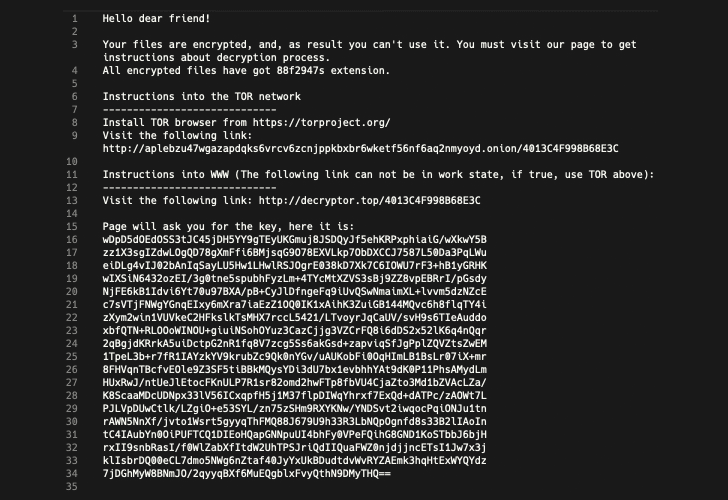
designed to encrypt files in a user’s directory and then delete
shadow copy backups from the system in an effort to prevent victims
from recovering their data without paying a ransom.
No Interaction Required to Deploy Ransomware
Since attackers are leveraging a remote code execution
vulnerability in the WebLogic Server, unlike typical ransomware
attacks, deploying the Sodinokibi ransomware requires no user
interaction.
“Historically, most varieties of ransomware have required some form
of user interaction, such as a user opening an attachment to an
email message, clicking on a malicious link, or running a piece of
malware on the device,” researchers explain in a blog post.
“In this case, the attackers simply leveraged the Oracle
WebLogic vulnerability, causing the affected server to download a
copy of the ransomware from attacker-controlled IP addresses.”
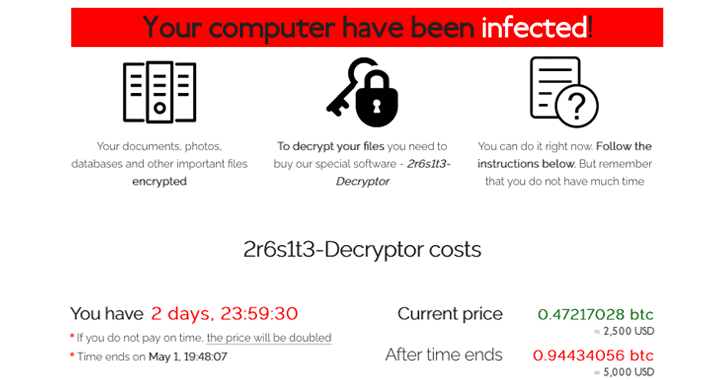
systems and displays a ransom note demanding up to $2,500 in
Bitcoin. The amount doubles to $5,000 if the ransom is not paid
within a specified number of days—which may vary from two days to
six days.
Hackers Are Also Installing GandCrab Ransomware
Researchers also noted that roughly eight hours after deploying
Sodinokibi on an infected system, the attackers exploited the same
WebLogic Server vulnerability to install another piece of
ransomware known as GandCrab
(v5.2).
“We find it strange the attackers would choose to distribute
additional, different ransomware on the same target,” the
researchers say. “Sodinokibi being a new flavor of ransomware,
perhaps the attackers felt their earlier attempts had been
unsuccessful and were still looking to cash in by distributing
Gandcrab.”
vulnerability in the wild since at least April 17 to distribute
cryptocurrency
miners and other types of
malware.
WebLogic Server is a popular Java-based multi-tier enterprise
application server typically used by businesses to support
enterprise apps, which makes it an often target of attackers trying
to carry out malicious operations, like running cryptocurrency
miners and infecting with ransomware.
Organizations that use Oracle WebLogic Server should make sure
to update their installations to the latest version of the software
as soon as possible.
References
- ^
vulnerability in Oracle WebLogic
Server (thehackernews.com) - ^
security update
(www.oracle.com) - ^
blog post
(blog.talosintelligence.com) - ^
GandCrab
(thehackernews.com) - ^
cryptocurrency miners
(isc.sans.edu) - ^
types of malware
(devcentral.f5.com)
Read more http://feedproxy.google.com/~r/TheHackersNews/~3/zYpi9q3o_jE/ransomware-oracle-weblogic.html