
Threat actors known for keeping a low profile do so by ceasing
operations for prolonged periods in between to evade attracting any
attention as well as constantly refining their toolsets to fly
below the radar of many detection technologies.
One such group is FIN8[1], a financially motivated
threat actor that’s back in action after a year-and-a-half hiatus
with a powerful version of a backdoor with upgraded capabilities
including screen capturing, proxy tunneling, credential theft, and
fileless execution[2].
First documented in 2016 by FireEye, FIN8 is known for its
attacks against the retail, hospitality, and entertainment
industries while making use of a wide array of techniques such as
spear-phishing and malicious tools like PUNCHTRACK[3]
and BADHATCH[4]
to steal payment card data from point-of-sale (POS) systems.
“The FIN8 group is known for taking long breaks to improve
TTPs[5]
and increase their rate of success,” Bitdefender researchers
said[6]
in a report published today. “The BADHATCH malware is a mature,
highly advanced backdoor that uses several evasion and defense
techniques. The new backdoor also attempts to evade security
monitoring by using TLS encryption to conceal Powershell
commands.”
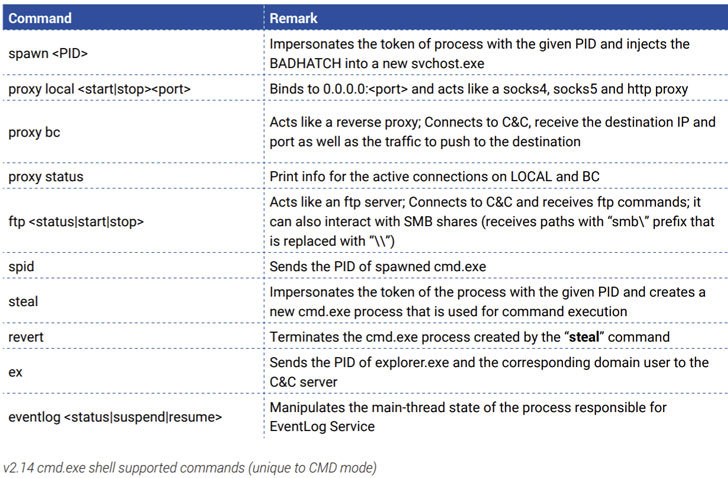
BADHATCH, since its discovery in 2019, has been deployed as an
implant capable of running attacker-supplied commands retrieved
from a remote server, in addition to injecting malicious DLLs in a
current process, gathering system information, and exfiltrating
data to the server.
Noting that at least three different variants of the backdoor
(v2.12 to 2.14) have been spotted since April 2020, the researchers
said the latest version of BADHATCH abuses a legitimate service
called sslp.io[7] to thwart detection
during the deployment process, using it to download a PowerShell
script, which in turn executes the shellcode containing the
BADHATCH DLL.
The PowerShell script, besides taking responsibility for
achieving persistence, also takes care of privilege escalation to
ensure that all commands post the script’s execution are run as the
SYSTEM user.
Furthermore, a second evasion technique adopted by FIN8 involves
passing off communications with the command-and-control (C2) server
that masquerade as legitimate HTTP requests.
According to Bitdefender, the new wave of attacks is said to
have taken place over the past year and directed against insurance,
retail, technology, and chemical industries in the U.S., Canada,
South Africa, Puerto Rico, Panama, and Italy.
“Like most persistent and skilled cyber-crime actors, FIN8
operators are constantly refining their tools and tactics to avoid
detection,” the researchers concluded, urging businesses to
“separate the POS network from the ones used by employees or
guests” and filter out emails containing malicious or suspicious
attachments.