Technical details have been disclosed regarding a number of
security vulnerabilities affecting Moxa’s MXview web-based network
management system, some of which could be chained by an
unauthenticated adversary to achieve remote code execution on
unpatched servers.
The five security weaknesses “could allow a remote,
unauthenticated attacker to execute code on the hosting machine
with the highest privileges available: NT AUTHORITY\SYSTEM,”
Claroty security researcher Noam Moshe said[1]
in a report published this week.
Moxa MXview[2]
is designed for configuring, monitoring, and diagnosing networking
devices in industrial networks. The flaws, which affect versions
3.x to 3.2.2 of the network management software, were rectified in
version 3.2.4 or higher[3]
following a coordinated disclosure process in October 2021.
“Successful exploitation of these vulnerabilities may allow an
attacker to create or overwrite critical files to execute code,
gain access to the program, obtain credentials, disable the
software, read and modify otherwise inaccessible data, allow remote
connections to internal communication channels, or interact and use
MQTT remotely,” the U.S. Cybersecurity and Infrastructure Security
Agency (CISA) said[4]
in an advisory.
MQTT refers to a messaging protocol that facilitates remote
asynchronous communication, enabling the transfer of messages to
and from different components in an MXview environment.
The list of flaws is as follows —
- CVE-2021-38452[5] (CVSS score: 7.5) – A
path traversal vulnerability in the application, allowing the
access or overwrite of critical files used to execute code - CVE-2021-38454[6] (CVSS score: 10.0) – A
misconfigured service that allows remote connections to MQTT,
making it possible to remotely interact and use the communication
channel - CVE-2021-38456[7] (CVSS score: 9.8) – Use
of hard-coded passwords - CVE-2021-38458[8] (CVSS score: 9.8) – An
issue with improper neutralization of special elements that could
lead to remote execution of unauthorized commands - CVE-2021-38460[9] (CVSS score: 7.5) – A
case of password leakage that may allow an attacker to obtain
credentials
Three of the aforementioned flaws — CVE-2021-38452,
CVE-2021-38454, and CVE-2021-38458, could be strung together to
achieve pre-authenticated remote code execution on vulnerable
MXView instances with SYSTEM privileges.
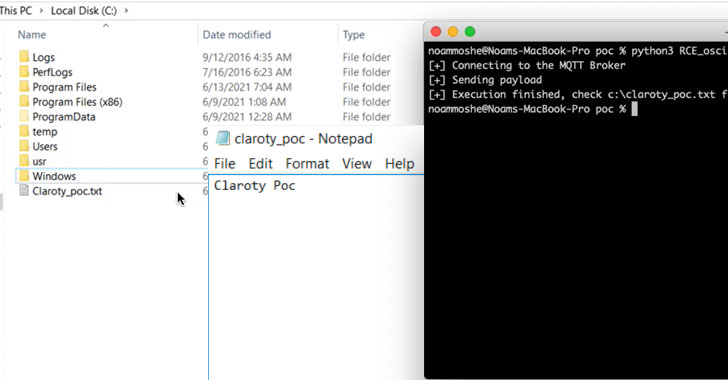
In a hypothetical attack scenario devised by Claroty,
CVE-2021-38452 could be abused to get hold of the plain-text MQTT
password by reading the configuration file gateway-upper.ini,
followed by leveraging CVE-2021-38454 to inject rogue MQTT
messages, triggering code execution through command injection on
the server.
“An attacker injects malicious messages to the MQTT broker
directly, bypassing all input validation performed by the server,
and achieves arbitrary remote code execution through the OS command
injection vulnerability,” Moshe explained.
References
- ^
said
(www.claroty.com) - ^
MXview
(www.moxa.com) - ^
version
3.2.4 or higher (www.moxa.com) - ^
said
(www.cisa.gov) - ^
CVE-2021-38452
(web.nvd.nist.gov) - ^
CVE-2021-38454
(web.nvd.nist.gov) - ^
CVE-2021-38456
(web.nvd.nist.gov) - ^
CVE-2021-38458
(web.nvd.nist.gov) - ^
CVE-2021-38460
(web.nvd.nist.gov)
Read more https://thehackernews.com/2022/02/critical-security-flaws-reported-in.html