
and proof-of-concept of a critical remote code execution
vulnerability affecting OpenWrt, a widely used Linux-based
operating system for routers, residential gateways, and other
embedded devices that route network traffic.
Tracked as CVE-2020-7982, the vulnerability resides in
the OPKG package manager of OpenWrt that exists in the way it
performs integrity checking of downloaded packages using the
SHA-256 checksums embedded in the signed repository index.
While an ‘opkg install’ command is invoked on the victim system,
the flaw could allow a remote man-in-the-middle attacker in a
position to intercept the communication of a targeted device to
execute arbitrary code by tricking the system into installing a
malicious package or software update without verification.
If exploited successfully, a remote attacker could gain complete
control over the targeted OpenWrt network device, and subsequently,
over the network traffic it manages.
The three-year-old vulnerability[1]
was discovered earlier this year by Guido Vranken from the
ForAllSecure software company, who then reported it responsibly to
the OpenWrt development team.
In a blog post
published[2] today, Vranken explained
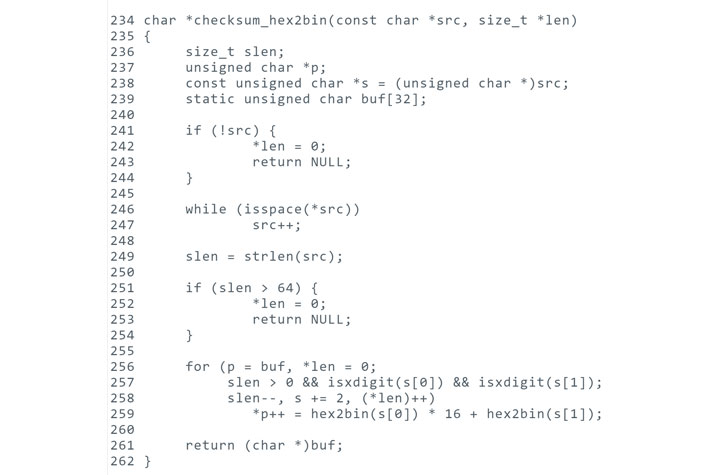
that when a checksum contains any leading spaces, OPKG on the
vulnerable versions of OpenWrt skips checking the integrity of the
downloaded package and proceeds to the installation task.
access to the entire filesystem, arbitrary code could be injected
by means of forged .ipk packages with a malicious
payload,” OpenWrt team[3]
said.
The remote exploitation of this vulnerability is possible due to
the fact that integrity in Linux based software installation
mechanisms rely on digitally signing files while downloading files
over the insecure HTTP connection.
Besides this, to exploit the vulnerability, attackers also need to
serve a malicious package with the size equals to that specified in
the package list on downloads.openwrt.org.
According to the project team, OpenWrt versions 18.06.0 to
18.06.6 and 19.07.0, as well as LEDE 17.01.0 to 17.01.7, are
affected.
“As a stopgap solution, OpenWRT removed the space in the SHA256sum
from the package list shortly after I reported the bug,” Vranken
said.
“However, this is not an adequate long-term solution because an
attacker can simply provide an older package list that was signed
by the OpenWRT maintainers.”
device firmware to the latest OpenWrt versions 18.06.7 and 19.07.1,
which were released last month.
References
- ^
vulnerability
(git.openwrt.org) - ^
blog post published
(blog.forallsecure.com) - ^
OpenWrt team
(openwrt.org)
Read more http://feedproxy.google.com/~r/TheHackersNews/~3/-KB-_DdjYXE/openwrt-rce-vulnerability.html