Amid heightened border tensions[1]
between India and China, cybersecurity researchers have revealed a
concerted campaign against India’s critical infrastructure,
including the nation’s power grid, from Chinese state-sponsored
groups.
The attacks, which coincided with the standoff between the two
nations in May 2020, targeted a total of 12 organizations, 10 of
which are in the power generation and transmission sector.
“10 distinct Indian power sector organizations, including four
of the five Regional Load Despatch Centres (RLDC) responsible for
operation of the power grid through balancing electricity supply
and demand, have been identified as targets in a concerted campaign
against India’s critical infrastructure,” Recorded Future said[2]
in a report published yesterday. “Other targets identified included
2 Indian seaports.”
Chief among the victims include a power plant run by National
Thermal Power Corporation (NTPC) Limited and New Delhi-based Power
System Operation Corporation Limited.
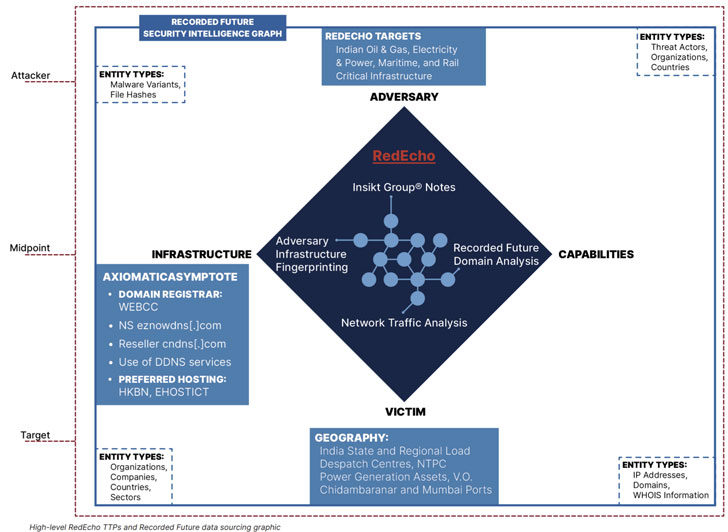
Pinning the intrusions on a new group dubbed “RedEcho,”
investigators from the cybersecurity firm’s Insikt Group said the
malware deployed by the threat actor shares strong infrastructure
and victimology overlaps with other Chinese groups APT41 (aka
Barium, Winnti, or Wicked Panda) and Tonto Team.
Border conflicts have flared up since last year after deadly
clashes between Indian and Chinese soldiers in Ladakh’s Galwan
Valley. While 20 Indian soldiers were killed in the clashes, China
formally identified four
casualties[3] on its side for the
first time on February 19.

In the intervening months, the Indian government has banned over
200 Chinese apps for allegedly engaging in activities that posed
threats to “national security and defence of India, which
ultimately impinges upon the sovereignty and integrity of
India.”
Noting that the standoff between the two countries was
accompanied by increased espionage activity on both sides, Recorded
Future said the attacks from China involved the use of
infrastructure it tracks as AXIOMATICASYMPTOTE, which encompasses a
modular Windows backdoor called ShadowPad[4]
that has been previously attributed to APT41 and subsequently
shared between other Chinese state-backed actors.
Additionally, the report also raises questions about a possible
connection between the skirmishes and a power blackout that
crippled Mumbai last October.
While initial probe[5]
conducted by the cyber department of the western Indian state of
Maharashtra traced the attack to a piece of unspecified malware
identified at a Padgha-based State Load Despatch Centre, the
researchers said, “the alleged link between the outage and the
discovery of the unspecified malware variant remains
unsubstantiated.”
“However, this disclosure provides additional evidence
suggesting the coordinated targeting of Indian Load Despatch
Centres,” they added.
Interestingly, these cyberattacks were described as originating
from Chengdu, which is also the base for a network technology firm
called Chengdu 404 Network Technology Company that operated as a
front for a decade-long hacking spree[6] targeting more than 100
high-tech and online gaming companies.
But it’s not just China. In the weeks leading to the clashes in
May, a state-sponsored group called Sidewinder[7]
— which operates in support of Indian political interests — is said
to have singled out Chinese military and government entities in a
spear-phishing attack[8]
using lures related to COVID-19 or the territorial disputes between
Nepal, Pakistan, India, and China.
The modus operandi aside, the finding is yet another reminder of
why critical infrastructure continues to be a lucrative target for
an adversary looking to cut off access to essential services used
by millions of people.
“The intrusions overlap with previous Indian energy sector
targeting by Chinese threat activity groups in 2020 that also used
AXIOMATICASYMPTOTE infrastructure,” the researchers concluded.
“Therefore, the focus in targeting India’s electricity system
possibly indicates a sustained strategic intent to access India’s
energy infrastructure.”
We have reached out to India’s Computer Emergency Response Team
(CERT-IN), and we will update the story if we hear back.
References
- ^
border
tensions (en.wikipedia.org) - ^
said
(www.recordedfuture.com) - ^
formally
identified four casualties
(www.globaltimes.cn) - ^
ShadowPad
(malpedia.caad.fkie.fraunhofer.de) - ^
initial
probe (www.indiatoday.in) - ^
decade-long hacking spree
(thehackernews.com) - ^
Sidewinder
(cybersecurity.att.com) - ^
spear-phishing attack
(www.trendmicro.com)