
A Chinese-speaking advanced persistent threat (APT) has been
linked to a new campaign targeting gambling-related companies in
South East Asia, particularly Taiwan, the Philippines, and Hong
Kong.
Cybersecurity firm Avast dubbed the campaign Operation Dragon Castling[1], describing its malware
arsenal as a “robust and modular toolset.” The ultimate motives of
the threat actor are not immediately discernible as yet nor has it
been linked to a known hacking group.
While multiple initial access avenues were employed during the
course of the campaign, one of the attack vectors involved
leveraging a previously unknown remote code execution flaw in the
WPS Office suite (CVE-2022-24934[2]) to backdoor its
targets. The issue has since been addressed by Kingsoft Office, the
developers of the office software.
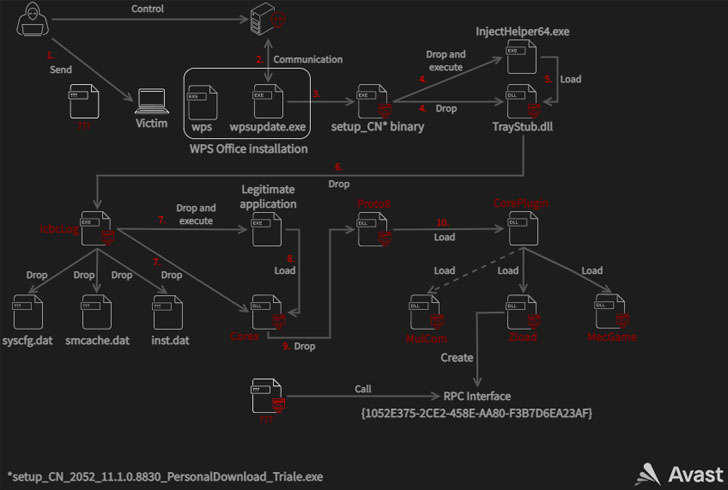
In the case observed by the Czech security firm, the
vulnerability was used to drop a malicious binary from a fake
update server with the domain update.wps[.]cn that triggers a
multi-stage infection chain that leads to the deployment of
intermediate payloads the allows for privilege escalation before
ultimately dropping the Proto8 module.
“The core module is a single DLL that is responsible for setting
up the malware’s working directory, loading configuration files,
updating its code, loading plugins, beaconing to
[command-and-control] servers and waiting for commands,” Avast
researchers Luigino Camastra, Igor Morgenstern, Jan Holman
said.
Proto8’s plugin-based system used to extend its functionality
enables the malware to achieve persistence, bypass user account
control (UAC[3]) mechanisms, create new
backdoor accounts, and even execute arbitrary commands on the
infected system.
References
- ^
Operation Dragon Castling
(decoded.avast.io) - ^
CVE-2022-24934
(nvd.nist.gov) - ^
UAC
(en.wikipedia.org)
Read more https://thehackernews.com/2022/03/chinese-apt-hackers-targeting-betting.html