The U.S. Department of Justice (DoJ) on Friday announced an
indictment against Jean-Francois Eap, the CEO of encrypted
messaging company Sky Global, and an associate for wilfully
participating in a criminal enterprise to help international drug
traffickers avoid law enforcement.
Eap (also known as “888888”) and Thomas Herdman, a former
high-level distributor of Sky Global devices, have been charged
with a conspiracy to violate the federal Racketeer Influenced and
Corrupt Organizations Act (RICO), according to warrants issued for
their arrests.
“The indictment alleges that Sky Global generated hundreds of
millions of dollars providing a service that allowed criminal
networks around the world to hide their international drug
trafficking activity from law enforcement,” Acting U.S. Attorney
Randy Grossman said[1]
in the announcement. “This groundbreaking investigation should send
a serious message to companies who think they can aid criminals in
their unlawful activities.”
Specifically, the indictment alleges that the company “knowingly
and intentionally” sold its encrypted communications devices to
criminal organizations involved in the transnational importation
and distribution of narcotics, used digital currencies such as
Bitcoin to conduct illegal transactions on the firm’s website, and
protect its customers’ anonymity, and obstructed investigations of
drug trafficking by “remotely delet[ing] evidence of such
activities.”
A Wave of Law Enforcement Action
The development comes on the heels of a coordinated exercise
called “Operation Argus” and “Operation A-Limit,” in which law
enforcement agencies from Belgium, France, and the Netherlands
announced major interventions against the messaging platform to
disrupt the illegal use of encrypted communications by large-scale
organized crime groups (OCGs).
By successfully breaking the encryption protections of Sky ECC
in mid-February, authorities said they were able to decipher over
half a billion messages and gain “invaluable insights into hundreds
of millions of messages exchanged between criminals,” culminating
in a series of nearly 275 raids and the arrest of 91 suspects,
besides seizing 17 tonnes of cocaine and €1.2 million.
The Belgian Federal Police[2]
and the Dutch National Police[3]
said the encrypted message traffic was read “live” for a period of
about three weeks, forestalling “dozens of planned serious violent
crimes, including kidnappings, liquidations and shootings.”
“This has resulted in the collection of crucial information on
over a hundred of planned large-scale criminal operations,
preventing potential life threatening situations and possible
victims,” Europol noted[4].
Sky ECC is said to have surged in popularity following a similar
takedown of Encrochat[5]
last July by French and Dutch investigators[6], with many criminal
gangs shifting to the service to carry out criminal acts. Sky, like
Encrochat’s EncroPhone, is part of the encrypted phone industry, in
which iPhone, Google Pixel, and Blackberry handsets are altered by
incorporating tamper-resistant hardware and OS-level protections
capable of resisting (lawful) attempts to gain access to their
contents.
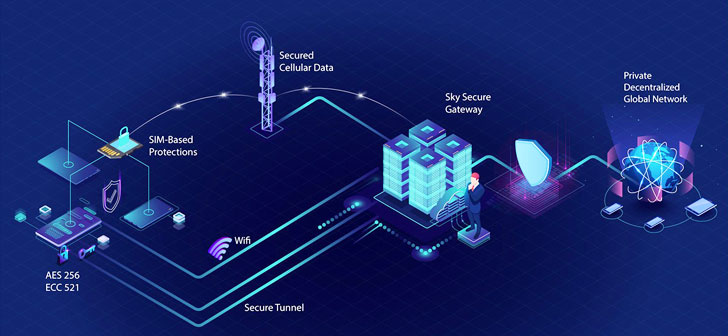
Sold for either a three or six months subscription at
$185/month, the phones also integrate their own encrypted messaging
applications with support for self-destructing chats, in addition
to disabling features like camera outside of the app, microphone,
calling, Bluetooth, NFC, biometrics, GPS sensors, and app store
access that could potentially compromise security.
Worldwide, there are an estimated 170,000 Sky ECC custom-made
phones in service, Europol said, adding around three million
messages are being exchanged each day on a global scale. Sky ECC is
operated from the U.S. and Canada while making use of computer
servers based in Europe. Around a quarter of its active users are
located in Belgium and the Netherlands.
Sky ECC Denies Involvement
Denying that it’s a “platform of choice for criminals,” Sky ECC
contested its involvement in the operations and said that its
platform remains secure and that none of the authorized devices had
been hacked, instead pointing fingers at an impostor reseller[7]
(named “SKYECC.EU”) that had no connection to the company.
“SKY ECC authorized distributors in Belgium and the Netherlands
brought to our attention that a fake phishing application falsely
branded as SKY ECC was illegally created, modified and side-loaded
onto unsecure devices, and security features of authorized SKY ECC
phones were eliminated in these bogus devices which were then sold
through unauthorized channels,” the company said[8].
The company has also claimed it had not been contacted by any
investigative authority, nor it cooperated with the parties
involved with the fake phishing application.
Responding to the DoJ’s indictment, Eap said[9], “the unfounded
allegations of involvement in criminal activity by me and our
company are entirely false,” adding, “In the coming days, my
efforts will be focused on clearing my name of these
allegations.”
Sky Global’s technology “was not created to prevent the police
from monitoring criminal organizations; it exists to prevent anyone
from monitoring and spying on the global community,” he added.
News of Sky ECC’s dismantlement also follows a similar crackdown
on providers of encrypted communications, including Ennetcom[10] and Phantom Secure[11], over the past five
years.
References
- ^
said
(www.justice.gov) - ^
Belgian
Federal Police (www.police.be) - ^
Dutch
National Police (www.politie.nl) - ^
noted
(www.europol.europa.eu) - ^
takedown
of Encrochat (thehackernews.com) - ^
French
and Dutch investigators (www.vice.com) - ^
impostor
reseller (www.skyecc.com) - ^
said
(www.skyecc.com) - ^
said
(www.skyecc.com) - ^
Ennetcom
(www.reuters.com) - ^
Phantom Secure
(www.vice.com)