campaign[1] has now shared details
of a new but similar attack campaign with The Hacker News that has
specifically been designed to target mobile users.
Just like the previous campaign, the new phishing attack is also
based on the idea that a malicious web page could mimic look and
feel of the browser window to trick even the most vigilant users
into giving away their login credentials to attackers.
Antoine Vincent
Jebara[2], co-founder and CEO of
password managing software Myki[3], shared a new video with
The Hacker News, demonstrating[4] how attackers can
reproduce native iOS behavior, browser URL bar and tab switching
animation effects of Safari in a very realistic manner on a
web-page to present fake login pages, without actually opening or
redirecting users to a new tab.
New Phishing Attack Mimics Mobile Browser Animation and
Design
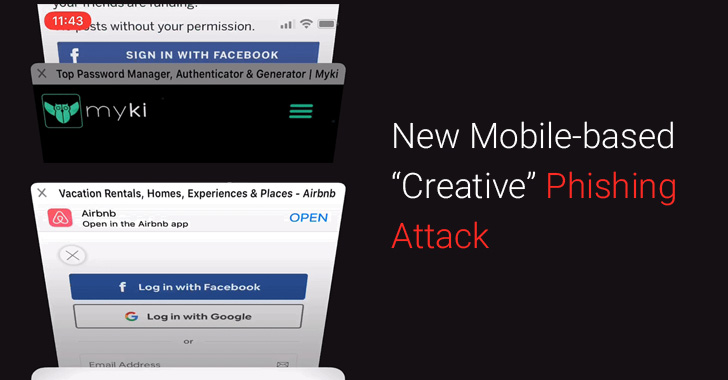
As you can see in the video, a malicious website that looks like
Airbnb prompts users to authenticate using Facebook login, but upon
clicking, the page displays a fake tab switching animation video
aimed to trick users into thinking that their browsers are behaving
normally.
“The Facebook login page is also definitely fake and is an overlay
over the current page that makes it look like an authentic Facebook
page,” Jebara said.
“From the moment a user accesses the malicious website, they are
manipulated into performing actions that seem legitimate, all with
the purpose of building up their confidence to submit their
Facebook password at the final stage of the attack.”
differences, they would eventually end up filling the username and
password fields on the phishing page, resulting in giving away
their social media credentials to the attackers.
“This attack is poorly implemented and contains multiple flaws from
both a process and design point of view. Login with Facebook
prompts are presented as an external window in Safari, not as an
additional tab that the user is switched to, as the origin URL
still appears in minimized form over the fake Facebook navigation
bar,” Jebara said.
“Although hackers would probably implement this campaign in a more
realistic manner, in its current form, a majority of users would
fall for this attack, as the details that give it away are
relatively subtle, and more importantly, the user is shown specific
‘familiar’ actions that seem to turn off the part of the brain that
doubts the legitimacy of the page.”
How to Protect Against Such New Form of Phishing Scams
It should be noted that such advanced phishing attacks are not
limited to Facebook, Safari browser or just to iOS mobile users
only, but could very easily be adapted to target Android devices or
any other social media site as well.
Cybercriminals can target different platforms by creating a
website that automatically serves different versions of phishing
pages based upon what browser app and mobile device operating
system victims use.
Since there are no clear guidelines to spot such creative phishing
attacks, users are highly recommended to:
- Use password managers that only auto-fill credentials on
legit domains, helping you avoid giving away credentials to fake
websites. - Enable two-factor authentication, wherever available,
preventing hackers from accessing your online accounts even if they
somehow manage to steal your credentials.
Besides this, Jebara also suggests users ask themselves “Why am
I asked to log in?” Or “Am I not already logged in to this?” when
hackers try to mimic the logins of popular websites for which you
already have an app on your smartphone.
Phishing is still one of the most severe threats to users as
well as companies, and hackers continue to try new and creative
ways to trick you into providing them with your sensitive and
financial details that they could later use to steal your money or
hack into your online accounts.
Stay Safe! Stay Tuned!
References
- ^
creative phishing campaign
(thehackernews.com) - ^
Antoine Vincent Jebara
(twitter.com) - ^
Myki
(twitter.com) - ^
demonstrating
(myki.com)
Read more http://feedproxy.google.com/~r/TheHackersNews/~3/G2AaKS4izps/ios-mobile-phishing-attack.html