the FBI, and Treasury warning about a new ATM scheme being used by
the prolific North Korean APT hacking group known as Hidden Cobra.
Hidden Cobra, also known as Lazarus Group and Guardians of
Peace, is believed to be backed by the North Korean government and
has previously launched attacks against a number of media
organizations, aerospace, financial and critical infrastructure
sectors across the world.
The group had also reportedly been associated with the WannaCry
ransomware menace that last year shut down
hospitals and big businesses worldwide, the SWIFT Banking
attack in 2016, as well as the Sony Pictures hack
in 2014.
[2][3][4][5]
Now, the FBI, the Department of Homeland Security (DHS), and the
Department of the Treasury have released
details about a new cyber attack, dubbed “FASTCash,” that
Hidden Cobra has been using since at least 2016 to cash out ATMs by
compromising the bank server.
FASTCash Hack Fools ATMs into Spitting Out Cash
The investigators analyzed 10 malware samples associated with
FASTCash cyber attacks and found that attackers remotely compromise
payment “switch application servers” within the targeted banks to
facilitate fraudulent transactions.
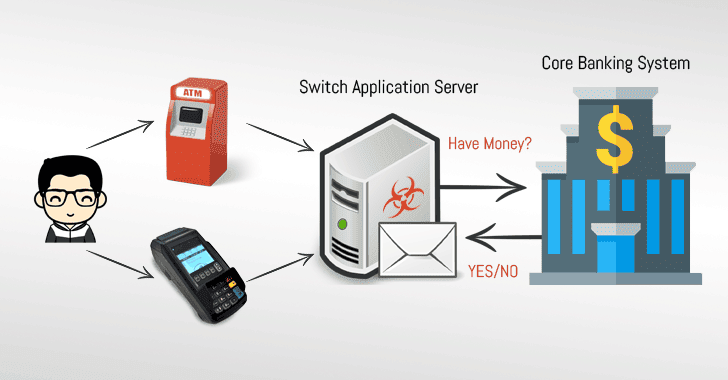
Switch application server is an essential component of ATMs and
Point-of-Sale infrastructures that communicates with the core
banking system to validate user’s bank account details for a
requested transaction.

in a retailer shop, the software asks (in ISO 8583 messages
formats) the bank’s switch application server to validate the
transaction—accept or decline, depending upon the available amount
in your bank account.
However, Hidden Cobra attackers managed to compromise the switch
application servers at different banks, where they had accounts
(and their payment cards) with minimal activity or zero
balances.
The malware installed on the compromised switch application
servers then intercepts transaction request associated with the
attackers’ payment cards and responds with fake but
legitimate-looking affirmative response without actually validating
their available balance with the core banking systems, eventually
fooling ATMs to spit out a large number of cash without even
notifying the bank.
“According to a trusted partner’s estimation, HIDDEN COBRA actors
have stolen tens of millions of dollars,” the reports says.
“In one incident in 2017, HIDDEN COBRA actors enabled cash to be
simultaneously withdrawn from ATMs located in over 30 different
countries. In another incident in 2018, HIDDEN COBRA actors enabled
cash to be simultaneously withdrawn from ATMs in 23 different
countries.”
target banks in Africa and Asia, though the U.S. authorities are
still investigating the FASTCash incidents to confirm whether the
attack targets banks in the United States.
How Attackers Managed to Compromise Banks’ Switch Application
Servers
Though the initial infection vector used to compromise Bank
networks is unknown, the U.S. authorities believe that the APT
threat actors used spear-phishing emails, containing malicious
Windows executable, against employees in different banks.
Once opened, the executable infected bank employees’ computers
with Windows-based malware, allowing hackers to move laterally
through a bank’s network using legitimate credentials and deploy
malware onto the payment switch application server.
Though most compromised switch application servers were found
running unsupported IBM Advanced Interactive eXecutive (AIX)
operating system versions, investigators found no evidence that
attackers exploited any vulnerability in AIX operating system.
US-CERT recommended banks to make two-factor authentication
mandatory before any user can access the switch application server,
and use best practices to protect their networks.
US-CERT has also provided a downloadable copy of IOCs
(indicators of compromise), to help you block them and enable
network defenses to reduce exposure to any malicious cyber activity
by the Hidden Cobra hacking group.
In May 2018, the US-CERT also published an advisory alerting
users of two different
malware[7]—Remote Access Trojan
(RAT) known as Joanap and Server Message Block (SMB) worm
called Brambul—linked to Hidden Cobra.
Last year, the DHS and the FBI also issued an alert describing
Hidden Cobra malware Delta
Charlie[8]—a DDoS tool that they
believed North Korea uses to launch distributed denial-of-service
attacks against its targets.
Other malware linked to Hidden Cobra in the past includes
Destover, Wild Positron or Duuzer, and Hangman with sophisticated
capabilities, like DDoS
botnets[9], keyloggers, remote
access tools (RATs), and wiper
malware[10].
References
- ^
Hidden Cobra
(thehackernews.com) - ^
WannaCry ransomware
(thehackernews.com) - ^
shut down hospitals
(thehackernews.com) - ^
SWIFT Banking attack
(thehackernews.com) - ^
Sony Pictures hack
(thehackernews.com) - ^
released
(www.us-cert.gov) - ^
two different malware
(thehackernews.com) - ^
Delta Charlie
(thehackernews.com) - ^
DDoS botnets
(thehackernews.com) - ^
wiper malware
(thehackernews.com)
Read more http://feedproxy.google.com/~r/TheHackersNews/~3/cDarPElzUlk/bank-atm-hacking.html