Apr 07, 2023Ravie Lakshmanan

Microsoft said it teamed up with Fortra and Health Information
Sharing and Analysis Center (Health-ISAC) to tackle the abuse of
Cobalt Strike by cybercriminals to distribute malware, including
ransomware.
To that end, the tech giant’s Digital Crimes Unit (DCU) revealed
that it secured a court order[1]
in the U.S. to “remove illegal, legacy copies of Cobalt Strike so
they can no longer be used by cybercriminals.”
While Cobalt Strike, developed and maintained by Fortra
(formerly HelpSystems), is a legitimate post-exploitation tool used
for adversary simulation, illegal cracked versions of the software
have been weaponized by threat actors over the years.
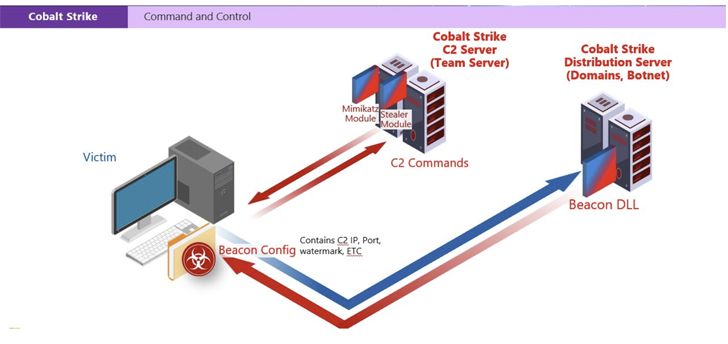
Ransomware actors, in particular, have leveraged Cobalt Strike
after obtaining initial access to a target environment to escalate
privileges, lateral move across the network, and deploy
file-encrypting malware.
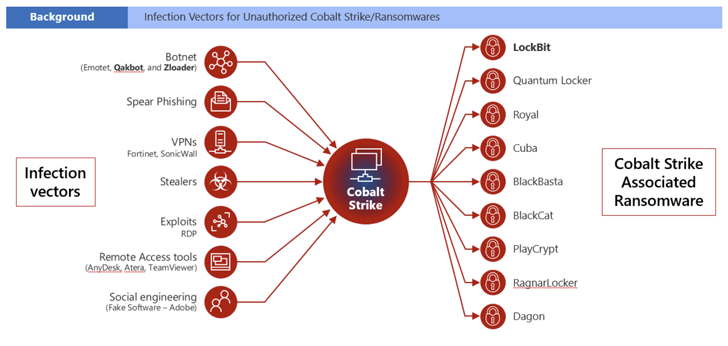
“The ransomware families associated with or deployed by cracked
copies of Cobalt Strike have been linked to more than 68 ransomware
attacks impacting healthcare organizations in more than 19
countries around the world,” Amy Hogan-Burney, general manager of
DCU, said[2].
By disrupting the use of legacy copies of Cobalt Strike and
compromised Microsoft software, the goal is to hinder the attacks
and force the adversaries to rethink their tactics, the company
added.
UPCOMING WEBINAR
Learn to Secure the Identity Perimeter – Proven Strategies
Improve your business security with our upcoming expert-led
cybersecurity webinar: Explore Identity Perimeter strategies!
Don’t Miss Out – Save Your Seat![3]
Redmond further noted the misuse of Cobalt Strike by
nation-state groups whose operations align with that of Russia,
China, Vietnam, and Iran, adding it detected malicious
infrastructure hosting Cobalt Strike across the globe, counting
China, the U.S., and Russia.
The legal crackdown comes months after Google Cloud identified[4]
34 different hacked release versions of the Cobalt Strike tool in
the wild in an attempt to “make it harder for bad guys to
abuse.”
Found this article interesting? Follow us on Twitter [5]
and LinkedIn[6]
to read more exclusive content we post.
References
- ^
court
order (noticeofpleadings.com) - ^
said
(blogs.microsoft.com) - ^
Don’t
Miss Out – Save Your Seat! (thehacker.news) - ^
identified
(thehackernews.com) - ^
Twitter
(twitter.com) - ^
LinkedIn
(www.linkedin.com)
Read more https://thehackernews.com/2023/04/microsoft-takes-legal-action-to-disrupt.html