Mar 08, 2023Ravie Lakshmanan

High-profile government entities in Southeast Asia are the
target of a cyber espionage campaign undertaken by a Chinese threat
actor known as Sharp Panda since late last year.
The intrusions are characterized by the use of a new version of
the Soul modular framework, marking a departure from the group’s
attack chains observed in 2021.
Israeli cybersecurity company Check Point said[1]
the “long-running” activities have historically singled out
countries such as Vietnam, Thailand, and Indonesia. Sharp Panda was
first documented[2]
by the firm in June 2021, describing it as a “highly-organized
operation that placed significant effort into remaining under the
radar.”
Interestingly, the use of the Soul backdoor was detailed[3]
by Broadcom’s Symantec in October 2021 in connection to an
unattributed espionage operation targeting defense, healthcare, and
ICT sectors in Southeast Asia.
The implant’s origins, according to research[4]
published by Fortinet FortiGuard Labs in February 2022, date as far
back as October 2017, with the malware repurposing code from Gh0st
RAT and other publicly available tools.
The attack chain detailed by Check Point begins with a
spear-phishing email containing a lure document that leverages the
Royal Road[5]
Rich Text Format (RTF) weaponizer to drop a downloader by
exploiting one of several vulnerabilities in the Microsoft Equation
Editor.
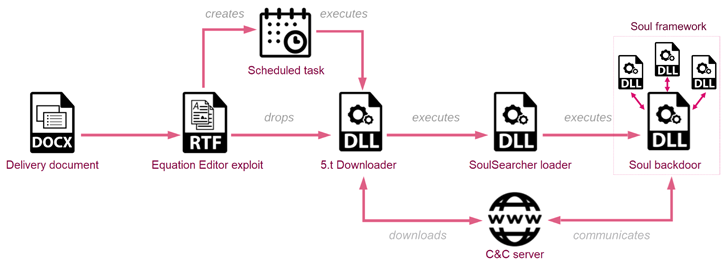
The downloader, in turn, is designed to retrieve a loader known
as SoulSearcher from a geofenced command-and-control (C&C)
server that only responds to requests originating from IP addresses
corresponding to the targeted countries.
The loader is then responsible for downloading, decrypting, and
executing the Soul backdoor and its other components, thereby
enabling the adversary to harvest a wide range of information.
“The Soul main module is responsible for communicating with the
C&C server and its primary purpose is to receive and load in
memory additional modules,” Check Point said.
Discover the Latest Malware Evasion Tactics and Prevention
Strategies
Ready to bust the 9 most dangerous myths about file-based
attacks? Join our upcoming webinar and become a hero in the fight
against patient zero infections and zero-day security events!
“Interestingly, the backdoor configuration contains a ‘radio
silence’-like feature, where the actors can specify specific hours
in a week when the backdoor is not allowed to communicate with the
C&C server.”
The findings are yet another indication of the tool sharing
that’s prevalent among Chinese advanced persistent threat (APT)
groups to facilitate intelligence gathering.
“While the Soul framework has been in use since at least 2017,
the threat actors behind it have been constantly updating and
refining its architecture and capabilities,” the company said.
It further noted that the campaign is likely “staged by advanced
Chinese-backed threat actors, whose other tools, capabilities and
position within the broader network of espionage activities are yet
to be explored.”
Found this article interesting? Follow us on Twitter [7]
and LinkedIn[8]
to read more exclusive content we post.
References
Read more https://thehackernews.com/2023/03/sharp-panda-using-new-soul-framework.html