
Multiple campaigns that distributed trojanized and typosquatted
packages on the NPM open source repository have been identified as
the work of a single threat actor dubbed
LofyGang.
Checkmarx said it discovered 199 rogue packages totaling
thousands of installations, with the group operating for over a
year with the goal of stealing credit card data as well as user
accounts associated with Discord Nitro, gaming, and streaming
services.
“LofyGang operators are seen promoting their hacking tools in
hacking forums, while some of the tools are shipped with a hidden
backdoor,” the software security company said in a report shared
with The Hacker News prior to its publication.
Various pieces of the attack puzzle have already been reported
by JFrog[1], Sonatype[2], and Kaspersky[3]
(which called it LofyLife), but the latest analysis pulls the
various operations together under one organizational umbrella that
Checkmarx is referring to as LofyGang[4].
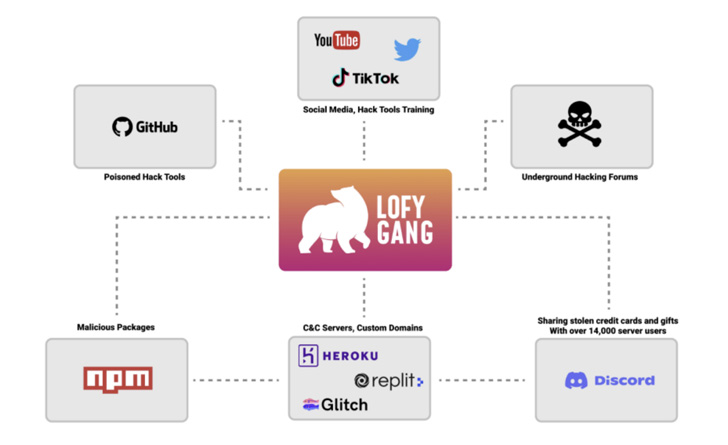
Believed to be an organized crime group of Brazilian origin, the
attackers have a track record of using sock puppet accounts to
advertise their tools and services on GitHub[5], YouTube[6], and leaking thousands
of Disney+ and Minecraft accounts on underground hacking
forums.
It’s also known to employ a Discord server created nearly a year
ago on October 31, 2021, to provide technical support and
communicate with their members. One of its main offerings is a
service that sells fake Instagram followers.
“Discord, Repl.it, glitch, GitHub, and Heroku are just a few
services LofyGang is using as [command-and-control] servers for
their operation,” the researchers noted.
What’s more, the fraudulent packages traced back to the group
have been found to embed password stealers and Discord-specific
malware, some of which are designed to steal credit cards.
To conceal the scale of the supply chain attack, the packages
are intentionally published through different user accounts so that
other weaponized libraries remain unaffected on the repositories
even if one of them is spotted and removed by the maintainers.
Furthermore, the adversary has been found using a sneaky
technique wherein the top-level package is kept free of malware but
have it depend on another package that introduces the malicious
capabilities.
That’s not all. Even the hacking tools shared by LofyGang on
GitHub depend on malicious packages, effectively acting as a
conduit to deploy persistent backdoors on the operator’s
machines.
The findings are yet another indication that threat actors are
increasingly setting their sights on the open source ecosystem as a
stepping point to widen the scope and effectiveness of the
attacks.
“Communities are being formed around utilizing open-source
software for malicious purposes,” the researchers concluded. “We
believe this is the start of a trend that will increase in the
coming months.”
References
Read more https://thehackernews.com/2022/10/lofygang-distributed-200-malicious-npm.html