Threat actors have been found deploying never-before-seen
post-compromise implants in VMware’s virtualization software to
seize control of infected systems and evade detection.
Google’s Mandiant threat intelligence division referred to it as
a “novel malware ecosystem” that impacts VMware ESXi, Linux vCenter
servers, and Windows virtual machines, allowing attackers to
maintain persistent access to the hypervisor[1]
as well as execute arbitrary commands.
The hyperjacking attacks[2], per the cybersecurity
vendor, involved the use of malicious vSphere Installation Bundles
(VIBs[3]) to sneak in two
implants, dubbed VIRTUALPITA and VIRTUALPIE, on the ESXi
hypervisors.
“It is important to highlight that this is not an external
remote code execution vulnerability; the attacker needs admin-level
privileges to the ESXi hypervisor before they can deploy malware,”
Mandiant researchers Alexander Marvi, Jeremy Koppen, Tufail Ahmed,
and Jonathan Lepore said in an exhaustive two-part[4]
report[5].
There is no evidence that a zero-day vulnerability was exploited
to gain access to ESXi servers. That said, the use of trojanized
VIBs, a software package format used to facilitate software
distribution and virtual machine management, points to a new level
of sophistication.
“This malware differs in that it supports remaining both
persistent and covert, which is consistent with the goals of larger
threat actors and APT groups who target strategic institutions with
the intention of dwelling undetected for some time,” VMware
disclosed[6].
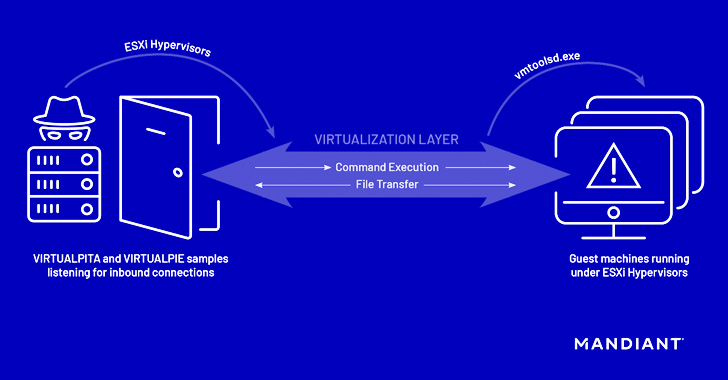
While VIRTUALPITA comes with capabilities to execute commands as
well as carry out file upload and download, VIRTUALPIE is a Python
backdoor with support for command line execution, file transfer,
and reverse shell features.
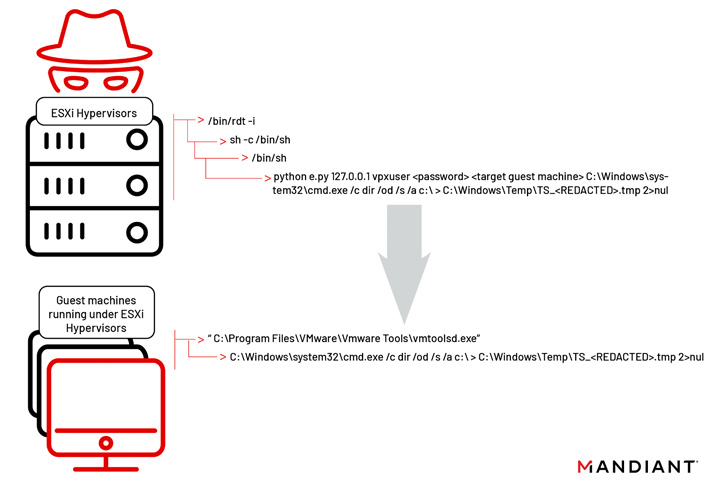
Also uncovered is a malware sample called VIRTUALGATE in Windows
guest virtual machines, which is a C-based utility program that
executes an embedded payload capable of using VMware’s virtual
machine communication interface (VMCI[7]) sockets to run commands
on a guest virtual machine from a hypervisor host.
Mandiant also warned that the campaign’s techniques to get
around traditional security controls by exploiting virtualization
software represent a new attack surface that’s likely to be picked
up by other hacker groups.
The attacks have been attributed to an uncategorized, emerging
threat cluster codenamed UNC3886, whose motivation is likely to be
espionage-driven considering the highly targeted nature of the
intrusions. It further assessed with low confidence that UNC3886
has a China-nexus.
References
Read more https://thehackernews.com/2022/09/new-malware-families-found-targeting.html