Cybersecurity researchers have taken the wraps off a previously
undocumented and stealthy custom malware called SockDetour
that targeted U.S.-based defense contractors with the goal of being
used as a secondary implant on compromised Windows hosts.
“SockDetour is a backdoor that is designed to remain stealthily
on compromised Windows servers so that it can serve as a backup
backdoor in case the primary one fails,” Palo Alto Networks’ Unit
41 threat intelligence said[1]
in a report published Thursday. “It is difficult to detect, since
it operates filelessly and socketlessly on compromised Windows
servers.”
Even more concerningly, SockDetour is believed to have been used
in attacks since at least July 2019, based on a compilation
timestamp on the sample, implying that the backdoor successfully
managed to slip past detection for over two-and-a-half years.
The attacks have been attributed to a threat cluster it tracks
as TiltedTemple[2]
(aka DEV-0322 by Microsoft), which is designated moniker for a
hacking group operating out of China and was instrumental in
exploiting zero-day[3]
flaws[4]
in Zoho ManageEngine ADSelfService Plus and ServiceDesk Plus
deployments as a launchpad for malware attacks last year.
The ties to TiltedTemple come from overlaps in the attack
infrastructure, with one of the command-and-control (C2) servers
that was used to facilitate the distribution of malware for the
late 2021 campaigns also hosting the SockDetour backdoor, alongside
a memory dumping utility and number of web shells for remote
access.
Unit 42 said it unearthed evidence of at least four defense
contractors targeted by the new wave of attacks, resulting in the
compromise of one of them.
The intrusions also predate the attacks that occurred through
compromised Zoho ManageEngine servers in August 2021 by a month.
Analysis of the campaign has revealed that SockDetour was delivered
from an external FTP server to a U.S.-based defense contractor’s
internet-facing Windows server on July 27, 2021.
“The FTP server that hosted SockDetour was a compromised Quality
Network Appliance Provider (QNAP) small office and home office
(SOHO) network-attached storage (NAS) server,” the researchers
pointed out. “The NAS server is known to have multiple
vulnerabilities, including a remote code execution[5]
vulnerability, CVE-2021-28799[6].”
What’s more, the same server is said to have been already
infected with the QLocker ransomware, raising the possibility the
TiltedTemple actor leveraged the same flaw to gain unauthorized
initial access.
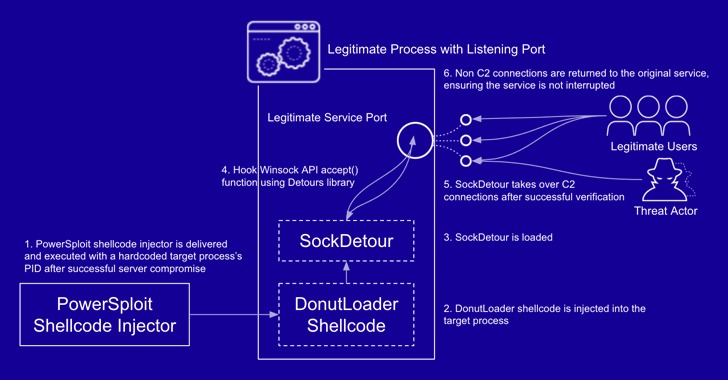
SockDetour, for its part, is fashioned as a stand-in backdoor
that hijacks legitimate processes network sockets to establish its
own encrypted C2 channel, followed by loading an unidentified
plugin DLL file retrieved from the server.
“Thus, SockDetour requires neither opening a listening port from
which to receive a connection nor calling out to an external
network to establish a remote C2 channel,” the researchers said.
“This makes the backdoor more difficult to detect from both host
and network level.”
References
- ^
said
(unit42.paloaltonetworks.com) - ^
TiltedTemple
(thehackernews.com) - ^
zero-day
(thehackernews.com) - ^
flaws
(thehackernews.com) - ^
remote
code execution
(unit42.paloaltonetworks.com) - ^
CVE-2021-28799
(thehackernews.com)
Read more https://thehackernews.com/2022/02/new-sockdetour-fileless-socketless.html