
Researchers have disclosed a novel technique by which malware on
iOS can achieve persistence on an infected device by faking its
shutdown process, making it impossible to physically determine if
an iPhone is off or otherwise.
The discovery — dubbed “NoReboot” — comes
courtesy of mobile security firm ZecOps, which found that it’s
possible to block and then simulate an iOS rebooting operation,
deceiving the user into believing that the phone has been powered
off when, in reality, it’s still running.
The San Francisco-headquartered company called[1]
it the “ultimate persistence bug […] that cannot be patched because
it’s not exploiting any persistence bugs at all — only playing
tricks with the human mind.”
NoReboot works by interfering with the routines used in iOS to
shutdown and restart the device, effectively preventing them from
ever happening in the first place and allowing a trojan to achieve
persistence without persistence as the device is never actually
turned off.
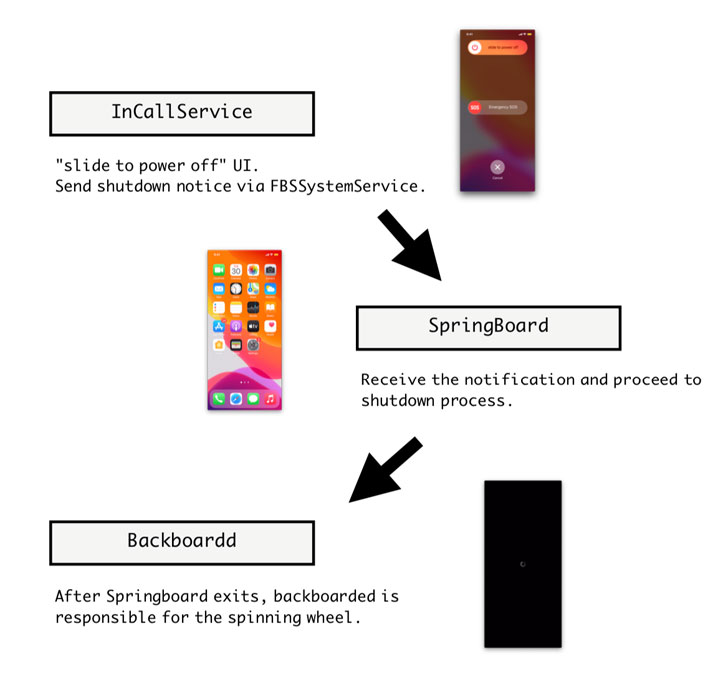
This is accomplished by injecting specially crafted code onto
three iOS daemons, namely the InCallService, SpringBoard[2], and Backboardd[3], to feign a shut down by
disabling all audio-visual cues associated with a powered-on
device, including the screen, sounds, vibration, the camera
indicator, and touch feedback.
Put differently, the idea is to give the impression that the
device has been shut down without really shutting it down by
hijacking the event that’s activated[4]
when the user simultaneously presses and holds the side button and
one of the volume buttons, and drags the “slide to power off”
slider.
“Despite that we disabled all physical feedback, the phone still
remains fully functional and is capable of maintaining an active
internet connection,” the researchers explained. “The malicious
actor could remotely manipulate the phone in a blatant way without
worrying about being caught because the user is tricked into
thinking that the phone is off, either being turned off by the
victim or by malicious actors using ‘low battery’ as an
excuse.”
The malware strain then forces the SpingBoard, which refers to
iOS’s graphical user interface, to exit (as opposed to the entire
OS), followed by commanding the BackBoardd, the daemon that handles
all touch and physical button click events, to display the Apple
logo effect should the user opt to turn the running phone back on,
while the malicious code continues to persist.
What’s more, this technique could be theoretically extended to
manipulate a force restart[5]
associated with an iPhone by deliberately causing the Apple logo to
appear a few seconds earlier when such an event is recorded via the
Backboardd, fooling the victim into releasing the side button
without genuinely triggering a force restart.
Although no malware to date has been detected or publicly
documented using a method resembling NoReboot, the findings
highlight that even the iOS restart process isn’t immune to being
hijacked once an adversary has gained access to a target device,
something that’s well within the reach of nation-state groups and
cyber mercenaries[6]
alike.
“Non-persistent threats achieved ‘persistency’ without
persistence exploits,” the researchers concluded. A
proof-of-concept (PoC) exploit demonstrating NoReboot can be
accessed via GitHub here[7].
References
- ^
called
(blog.zecops.com) - ^
SpringBoard
(www.theiphonewiki.com) - ^
Backboardd
(www.theiphonewiki.com) - ^
activated
(support.apple.com) - ^
force
restart (support.apple.com) - ^
cyber
mercenaries (thehackernews.com) - ^
here
(github.com)
Read more https://thehackernews.com/2022/01/new-trick-could-let-malware-fake-iphone.html