
By the end of 2021, there will be 12 billion connected IoT
devices, and by 2025, that number will rise to 27 billion[1].
All these devices will be connected to the internet and will
send useful data that will make industries, medicine, and cars more
intelligent and more efficient.
However, will all these devices be safe? It’s worth asking what
you can do to prevent (or at least reduce) becoming a victim of a
cybercrime such as data theft or other forms of cybercrime in the
future?
Will IoT security ever improve?
In recent years, the number of security vulnerabilities related
to the Internet of Things has increased significantly.
Let us start at the very beginning — most IoT devices come with
default and publicly disclosed passwords. Moreover, the fact is
that there are many cheap and low-capacity Internet of Things
devices that lack even the most basic security.
And that’s not all — security experts are discovering new
critical vulnerabilities every day. Numerous IoT devices undergoing
security audits repeatedly exhibit the same issues over and over
again: remote code execution vulnerabilities at the IP or even
radio level, unauthenticated or broken access control
mechanisms.
Weak hardware security is one of the issues that have been
discovered most frequently. By this complex term, we refer to all
the attack possibilities that hackers can exploit when they have an
IoT device in their hands: extracting security credentials stored
in clear in the device’s memory → Using this data to breach into
the servers where the device’s data is sent → sharing or selling
these credentials in the “dark web” to remotely attack other
devices of the same type, etc.
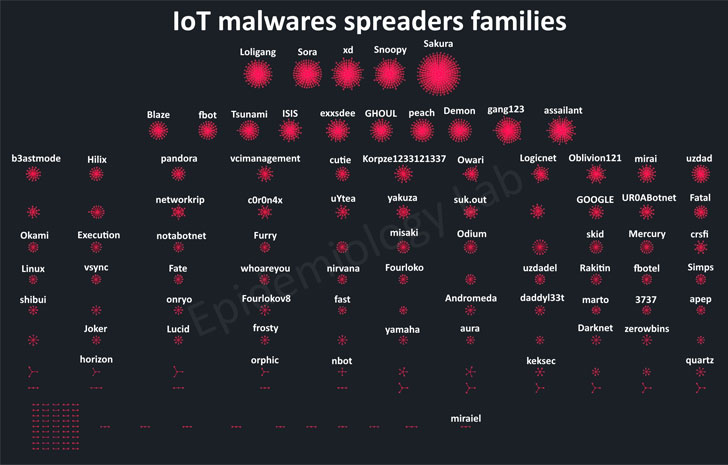
There is a real silent IoT battle going on, and tens of
thousands of IoT devices have already been compromised. In order to
give you an idea about the level of awareness that is on the rise,
the Epidemiology Lab of Orange Cyberdefense provides us with some
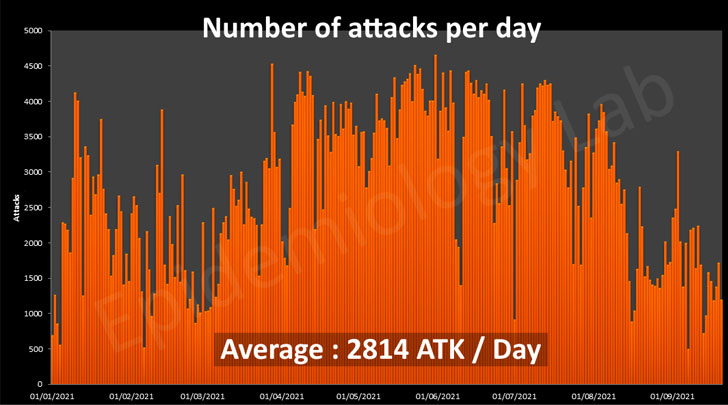
exciting and frightening figures: In 2019, for example, a
vulnerable IoT device could be infected in less than 3 minutes, and
in 2021, an IoT device is attacked on an average of 2814 times
every single day by more than 100 different botnets trying to
hijack it. Therefore, it is not surprising that five years after
Mirai, a new IoT botnet called Meris has emerged and was used for
massive DDoS
attacks against Yandex[2], a very large Russian
search engine website.
Light at the end of the tunnel
However, the situation may start to change in the near future.
Recently, Orange, the largest player in the European
telecommunications industry, launched an initiative called
“IoT SAFE[3]” in collaboration with
Thales, a major manufacturer of electronic devices. It has been
shown that collaboration between a network provider and an IoT
device manufacturer significantly improves the security of IoT
devices (and thus the security posture of their users).
IoT SAFE has been standardized by the GSMA[4] as a result of a broad
collaboration between device and chipset manufacturers, cloud
providers, and mobile network operators.
The key idea is to use a SIM card (or an embedded SIM) as an
applicative KeyStore where security keys are securely stored and
dynamically managed. There is no longer a need to hand over secrets
to an untrusted provider. There is also no need to add an expensive
and dedicated Secure Element. In addition, there is no requirement
for proprietary interfaces.
Thanks to IoT SAFE, a wide range of cryptographic services can
be covered directly by the SIM card.
You may ask: Why do we stick with a SIM or an embedded SIM to
secure an IoT device? It’s because SIM cards are very well
protected against physical attacks. They are also standardized and
can be considered reliable and well-developed chips. All IoT
devices that are connected to the cellular network are usually
equipped with SIM cards. With 5G for the industrial IoT just around
the corner, they will surely retain their popularity. They are also
inexpensive, as many mobile IoT devices are small and have cheap
sensors, so a specialized chip is probably not needed.
How does it work? An example.
Moreover, this new standard also brings the benefit of overall
simplicity to the table.
An example of this is “Zero Touch Provisioning.” In this use
case, the network operator remotely installs and configures an
instance of the IoT SAFE applet as soon as the IoT device is turned
on by the user. Then, the network operator instructs the applet to
create a new key pair consisting of a private key that is securely
stored on the SIM card and a public key that is sent back to the
server. The server generates a new client certificate and sends it
back to the applet. Finally, the IoT SAFE compatible device uses
this data to establish a secure connection to the cloud using a
mutually authenticated TLS session.
If it is suspected that the device has been compromised, the
credentials are deleted remotely over the mobile network.
There are also more complex use cases that can also be covered
by IoT SAFE, such as storing critical user data on SIM or
authenticating software before execution to prevent the execution
of unauthorized code by IoT malware.
To a bright and secure IoT world
Orange released the first open source[5]
implementation of the standard in October 2020, based on plain C
language. The implementation of this project was tested on two
constrained devices using applets from two different vendors. It
has been successfully integrated into two well-known public Clouds
– Azure and AWS – and into Orange’s own private Live Objects Cloud.
Thanks to the permissive license of this open source code, device
manufacturers will be able to implement an IoT SAFE compatible
device easily.
The IoT SAFE initiative has been presented at several
conferences, including Java Card Forum, Global Platform, and Mobile
IoT Summit. During the seminars, use cases for implementing IoT
SAFE were demonstrated and discussed in detail with the IoT
community. Thanks to these efforts, wolfSSL[6]
has added support for IoT SAFE to their well-known SSL/TLS
library.
Of course, IoT SAFE developments and prototypes were also
demonstrated at the Orange booth at this year’s Mobile World
Congress. It was obvious that the IoT industry showed great
interest after this demonstration. In addition to device
manufacturers, chip makers and even an airplane manufacturer, many
others were also excited about the potential of IoT SAFE.
One for all
It is undeniable that these connected devices do not provide
adequate security protection. In the era of ever-increasing unsafe
devices, there is no doubt that they pose a threat to us all.
Moreover, security threats are seen as a major hindrance to the
development of IoT markets. According to the Internet of Things
World and Omdia, 85% of 170 industry leaders surveyed believe
security concerns remain a major barrier to IoT adoption. Often,
potential customers are hesitant to purchase IoT objects because
they are concerned about them getting compromised.
Ultimately, only reliable and reasonably secure devices will
succeed in the market and lead to reasonable IoT business growth.
Therefore, the vendor community should actively contribute to IoT
security to boost the IoT market and increase business
opportunities.
If you want to learn more about what the hardworking Orange
Cyberdefense researchers have been investigating this year, you can
just hop over to the landing page of their recently published
Security Navigator[7].
References
- ^
27
billion (iot-analytics.com) - ^
DDoS attacks against Yandex
(thehackernews.com) - ^
IoT
SAFE (hellofuture.orange.com) - ^
GSMA
(www.gsma.com) - ^
open
source (opensource.orange.com) - ^
wolfSSL
(www.wolfssl.com) - ^
Security
Navigator (orangecyberdefense.com)
Read more https://thehackernews.com/2021/12/iot-safe-innovative-way-to-secure-iot.html