
Amidst the massive supply-chain ransomware attack[1] that triggered an
infection chain compromising thousands of businesses on Friday, new
details have emerged about how the notorious Russia-linked REvil
cybercrime gang may have pulled off the unprecedented hack.
The Dutch Institute for Vulnerability Disclosure (DIVD) on
Sunday revealed[2]
it had alerted Kaseya to a number of zero-day vulnerabilities in
its VSA software (CVE-2021-30116) that it said were being exploited
as a conduit to deploy ransomware. The non-profit entity said the
company was in the process of resolving the issues as part of a
coordinated vulnerability disclosure when the July 2 attacks took
place.
More specifics about the flaws were not shared, but DIVD chair
Victor Gevers hinted[3]
that the zero-days are trivial to exploit. At least 1,000
businesses are said to have been affected by the attacks, with
victims identified in at least 17 countries, including the U.K.,
South Africa, Canada, Argentina, Mexico, Indonesia, New Zealand,
and Kenya, according to ESET.
Kaseya VSA[4]
is a cloud-based IT management and remote monitoring solution for
managed service providers (MSPs), offering a centralized console to
monitor and manage endpoints, automate IT processes, deploy
security patches, and control access via two-factor
authentication.
REvil Demands $70 Million Ransom
Active since April 2019, REvil[5] (aka Sodinokibi) is best
known for extorting $11 million[6]
from the meat-processor JBS early last month, with the
ransomware-as-a-service business accounting for about 4.6% of
attacks on the public and private sectors in the first quarter of
2021.

The group is now asking for a $70 million ransom payment to
publish a universal decryptor that can unlock all systems that have
been crippled by file-encrypting ransomware.
“On Friday (02.07.2021) we launched an attack on MSP providers.
More than a million systems were infected. If anyone wants to
negotiate about universal decryptor – our price is 70,000,000$ in
BTC and we will publish publicly decryptor that decrypts files of
all victims, so everyone will be able to recover from attack in
less than an hour,” the REvil group posted on their dark web data
leak site.
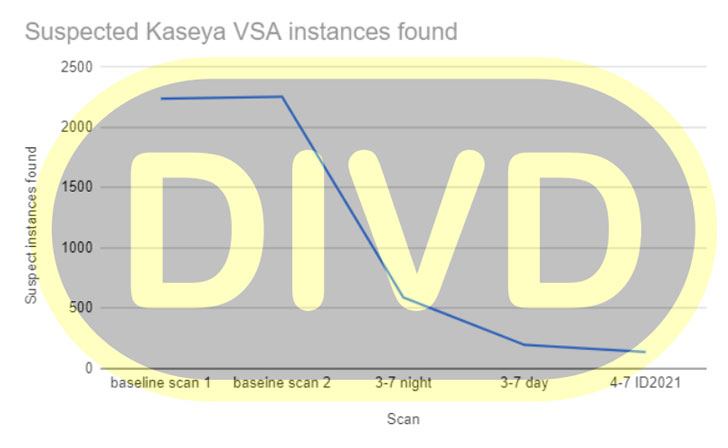
Kaseya, which has enlisted the help of FireEye to help with its
investigation into the incident, said[7]
it intends to “bring our SaaS data centers back online on a
one-by-one basis starting with our E.U., U.K., and Asia-Pacific
data centers followed by our North American data centers.”
On-premises VSA servers will require the installation of a patch
prior to a restart, the company noted, adding it’s in the process
of readying the fix for release on July 5.
CISA Issues Advisory
The development has prompted the U.S. Cybersecurity and
Infrastructure Security Agency (CISA) to issue an advisory[8], urging customers to
download the Compromise Detection Tool[9] that Kaseya has made
available to identify any indicators of compromise (IoC), enable
multi-factor authentication, limit communication with remote
monitoring and management (RMM) capabilities to known IP address
pairs, and Place administrative interfaces of RMM behind a virtual
private network (VPN) or a firewall on a dedicated administrative
network.
“Less than ten organizations [across our customer base] appear
to have been affected, and the impact appears to have been
restricted to systems running the Kaseya software,” said Barry
Hensley, Chief Threat Intelligence Officer at Secureworks, told The
Hacker News via email.
“We have not seen evidence of the threat actors attempting to
move laterally or propagate the ransomware through compromised
networks. That means that organizations with wide Kaseya VSA
deployments are likely to be significantly more affected than those
that only run it on one or two servers.”
By compromising a software supplier to target MSPs, who, in
turn, provide infrastructure or device-centric maintenance and
support to other small and medium businesses, the development once
again underscores the importance of securing the software supply
chain, while also highlighting how hostile agents continue to
advance their financial motives by combining the twin threats of
supply chain attacks and ransomware to strike hundreds of victims
at once.
“MSPs are high-value targets — they have large attack surfaces,
making them juicy targets to cybercriminals,” said Kevin Reed, the
chief information security officer at Acronis. “One MSP can manage
IT for dozens to a hundred companies: instead of compromising 100
different companies, the criminals only need to hack one MSP to get
access to them all.”
References
- ^
supply-chain ransomware attack
(thehackernews.com) - ^
revealed
(csirt.divd.nl) - ^
hinted
(twitter.com) - ^
Kaseya
VSA (www.kaseya.com) - ^
REvil
(attack.mitre.org) - ^
extorting $11 million
(thehackernews.com) - ^
said
(helpdesk.kaseya.com) - ^
issue an
advisory (us-cert.cisa.gov) - ^
Compromise Detection Tool
(kaseya.app.box.com)