
Enterprise cloud security firm Qualys has become the
latest victim to join a long list of entities to have suffered a
data breach after zero-day vulnerabilities in its Accellion File
Transfer Appliance (FTA) server were exploited to steal sensitive
business documents.
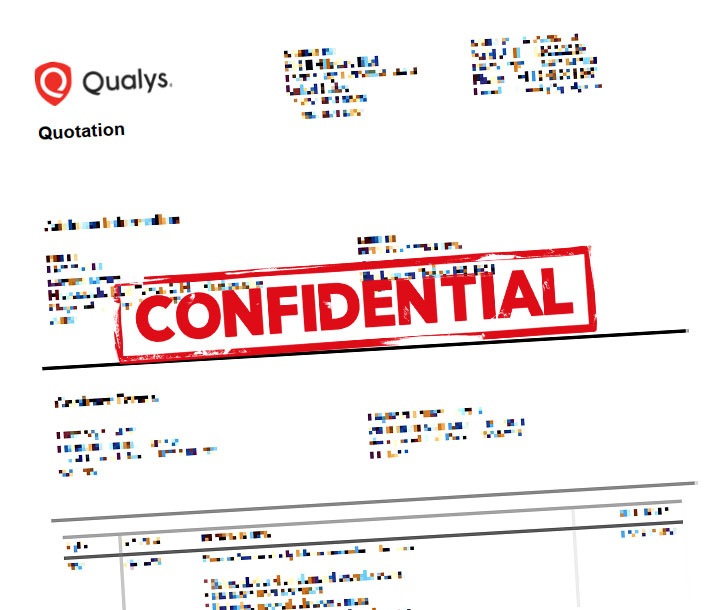
As proof of access to the data, the cybercriminals behind the
recent hacks targeting Accellion FTA servers have shared
screenshots of files belonging to the company’s customers on a
publicly accessible data leak website operated by the CLOP
ransomware gang.
Confirming the incident, Qualys Chief Information Security
Officer Ben Carr said[1]
a detailed probe “identified unauthorized access to files hosted on
the Accellion FTA server” located in a DMZ (aka demilitarized zone[2]) environment that’s
segregated from the rest of the internal network.
“Based on this investigation, we immediately notified the
limited number of customers impacted by this unauthorized access,”
Carr added. “The investigation confirmed that the unauthorized
access was limited to the FTA server and did not impact any
services provided or access to customer data hosted by the Qualys
Cloud Platform.”
Last month, FireEye’s Mandiant threat intelligence team disclosed[3]
details of four zero-day flaws in the FTA application that were
exploited by threat actors to mount a wide-ranging data theft and
extortion campaign, which involved deploying a web shell called
DEWMODE on target networks to exfiltrate sensitive data, followed
by sending extortion emails to threaten victims into paying bitcoin
ransoms, failing which the stolen data was posted on the data leak
site.
While two of the flaws (CVE-2021-27101 and CVE-2021-27104) were
addressed[4]
by Accellion on December 20, 2020, the other two vulnerabilities
(CVE-2021-27102 and CVE-2021-27103) were identified and fixed
earlier this year on January 25.
Qualys didn’t say if it received extortion messages in the wake
of the breach, but said an investigation into the incident is
ongoing.
“The exploited vulnerabilities were of critical severity because
they were subject to exploitation via unauthenticated remote code
execution,” Mandiant said[5]
in a security assessment of the FTA software published earlier this
week.
Additionally, Mandiant’s source code analysis uncovered two more
previously unknown security flaws in the FTA software, both of
which have been rectified in an FTA patch (version 9.12.444)
released on March 1 —
- CVE-2021-27730: An argument injection
vulnerability (CVSS score 6.6) accessible only to authenticated
users with administrative privileges, and - CVE-2021-27731: A stored cross-site scripting
flaw (CVSS score 8.1) accessible only to regular authenticated
users
The FireEye-owned subsidiary is tracking the exploitation
activity and the follow-on extortion scheme under two separate
threat clusters it calls UNC2546 and UNC2582, respectively, with
overlaps identified between the two groups and previous attacks
carried out by a financially motivated threat actor dubbed FIN11.
But it is still unclear what connection, if any, the two clusters
may have with the operators of Clop ransomware.