Cybersecurity researchers today disclosed an unpatched
vulnerability in Microsoft Azure Functions that could be used by an
attacker to escalate privileges and escape the Docker container
used for hosting them.
The findings come as part of Intezer Lab[1]‘s investigations into
the Azure compute infrastructure.
Following disclosure to Microsoft, the Windows maker is said to
have “determined that the vulnerability has no security impact on
Function users, since the host itself is still protected by another
defense boundary against the elevated position we reached in the
container host.”
Azure Functions[2], analogous to Amazon AWS
Lambda, is a serverless solution that allows users to run
event-triggered code without having to provision or manage
infrastructure explicitly while simultaneously making it possible
to scale and allocate compute and resources based on demand.
By incorporating Docker into the mix, it makes it possible for
developers to easily deploy and run Azure Functions either in the
cloud or on-premises.
Since the trigger code is an event (e.g., an HTTP request) that
is configured to call an Azure Function, the researchers first
created an HTTP trigger[3]
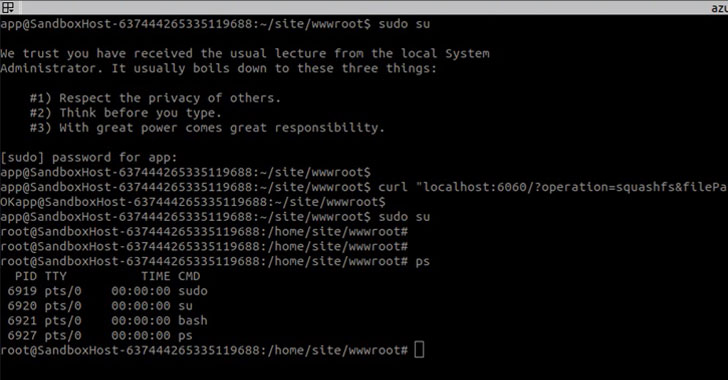
to gain a foothold over the Function container, using it to find
sockets belonging to processes with “root” privileges.
From there, one such privileged process associated with a “Mesh”
binary was identified to contain a flaw that could be exploited to
grant the “app” user that runs the above Function root
permissions.
While the Mesh binary in itself had little to no documentation
to explain its purpose, Intezer researchers found references to it
in a public Docker image[4], which they used to
reverse engineer and achieve privilege escalation.
In the final step, the extended privileges assigned to the
container (using the “–privileged[5]” flag) were abused to
escape the Docker container[6] and run an arbitrary
command on the host.
Intezer has also released[7]
a proof-of-concept (PoC) exploit code on GitHub to probe the Docker
host environment.
“Instances like this underscore that vulnerabilities are
sometimes out of the cloud user’s control,” Intezer Labs
researchers said. “Attackers can find a way inside through
vulnerable third-party software.
“It’s critical that you have protection measures in place to
detect and terminate when the attacker executes unauthorized code
in your production environment. This Zero Trust mentality[8]
is even echoed by Microsoft.”
References
- ^
Intezer
Lab (www.intezer.com) - ^
Azure
Functions (docs.microsoft.com) - ^
HTTP
trigger (docs.microsoft.com) - ^
public
Docker image (hub.docker.com) - ^
–privileged
(docs.docker.com) - ^
escape
the Docker container (blog.trailofbits.com) - ^
released
(github.com) - ^
Zero
Trust mentality (thehackernews.com)