
deploy software applications, malicious actors are taking advantage
of the opportunity to target exposed API endpoints and craft
malware-infested images to facilitate distributed denial-of-service
(DDoS) attacks and mine cryptocurrencies.
According to a report published by Palo Alto Networks’ Unit 42
threat intelligence team, the purpose of these Docker images is to
generate funds by deploying a cryptocurrency miner using Docker
containers and leveraging the Docker Hub repository to distribute
these images.
“Docker containers provide a convenient way for packaging
software, which is evident by its increasing adoption rate,” Unit
42 researchers
said[1]. “This, combined with
coin mining, makes it easy for a malicious actor to distribute
their images to any machine that supports Docker and instantly
starts using its compute resources towards cryptojacking.”
Docker is a well-known platform-as-a-service (PaaS) solution for
Linux and Windows that allows developers to deploy, test, and
package their applications in a contained virtual environment — in
a way that isolates the service from the host system they run
on.
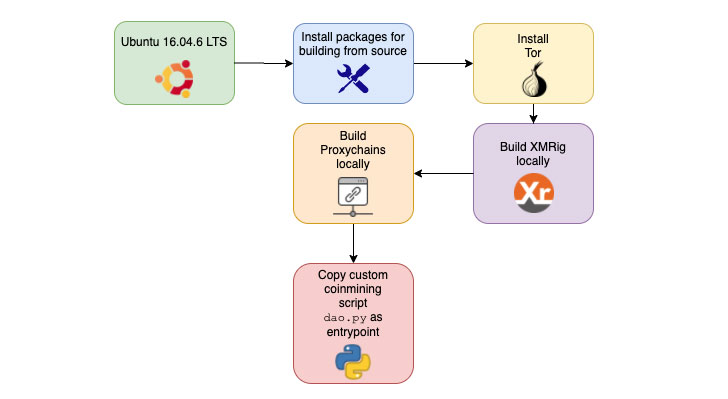
The now taken down Docker Hub account, named “azurenql,” consisted
of eight repositories hosting six malicious images capable of
mining Monero, a privacy-focused cryptocurrency.
The malware author behind the images used a Python script to
trigger the cryptojacking operation and took advantage of network
anonymizing tools such as ProxyChains and Tor to evade network
detection.
The coin mining code within the image then exploited the
processing power of the infected systems to mine the blocks.
over two million times since the start of the campaign in October
2019, with one of the wallet IDs used to earn more than 525.38 XMR
($36,000).
Exposed Docker Servers Targeted With DDoS Malware
That’s not all. In a new mass-scanning operation spotted by Trend Micro
researchers, unprotected Docker servers are being targeted with
at least two different kinds of malware — XOR DDoS and Kaiji — to
collect system information and carry out DDoS attacks.
“Attackers usually used botnets to perform brute-force attacks
after scanning for open Secure Shell (SSH) and Telnet ports,” the
researchers said. “Now, they are also searching for Docker servers
with exposed
ports[3] (2375).”
It’s worth noting that both XOR DDoS and Kaiji are Linux trojans
known for their ability to conduct DDoS attacks, with the latter
written entirely
from scratch[4] using Go programming
language to target IoT devices via SSH brute-forcing.
The XOR DDoS malware strain works by searching for hosts with
exposed Docker API ports, followed by sending a command to list all
the containers hosted on the target server, and subsequently
compromising them with the XORDDoS malware.
Likewise, the Kaiji malware scans the internet for hosts with
exposed port 2375 to deploy a rogue ARM container (“linux_arm”)
that executes the Kaiji binary.
“While the XOR DDoS attack infiltrated the Docker server to
infect all the containers hosted on it, the Kaiji attack deploys
its own container that will house its DDoS malware,” the
researchers said, noting the difference between the two malware
variants.
In addition, both the two pieces of malware gather details such
as domain names, network speeds, process identifiers of running
processes, and CPU and network information that are needed to mount
a DDoS attack.
“Threat actors behind malware variants constantly upgrade their
creations with new capabilities so that they can deploy their
attacks against other entry points,” the researchers concluded.
“As they are relatively convenient to deploy in the cloud,
Docker servers are becoming an increasingly popular option for
companies. However, these also make them an attractive target for
cybercriminals who are on the constant lookout for systems that
they can exploit.”
It’s advised that users and organizations who run Docker
instances immediately check if they expose API endpoints on the
Internet, close the ports, and adhere to recommended best
practices[5].
References
- ^
researchers said
(unit42.paloaltonetworks.com) - ^
Trend Micro researchers
(blog.trendmicro.com) - ^
exposed ports
(docs.docker.com) - ^
written entirely from scratch
(intezer.com) - ^
recommended best practices
(docs.docker.com)
Read more http://feedproxy.google.com/~r/TheHackersNews/~3/Hxwxfq3o9s4/cryptocurrency-docker-image.html