
version of ComRAT backdoor, one of the earliest known backdoors
used by the Turla APT group, that leverages Gmail’s web interface
to covertly receive commands and exfiltrate sensitive data.
“ComRAT v4 was first seen in 2017 and known still to be in use
as recently as January 2020,” cybersecurity firm ESET said in a
report[1] shared with The Hacker
News. “We identified at least three targets: two Ministries of
Foreign Affairs in Eastern Europe and a national parliament in the
Caucasus region.”
Turla[2], also known as Snake,
has been active for over a decade with a long history of the
watering hole and spear-phishing campaigns against embassies and
military organizations at least since 2004.
The group’s espionage platform started off as Agent.BTZ, in 2007,
before it evolved to ComRAT, in addition to
gaining additional capabilities to achieve persistence and to steal
data from a local network.
[3][4]
It is now known that earlier versions of Agent.BTZ were responsible
for infecting US
military networks in the Middle East in 2008. In recent years,
Turla is said to have been behind the compromise of French
Armed Forces in 2018 and the Austrian Foreign
Ministry early this year.
USB-stick infection mechanism in favor of injecting itself into
every process
of the infected machine and executing its primary payload in
“explorer.exe.”
What’s New in ComRAT v4?
The ComRAT v4 (or “Chinch” by the malware authors), as the new
successor is called, uses an entirely new code base and is far more
complex than its earlier variants, according to ESET. The firm said
the first known sample of the malware was detected in April 2017.
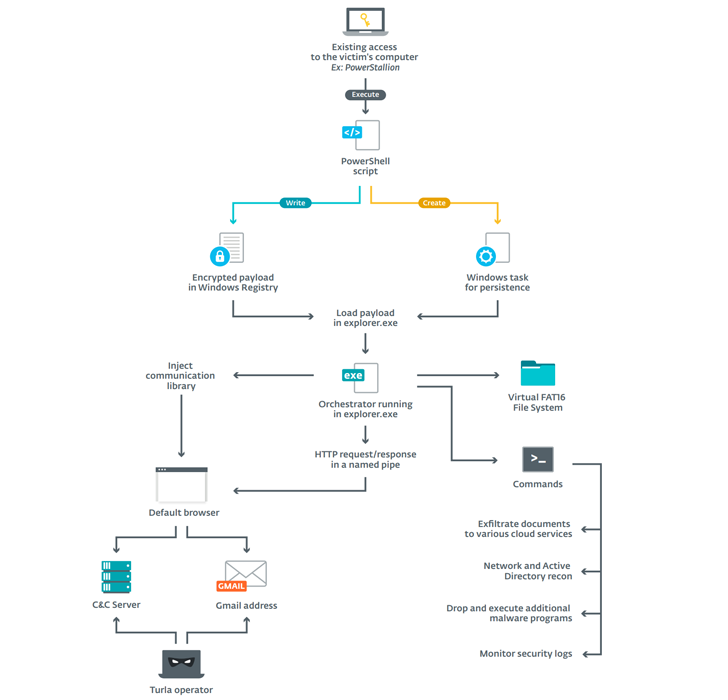
ComRAT is typically installed via PowerStallion[9], a lightweight
PowerShell backdoor used by Turla to install other backdoors. In
addition, the PowerShell loader injects a module called ComRAT
orchestrator into the web browser, which employs two different
channels — a legacy and an email mode — to receive commands from a
C2 server and exfiltrate information to the operators.
“The main use of ComRAT is discovering, stealing, and
exfiltrating confidential documents,” the researchers said. “In one
case, its operators even deployed a .NET executable to interact
with the victim’s central MS SQL Server database containing the
organization’s documents.”
the orchestrator DLL and the scheduled task for persistence, are
stored in a virtual file
system (VFS).
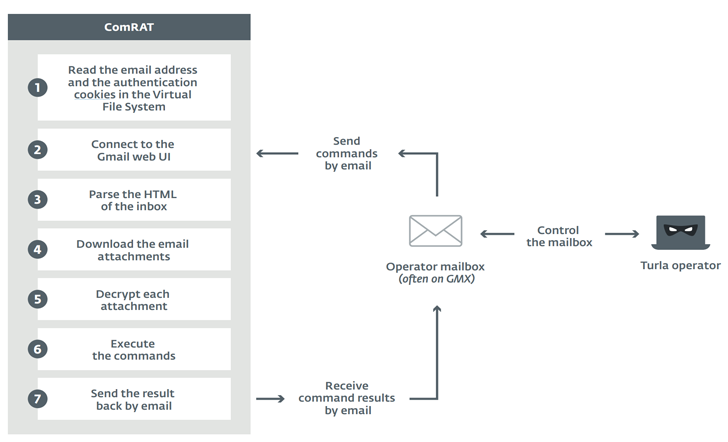
The “mail” mode works by reading the email address and the
authentication cookies located in the VFS, connecting to the basic
HTML view of Gmail, and parsing the inbox HTML page (using Gumbo HTML parser)
to get the list of emails with subject lines that match those in a
“subject.str” file in the VFS.
[11]
For each email that meets the above criteria, the comRAT proceeds
by downloading the attachments (e.g. “document.docx,”
“documents.xlsx”), and deleting the emails to avoid processing them
a second time.
Despite the “.docx” and “.xlsx” format in the filenames, the
attachments are not documents themselves, but rather encrypted
blobs of data that include a specific command to be executed:
read/write files, execute additional processes, and gather
logs.
In the final stage, the results of the command execution are
encrypted and stored in an attachment (with the double extension
“.jpg.bfe”), which is then sent as an email to a target address
specified in the “answer_addr.str” VFS file.
The exfiltrated data comprises user details and security-related
log files to check if their malware samples were detected during a
scan of the infected systems.
Based on the Gmail email distribution patterns over a one-month
period, ESET said the operators behind the campaign are working in
the UTC+3 or UTC+4 time zones.
“Version four of ComRAT is a totally revamped malware family
released in 2017,” ESET researcher Matthieu Faou said. “Its most
interesting features are the Virtual File System in FAT16 format
and the ability to use the Gmail web UI to receive commands and
exfiltrate data. Thus, it is able to bypass some security controls
because it doesn’t rely on any malicious domain.”
References
- ^
report
(www.welivesecurity.com) - ^
Turla
(attack.mitre.org) - ^
Agent.BTZ
(attack.mitre.org) - ^
ComRAT
(attack.mitre.org) - ^
US military networks
(securelist.com) - ^
French Armed Forces
(www.welivesecurity.com) - ^
Austrian Foreign Ministry
(www.theregister.co.uk) - ^
every process
(www.gdatasoftware.com) - ^
PowerStallion
(www.welivesecurity.com) - ^
virtual file system
(en.wikipedia.org) - ^
Gumbo HTML parser
(github.com)
Read more http://feedproxy.google.com/~r/TheHackersNews/~3/3q-UVnrYyXo/gmail-malware-hacker.html