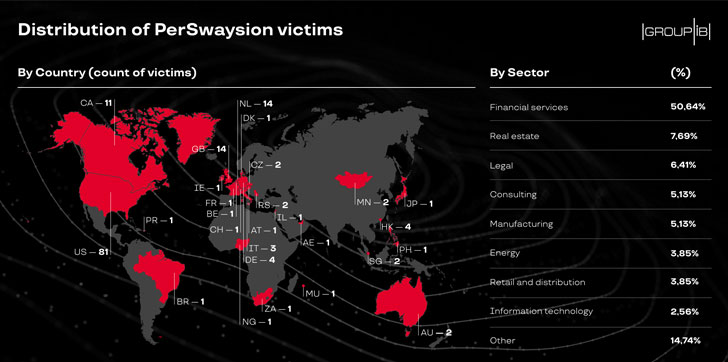
successfully compromised corporate email accounts of at least 156
high-ranking officers at various firms based in Germany, the UK,
Netherlands, Hong Kong, and Singapore.
Dubbed ‘PerSwaysion,’ the newly spotted cyberattack
campaign leveraged Microsoft file-sharing services—including Sway,
SharePoint, and OneNote—to launch highly targeted phishing
attacks.
According to a report Group-IB Threat Intelligence team
published today and shared with The Hacker News, PerSwaysion
operations attacked executives of more than 150 companies around
the world, primarily with businesses in finance, law, and real
estate sectors.
[1]
“Among these high-ranking officer victims, more than 20 Office365
accounts of executives, presidents, and managing directors
appeared.”
So far successful and still ongoing, most PerSwaysion operations
were orchestrated by scammers from Nigeria and South Africa who
used a Vue.js JavaScript framework based phishing kit, evidently,
developed by and rented from Vietnamese speaking hackers.
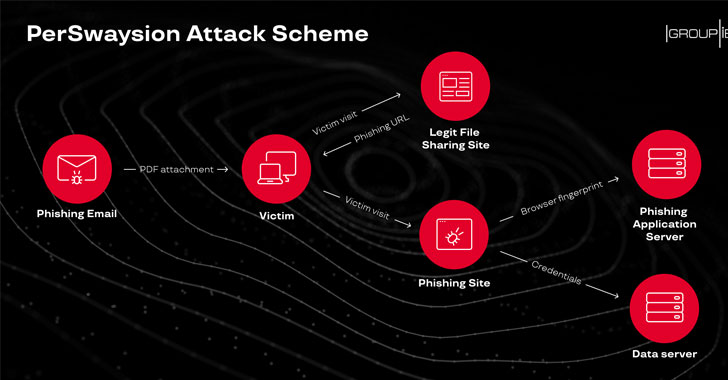
mature technology stacks, using Google appspot for phishing web
application servers and Cloudflare for data backend servers.”
Like most phishing attacks aiming to steal Microsoft Office 365
credentials, fraudulent emails sent as part of PerSwaysion
operation also lured victims with a non-malicious PDF attachment
containing ‘read now’ link to a file hosted with Microsoft
Sway.
“The attackers pick legitimate cloud-based content sharing
services, such as Microsoft Sway, Microsoft SharePoint, and OneNote
to avoid traffic detection,” the researchers said.
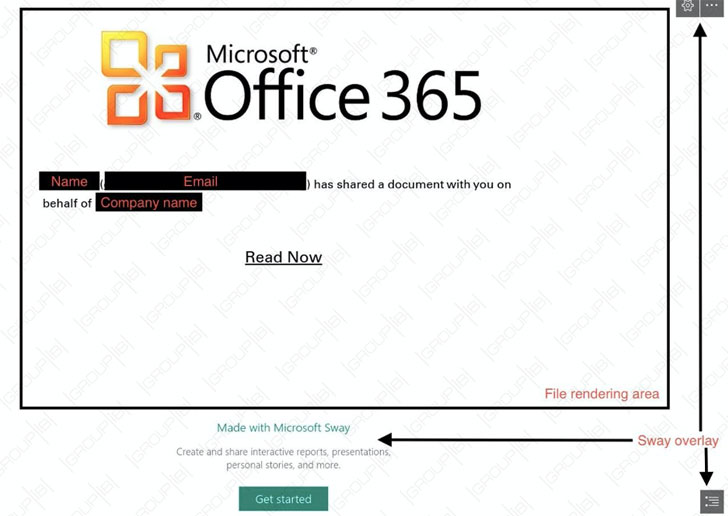
Next, the specially crafted presentation page on Microsoft Sway
service further contains another ‘read now’ link that redirects
users to the actual phishing site—waiting for the victims to enter
their email account credentials or other confidential information.
Once stolen, attackers immediately move on to the next step and
download victims’ email data from the server using IMAP APIs and
then impersonate their identities to further target people who have
recent email communications with the current victim and hold
important roles in the same or other companies.
victim’s full name, email address, legal company name. These PDF
files are sent to a selection of new people who tend to be outside
of the victim’s organization and hold significant positions. The
PerSwaysion operators typically delete impersonating emails from
the outbox to avoid suspicion.”
“Evidence indicates that scammers are likely to use LinkedIn
profiles to assess potential victim positions. Such a tactic
reduces the possibility of early warning from the current victim’s
co-workers and increases the success rate of new phishing
cycle.”
Though there’s no clear evidence on how attackers are using
compromised corporate data, researchers believe it can be ‘sold in
bulk to other financial scammers to conduct traditional monetary
scams.’
Group-IB also has set-up an online web-page where
anyone can check if their email address was compromised as part of
PerSwaysion attacks—however, you should only enter your email if
you’re highly expecting to be attacked.
[2]