
platforms such as Zoom explode in popularity in the wake of
coronavirus outbreak, cybercriminals are taking advantage of the
spike in usage by registering new fake “Zoom” domains and malicious
“Zoom” executable files in an attempt to trick people into
downloading malware on their devices.
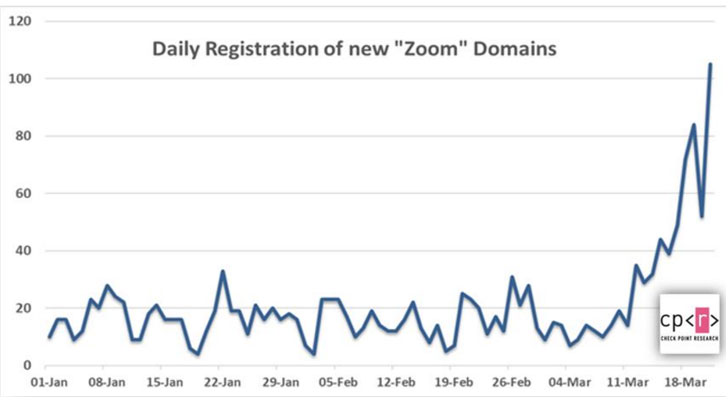
According to a report published by Check Point and shared with
The Hacker News, over 1,700 new “Zoom” domains have been registered
since the onset of the pandemic, with 25 percent of the domains
registered in the past seven days alone.
“We see a sharp rise in the number of ‘Zoom’ domains being
registered, especially in the last week,” said Omer Dembinsky,
Manager of Cyber Research at Check Point.
“The recent, staggering increase means that hackers have taken
notice of the work-from-home paradigm shift that COVID-19 has
forced, and they see it as an opportunity to deceive, lure, and
exploit. Each time you get a Zoom link or document messaged or
forwarded to you, I’d take an extra look to make sure it’s not a
trap.”
With over 74,000 customers and 13 million monthly active users,
Zoom is one of the most popular cloud-based enterprise
communication platforms that offers chat, video and audio
conferencing, and options to host webinars and virtual meetings
online.
The popularity of Zoom has shot up significantly in recent weeks
as millions of students, business people, and even government
employees across the world are forced to work and socialize from
home during coronavirus pandemic.
malicious
coronavirus-related domains, with bad actors finding new ways to profit
off the global health concern to stage a variety of malware
attacks, phishing campaigns, and create scam sites and
malicious tracker apps.
What’s more, the researchers said they detected malicious files
with the name “zoom-us-zoom_##########.exe,” which when executed,
installed potentially unwanted programs (PUPs) such as InstallCore[4], a dodgy bundleware
application that’s known to install other kinds of malware.
But Zoom is not the only app to be targeted by cybercriminals.
With schools turning to online learning platforms to keep students
occupied, Check Point researchers said they also discovered
phishing sites masquerading as the legitimate Google
Classroom[5] (e.g.,
googloclassroom\.com and googieclassroom\.com) website to trick
unwitting users into downloading malware.
Zoom Fixes Privacy Issue in Its iOS App
Zoom, for its part, has had its share of privacy and security
issues too. Last year, the video conferencing app fixed a
vulnerability that could let websites hijack users’ webcam and
“forcibly” join them to a Zoom call without their permission.
Then earlier this January, the company squashed another bug that
could have allowed attackers to guess
a meeting ID and join an unprotected meeting, potentially
exposing private audio, video, and documents shared throughout the
session. Following the disclosure, Zoom introduced default
passwords for each meeting that participants need to enter when
joining by manually entering the meeting ID.
And finally, just over the weekend, Zoom updated its iOS
app[8] after it was caught
sending device information and a unique advertiser
identifier[9] to Facebook using the
social network’s software development kit (SDKs) and concerns were
raised over its failure to disclose data sharing in its privacy
policy.
Highlighting some of the privacy risks associated with using
Zoom’s products, The Electronic
Frontier Foundation[10] (EFF) said hosts of
Zoom calls can see if participants have the Zoom video window
active or not to track if they are paying attention. Administrators
can also see the IP address, location data, and device information
of each participant.
To safeguard
yourself[11] from such threats, it’s
essential that the apps are kept up-to-date, and be on the lookout
for emails from unknown senders and lookalike domains that contain
spelling errors.
Besides this, also don’t open unknown attachments or click on
links in the emails, the cure for Corona will not arrive via email
and also ensure ordering goods from an authentic source only.
References
- ^
malicious coronavirus-related
domains (thehackernews.com) - ^
new ways to profit off
(thehackernews.com) - ^
malware attacks
(thehackernews.com) - ^
InstallCore
(blog.malwarebytes.com) - ^
Google Classroom
(edu.google.com) - ^
fixed a vulnerability
(thehackernews.com) - ^
attackers to guess a meeting ID
(thehackernews.com) - ^
updated its iOS app
(blog.zoom.us) - ^
advertiser identifier
(www.vice.com) - ^
Electronic Frontier Foundation
(www.eff.org) - ^
safeguard yourself
(blog.checkpoint.com)
Read more http://feedproxy.google.com/~r/TheHackersNews/~3/ALfrjONDEQE/zoom-video-coronavirus.html