today released proof-of-concept (PoC) exploit code for a new
zero-day vulnerability affecting Windows 10 operating system—that’s
his/her 5th publicly disclosed Windows zero-day exploit [1, 2, 3] in less than a year.
Published on GitHub, the new
Windows 10 zero-day vulnerability is a privilege escalation issue
that could allow a local attacker or malware to gain and run code
with administrative system privileges on the targeted machines,
eventually allowing the attacker to gain full control of the
machine.
[1]
The vulnerability resides in Task Scheduler, a utility that enables
Windows users to schedule the launch of programs or scripts at a
predefined time or after specified time intervals.
SandboxEscaper’s exploit code makes use of SchRpcRegisterTask, a
method in Task Scheduler to register tasks with the server, which
doesn’t properly check for permissions and can, therefore, be used
to set an arbitrary DACL (discretionary access control list)
permission.
“This will result in a call to the following RPC
“_SchRpcRegisterTask,” which is exposed by the task scheduler
service,” SandboxEscaper said.
malformed .job file to obtain SYSTEM privileges, eventually
allowing the attacker to gain full access to the targeted system.
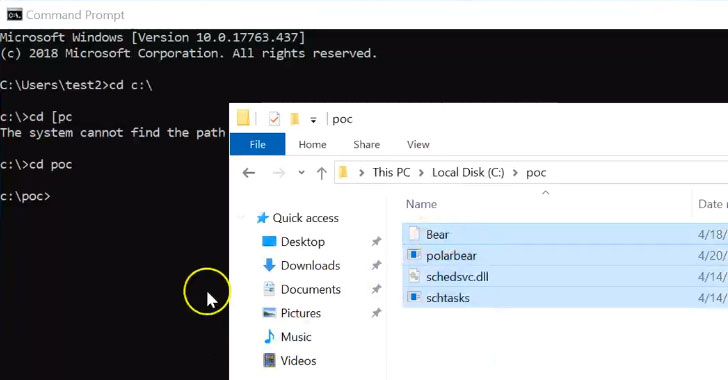
SandboxEscaper also shared a proof-of-concept video showing the new
Windows zero-day exploit in action.
The vulnerability has been tested and confirmed
to be successfully working on a fully patched and updated version
of Windows 10, 32-bit and 64-bit, as well as Windows Server 2016
and 2019.
More Windows Zero-Day Exploits to Come
Besides this, the hacker also teased that he/she still has 4 more
undisclosed zero-day bugs in Windows, three of which leads to local
privilege escalation and fourth one lets attackers bypass sandbox
security.
The details and exploit code for the new Windows zero-day came
just a week after Microsoft monthly patch updates, which means no
patch exists for this vulnerability at the current, allowing anyone
to exploit and abuse.
Windows 10 users need to wait for a security fix for this
vulnerability until Microsoft’s next month security updates—unless
the company comes up with an emergency update.
Read more http://feedproxy.google.com/~r/TheHackersNews/~3/S3_XI7mmIWg/windows-zero-day-vulnerability.html