
built specifically to run on mobile phones and smart IoT devices
that don’t have the specialized hardware to use current encryption
methods to encrypt locally stored data efficiently.
Encryption has already become an integral part of our everyday
digital activities.
However, it has long been known that encryption is expensive, as
it causes performance issues, especially for low-end devices that
don’t have hardware support for making the encryption and
decryption process faster.
Since data security concerns have recently become very
important, not using encryption is no more a wise tradeoff, and at
the same time, using a secure but slow device on which apps take
much longer to launch is also not a great idea.
Currently Android OS supports AES-128-CBC-ESSIV for full-disk
encryption and AES-256-XTS for file-based encryption, and Google
has already made it mandatory for device manufacturers to include
AES encryption on most devices shipped with Android 6.0 or later.
However, unfortunately, many low-end and other connected devices
today available in the market are exempted from using encryption
because of poor AES performance (50 MiB/s and below).
Adiantum: Fast Local Storage Encryption for Every Device
To solve this issue, Google has once again stepped forward, this
time with “Adiantum[1],” a new form of
efficient storage encryption that has been designed to protect
local data without slowing down devices that don’t support
hardware-accelerated cryptography.
“Adiantum allows us to use the ChaCha stream cipher in a
length-preserving mode, by adapting ideas from AES-based proposals
for length-preserving encryption such as HCTR and HCH,” Google
said.
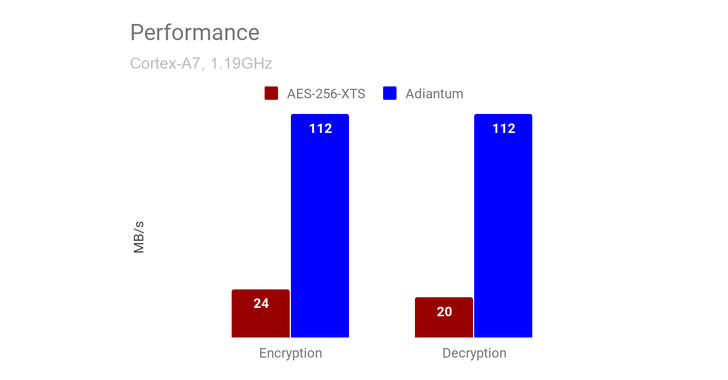
“On ARM Cortex-A7, Adiantum encryption and decryption on
4096-byte sectors is about 10.6 cycles per byte, around 5x faster
than AES-256-XTS.”
and much faster than Advanced Encryption Standard (AES) when
hardware acceleration is unavailable, as it exclusively relies on
operations that all CPUs natively support—additions, rotations, and
XORs.
According to Google, Adiantum has primarily been designed to become
the next widely accepted alternative that offers maximum security
along with sufficient performance on lower-end ARM processors.
“Our hope is that Adiantum will democratize encryption for all
devices,” Eugene Liderman, Director of Mobile Security Strategy at
Android Security and Privacy Team says. “Just like you would not
buy a phone without text messaging, there’ll be no excuse for
compromising security for the sake of device performance.”
generation of phones and smart devices more secure than their
predecessors by allowing everything—from smartwatches to
Internet-connected medical devices—to encrypt users’ sensitive data
without compromising on the performance.
For more technical details about Adiantum and how it works, you
can head on to the Google Security blog
post[3] and a white paper[4] (PDF and GitHub)
published by the company with more information.
References
Read more http://feedproxy.google.com/~r/TheHackersNews/~3/x2DBIW5NRVo/fast-adiantum-file-encryption.html