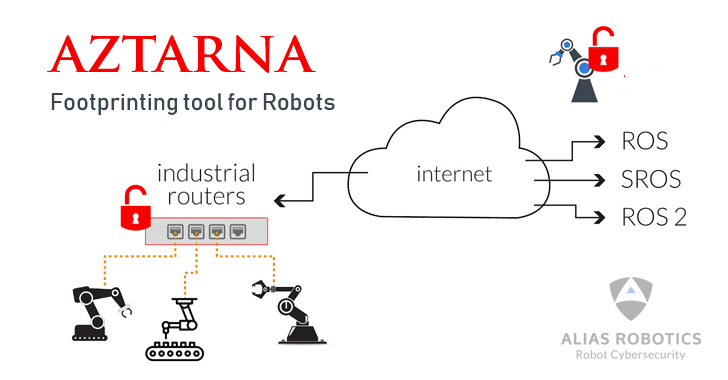
open-source tool for information security professionals to help
them easily ‘footprint’ and detect unprotected robots, not only
connected to the Internet, but also to the industrial environments
where they operate.
Dubbed “Aztarna[1],” the framework has
been developed by Alias
Robotics[2], a Spanish cybersecurity
firm focused on robots and is capable of detecting vulnerable
industrial routers and robots powered by ROS (Robot Operating
System), SROS (Secure ROS) and other robot technologies.
Written in Python 3, Aztarna is basically a port scanning tool
with a built-in database of fingerprints for industrial routers
(including Westermo, Moxa, Sierra Wireless, and eWON), and robotic
technologies and components, as well as patterns that power the
tool to test those devices against various known vulnerabilities
and security misconfigurations.
Researchers at Alias Robotics told The Hacker News that Aztarna has
been designed to work in different work modes based upon different
penetration testing scenarios. It can scan a list of given IP
addresses, a network IP range, results from Shodan search engine
and even the whole Internet in conjunction with other scanning
tools like ZMap or masscan.
“Motivated by the lack of dedicated tooling for security research
in the field of robotics, we have developed aztarna, a tool aimed
to help in the detection and scan of robots and robot technologies
(including software components) on a network,” the researchers
said. 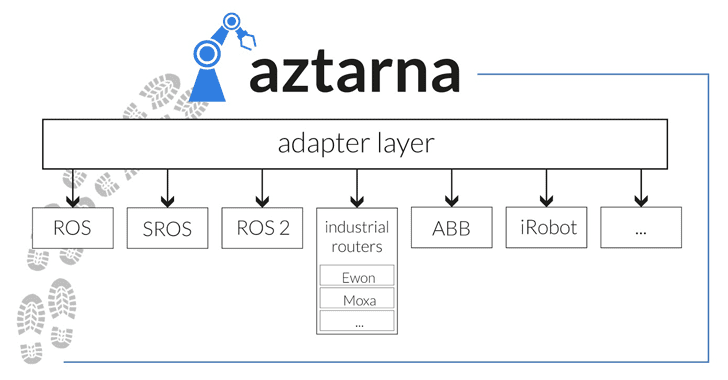
106 open ROS systems and 9,000 insecure industrial routers
worldwide, a potential entry point for attackers to target
vulnerable robots connected to the network, that can be accessed
remotely using default credentials or even without requiring any
authorization.
“Some the ROS instances found corresponded to empty systems or
simulations, but a considerable proportion of real robots were
identified. Including an array of research-oriented machines, but
also a series of robots in industrial environments,” the
researchers said.
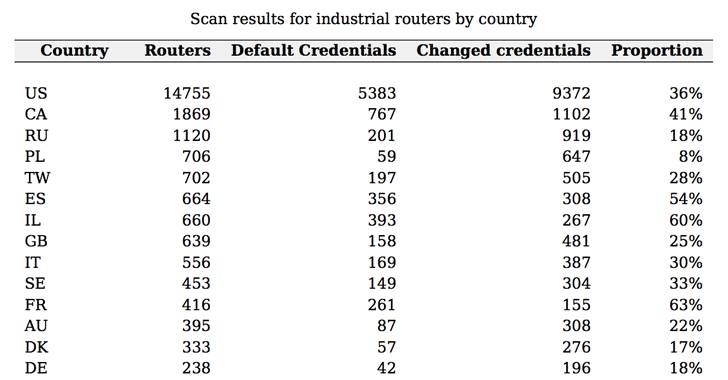
found located in European countries, with France and Spain leading
the ranking of misconfigured routers.
The highest amount of industrial routers were detected in North
American countries with poor security settings in the 36 percent of
the connected routers located in the United States and 41 percent
in Canada.
According to the researchers, the open-source framework can
easily be extended to receive more fingerprints and patterns with
future releases and to support new software or hardware robot
components, allowing researchers to determine the specific firmware
version in robots and discover “third-party libraries used and
their versions, e.g. robot middle-ware version, communication
infrastructure, etc.”
vulnerable robots, but argued that the release of Aztarna is “a
natural consequence of the general lack of concern among robot
manufacturers towards security and cybersecurity.”
“It’s not only that they are very slow patching their flaws when we
warn them. Many just don’t care and say: We know our robots have a
set of reported vulnerabilities, but we leave security up to the
end user,” the researchers wrote.
[PDF[3]] detailing Aztarna, how
it can be reproduced and how it allows for future extensions. You
can head on to the paper to know more about the open source
footprinting tool for robots.
Read more http://feedproxy.google.com/~r/TheHackersNews/~3/wIVmjeswnb0/robot-cybersecurity-tool.html