
At present, Python is one of the most advanced and demanding programming languages[1] that let anyone work
more quickly and efficiently and helps to integrate the system more
effectively. The language formulates on an object-oriented
approach, that helps programmers to write readable and logical code
for any scaled (large or small) projects. A developer’s caliber
will be evaluated by his/her programming skills, analytical
ability, problem-solving capability in the shortest possible time,
and his vast knowledge on the tools and language that he will be
using to do so. To assist you with your upcoming interview, we have
short-listed the top 50 Python Interview Questions and Answers.
Python Interview Questions and Answers
 With this
basic information on Python, let us move into the most popular
questions that you should expect to be asked during your
interview.
- Firstly, you will be assessed on your basic knowledge of
Python, which may include popular commands, key features, memory
management, etc. - Secondly, you will be judged on your knowledge of
object-oriented programming and Python libraries. - Finally, your problem-solving skills, using various algorithms
will be examined.
Here, we have outlined a few popular python interview questions
that will brush up your knowledge on Python, and get you ready for
the interview.
Q-1: What is Python?
The first entry in this list of Python interview questions is
one of the most basic ones. However, the majority of interviewers
never skip this basic question. Python is one of the most
progressive, elevated levels, broadly useful, powerful programming
dialects with objects, modules, strings, special cases, and
programmed memory management.
It is adaptable, simple to utilize, and quick to create.
Moreover, it has an open-source and vibrant community, and one can
get all the libraries that he/she can imagine. However, it has some
limitations with speed, few problems with threading, and the
harshest part that it is not native to a mobile environment.
Q-2: Explain Some Key Features of Python
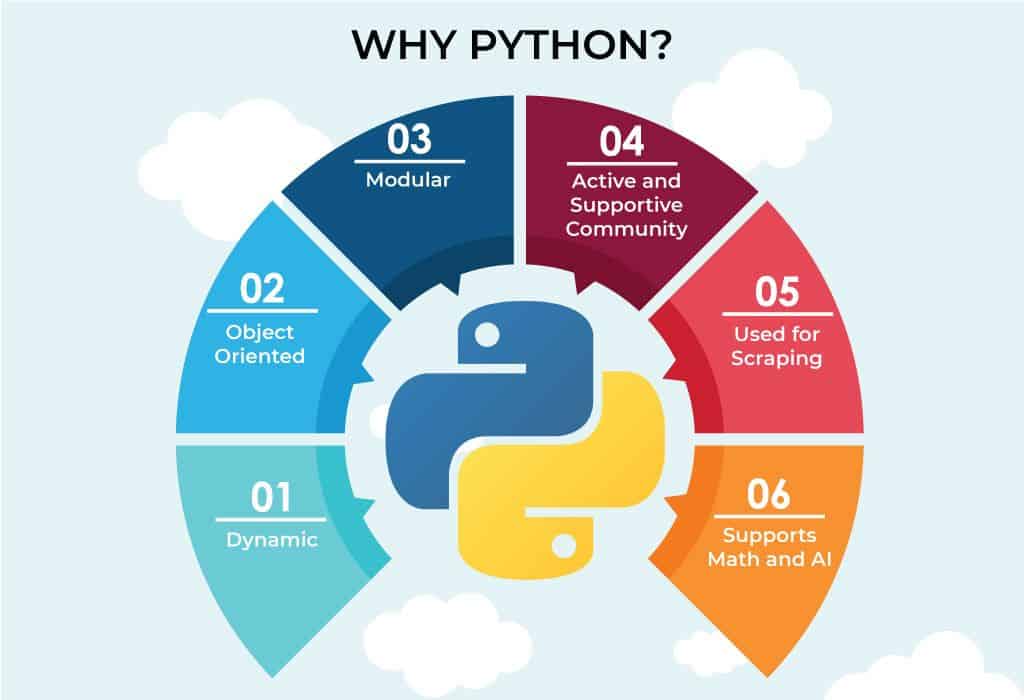
Countless programming languages are famous because of their
specialties, but what makes a programming language unique is its
key features. The key features that you should remember are as
follows:
- Easy to Read and Code: Python is very
easy to code due to its easy syntaxes; as a result, it takes a few
hours to acquire them. Moreover, code readability is very simple,
and one can simply see the code and understand the functionality of
the code. - Interpreted Language: Python is an interpreted
language like PHP and Ruby, which means it does not need to compile
before it runs. - Dynamically Typed: Python is dynamically
typed, which means while writing code, you don’t need to declare or
set a type to a variable while assigning a value or task to
it. - Large Standard
Library: One of the best features of Python
that saves a lot of time while writing code is its available
standard library as one does not have to write a code for every
single thing. - High Level: Python is a high-level
language; as a result, programmers can code without worrying about
the system architecture, nor they have to think about the memory,
which makes Python a programmer-friendly language. - Object-Oriented Programming: Python supports
both procedure-oriented and object-oriented programming. In OOP, it
permits the meaning of classes alongside synthesis and legacy and
doesn’t have any specifiers (open, private).In OOP, it allows the
meaning of classes alongside creation and legacy and doesn’t have
any specifiers (open, private).
Q-3: How is Memory Managed in Python?
Memory management in Python, for the most part, includes a
private pile space, where every one of the information structures
and articles is found. Python additionally has an inbuilt city
worker that will reuse the unused memory and make it accessible to
the load space.
Q-4: What is the PYTHONPATH environment
variable?
PYTHONPATH is an environment variable that has a string value,
which is added in Python’s system directory list as it has a set of
directories. PYTHONPATH is generally used when we have not made any
installable Python package, but we want to import some code that we
have written in a program.
Q-5: What is the Difference Between List and Tuple in
Python?

The most applicable response to this python programming
interview question would be that List and Tuple behave almost the
same way, and any item stored in a List or Tuple can be accessed by
its index. Still, two major differences between them are that List
is mutable, but Tuple is immutable, which means, List can be
modified, but Tuple cannot be modified. Besides, Lists are slower
than Tuples.
Q-6: How is Python an Interpreted
Language?
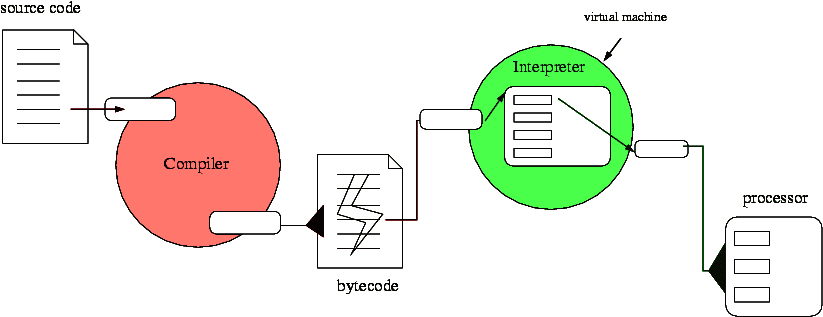
An interpreted language is a language that is read in its raw
form, and the statements are executed without being first compiled.
Python is an interpreted language as it runs directly from the
source code. The source code written by the programmer is first
converted into an intermediate language and then to a machine
language that has to be executed.
Q-7: What are the tools that help to
find Bugs or Perform Static Analysis?
Pychecker and Pylint are the static analysis tools that help to
find bugs in Python. Pychecker is an open-source device that gets
bugs from the source code and shows cautioning about the style and
unpredictability of the code.
Pylint has a special purpose, and it controls warning and
errors. It searches for programming blunder and keeps up the
programming standard. It checks the length of each programming line
and whether the names of the variable are like the undertaking
style.
Q-8: What is PEP 8?
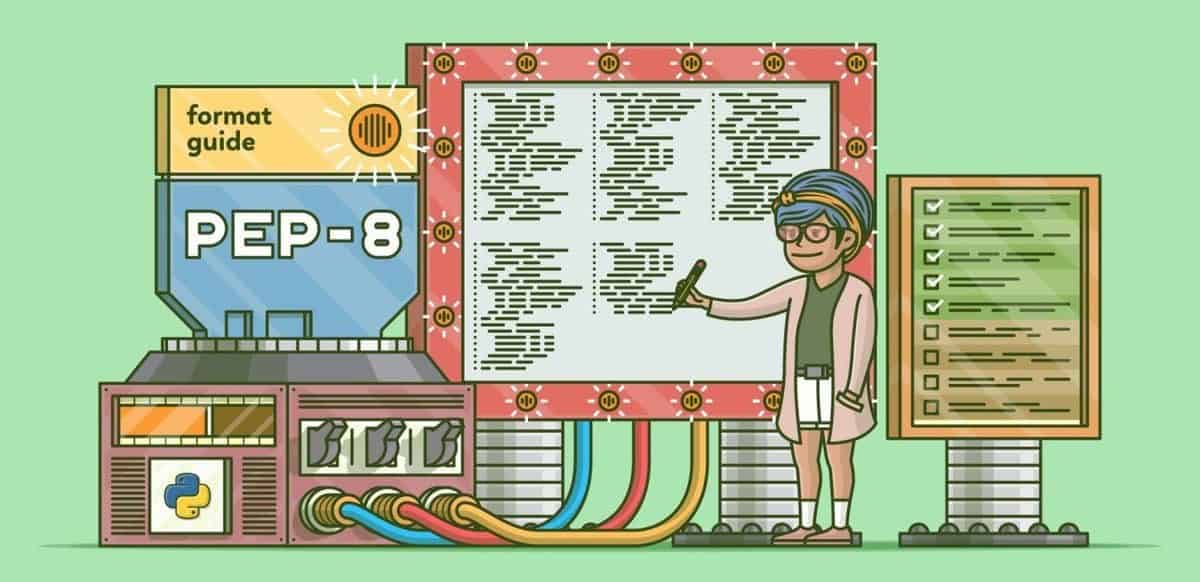
PEP represents the Python Enhancement Proposal. It is a set of
rules to allow maximum readability of Python code in terms of
formatting. The document describes new features for Python, which
includes design and style, suggested by the community.
Q-9: What is the Difference Between
remove() function and del statement?
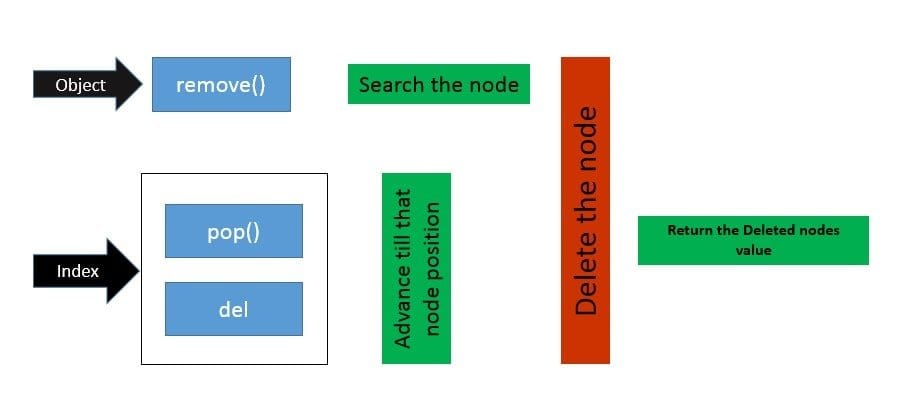
The remove() function deletes the matching element/object,
whereas del removes the element at a specific index. This is one of
the basic Python programming interview questions that interviewers
never want to miss out on.
Record is the main capacity that searches an article (not
record). If we need to erase a particular item in the rundown, we
can utilize the evacuate strategy. If we need to erase the article
at a particular area (a record) on the rundown, we can either
utilize del or pop.
Q-10: What is the shuffle() Method in
Python?
The shuffle() method, for the most part, takes a succession
(rundown, string, or tuple) from the program and rearranges the
request for the things. Be that as it may, this technique changes
just the first rundown/tuple/string, it doesn’t restore another
rundown/tuple/string. This is a significant python inquiry
question.
Syntax
random.shuffle(sequence, function)
Parameter Values
| Parameter | Description |
| sequence | It is Required. A grouping. It very well may be a rundown, a tuple, or a string. |
| function | It is Optional. The name of a function that returns a number between 0.0 and 1.0. If it is not specified, the function random()[2] will be used |
Q-11: Why do we Use join() Function in
Python?
This is another asked python programming interview question
among the important python interview questions. The join() work is
a string method that profits a string linked with the components of
an iterable. This technique gives an adaptable method to connect
string. It links every component of an iterable, (for example,
rundown, string, and tuple) to the string and afterward restores
the connection string.
The syntax of join() is:
string.join(iterable)
Join() Parameters: Join() method takes an
iterable – objects capable of returning its members one at a
time.
Return Value: This technique restores a string
connected with the components of iterable.
Q-12: What is lstrip() Function in
Python?
The lstrip() is the strategy that profits a duplicate of the
string with driving characters expelled (because of the string
contention passed). It is a common Python coding interview question
often asked. It expels characters from the left, dependent on the
contention (a string determining the arrangement of characters to
be evacuated).
The syntax of lstrip() is:
string.lstrip([chars])
lstrip() Parameters: chars
Return Value: lstrip() will return a copy of
the string with leading characters stripped. Every one of the mixes
of characters in the singes contention is expelled from the left of
the string until the primary confound.
Q-13: What is swapcase() Function in
Python?
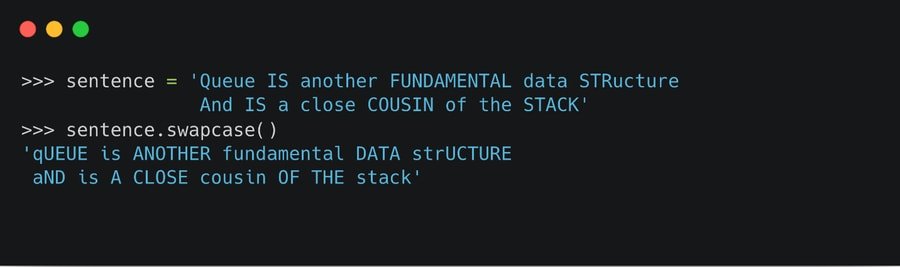
The string swapcase() strategy changes over every single
capitalized character to lowercase and do the other way around of
the given string, and returns it.
Syntax: string_name.swapcase()
Here the string name is the string whose cases are to be
swapped.
Parameter: The swapcase() technique, by and
large, doesn’t take any parameter.
Return value: The swapcase() technique will
restore a string with every one of the cases changed. That is to
say, swapcase() technique restores the string where every single
capitalized character is changed over to lowercase, and lowercase
characters are changed over to capitalized.
Q-14: Can Python be used for web
client and web server side programming?
This question is discussed in Python interview questions and
answers frequently by the interviewers. Python can be utilized to
fabricate web server-side programming and applications. Be that as
it may, the greater part of the Python engineers composes their web
applications utilizing a blend of Python and JavaScript. While
Python is executed on the server-side, JavaScript[3]
is downloaded to the customer and run by the internet browser[4].
Python is a high-level language with good package support and
several matured Web application frameworks. Writing a Web
application in Python is likely to produce results very rapidly
given the number of supporting libraries, examples, and code
snippets available to web developers.
Q-15: Mention the benefits of using
Python over Javascript
Python is contrasted with other deciphered dialects, for
example, Java, JavaScript, Perl, Tcl, or Smalltalk various
occasions. It is often asked in Python programming interview
question, why it is most preferable.
These comparisons are mainly concentrated on language issues
only. In the handy world, the decision of a programming language is
regularly directed by other certifiable limitations, for example,
cost, accessibility, preparing, and earlier speculation, or even
enthusiastic connection. Since these angles are exceptionally
factor, it normally appears to be an exercise in futility to think
of them as much for this examination.
Some of its benefits are-
- Extensive Support Libraries
- Integration Feature
- Improved Programmer’s Productivity
- Productivity of applications
- excellent support community
Q-16: Does Python allow you to program
in a structured style?
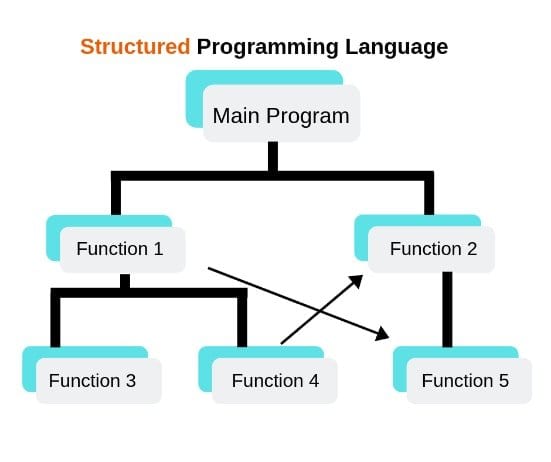
One of the key Python interview questions includes if we can
program in a structured style. As Python is a high-level
programming language, it supports both objects as well as
structured oriented language.
A structured style is used to reduce faults and
misinterpretation in a huge program by breaking it down into
smaller modules where each module uses structured codes, thus
making it a more well-organized program.
These include, if clauses, for/while loops, assignment
statements, sequences (such as strings, lists, and tuples), stacks
and queues, etc.
Q-17: What is PIP software in the
Python world?
Sometimes in Python interview questions, we are asked about PIP
software. PIP is nothing but a package manager (containing all the
records required for a module) or a standard package management
system that is used to install as well as manage software packages
written in Python.
This permits us to use other libraries that are not available in
the standard library. One of the greatest advantages of using PIP
is, how easily one can use a command-line-interface, thus making
life easier in installing Python software packages. Other features
of PIP also include the way we can manage the full lists of
packages and the numbers, respectively, through a “requirements”
file.
Q-18: What should be the typical build
environment for Python-based application development?
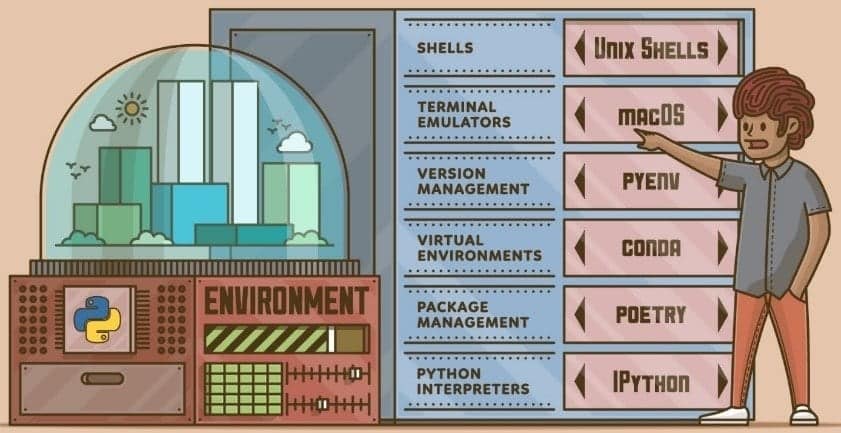
Python code needs to be written, implemented, and verified to
build applications. The two most basic things required to develop
Python-based applications are text editor[5]
and a terminal.
The text editor allows us to write the code, whereas the runtime
environment implementation such as CPython or PyPy delivers the
technique for executing the code. In this way, it tests the code
and checks if it works what we want by either manually or by unit
and functional tests. Text editors include Sublime, Notepad++[6], or even a complete IDE
such as PyCharm.
Q-19: What tools can be used to unit test a Python
code?
Python basic interview questions include the tools that can be
used to test the Python code. It is very important to test the code
that has been written as it checks if it runs the way we want it
to. It is a very tedious job to check the entire code manually, and
also increases the chance of error.
There are mainly four tools used to test the Python code. They
are Unittest (a Python module for creating tests), Nose (a test
runner for your tests), Coverage (measuring the code coverage), and
Mock (faking objects for unit tests).
Q-20: How does For loop and While loop differ in
Python?
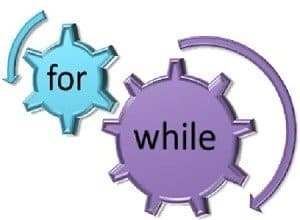
Often in our Python coding interviews, we are asked questions
regarding loops. A loop can perform a block of code numerous times
until a particular condition is met. There are mainly 2 loops, for
loop and while loop.
A for loop is used when we know how many times the code should
run. That particular piece of code will iterate “n” number of
times.
Whereas, a while loop is used in code to repeat some statements,
and it runs until a condition is false. It is almost similar to “if
statement” except that it does not run only once.
Q-21: How are data types defined in
Python?
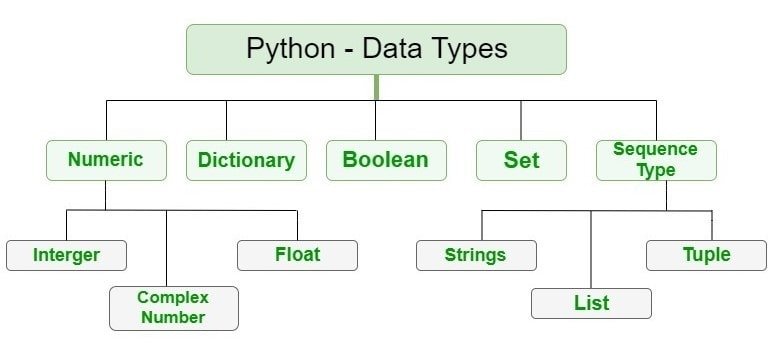
The coverage of the best Python interview questions would also
include this particular question. Usually, we know a data type
describes the format of the data that is to be input by the user,
so it can be used properly. In Python, a variable does not need to
be declared by mentioning its data type(also known as dynamic
typing) it determines the type of a literal straight from the
syntax at runtime.
Some important data types in Python are Booleans, Numbers,
Strings, Bytes, Lists, Tuples, Sets, and Dictionaries. Integer data
types hold 4 bytes, and Decimal data types hold 4 bytes.
Q-22: How do you make use of Arrays in
Python?
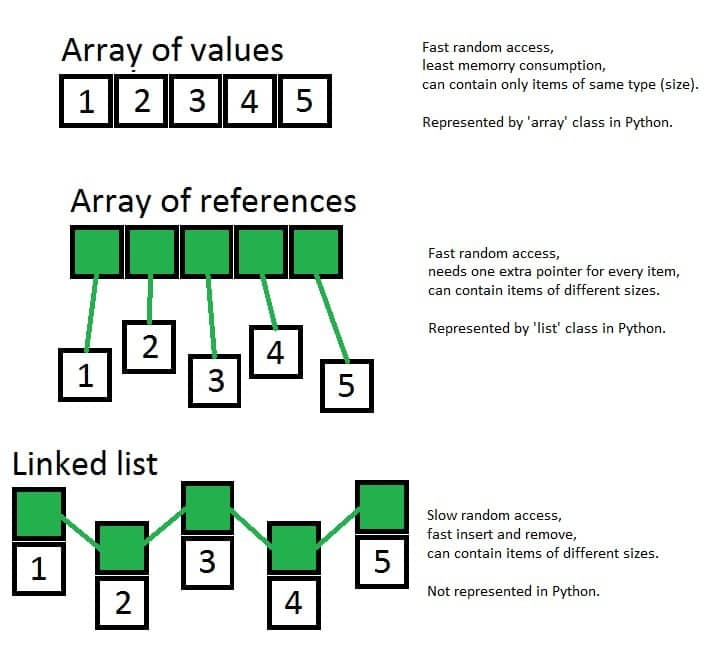
Python programming interview questions incorporate the
utilization of arrays. Arrays are special variables and are used to
store multiple values in one single variable, at continuous memory
locations, thus making it easier to calculate the position of each
element just by adding an offset to a base value. Not only this,
but they can also store elements of the different data types.
To create array we write :
array(data_type,
value_list). To add elements in the array, we
write: insert(). To remove array, we write:
remove(). We use slice operation to print a
particular scope of components from the exhibit.
Q-23: Given that Python is best suited for the
server-side application, how do you implement
JSON?
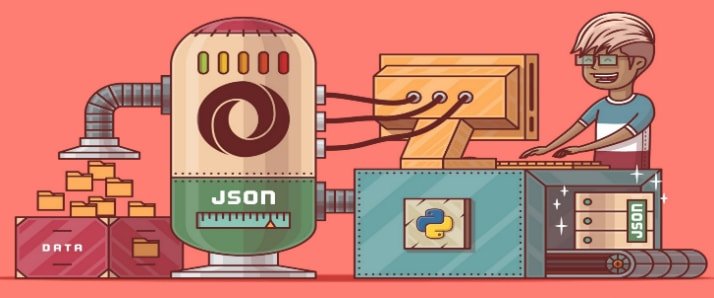
We are often asked about JSON in our Python coding interview
questions. JSON is the short type of JavaScript Object
Notation[7]. JSON is a powerful way
to allow transmission between client and server, and an easy to
read, adjustable text format used to store and communicate
information to other products.
To implement JSON, python has a JSON module that helps convert
data structures to JSON strings. We first need to import the
function to import the JSON module by writing: import
JSON. At that point, the JSON module is utilized to change
over the python lexicon into a JSON string that can be composed
into a record.
Q-24: What is the best way to parse strings and find
patterns in Python?
Often in Python interview questions and answers, we are asked
the way to parse strings. Parsing a string is to analyze a
particular string or text and convert that data into a more usable
format.
We can parse strings in a standard format by using an existing
package to read the data, or we can parse texts using string
methods by using the common string operations and extract data from
a string, or we can also parse in a complex format using regular
expressions. re.search() is commonly used to search for patterns in
a text in Python.
Q-25: Which databases are supported by
Python?
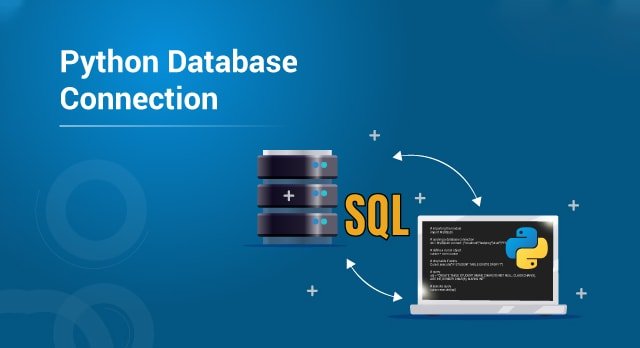
Several times we are asked this in Python interview questions,
and to answer this, we should explain what a database is. A
database is a structured set of data that is held in a computer and
is accessible in numerous ways. The two most common databases
supported by Python are PostgreSQL and MySQL.
The feature set, active development, and stability of PostgreSQL
are the main reason why we can find abundant live applications on
the Web today. MySQL, the most popular open-source database
management system, is a relational database that stores data in
distinct tables instead of putting all the data in one space.
Q-26: How can you create a GUI based application in
Python for client-side functionality?
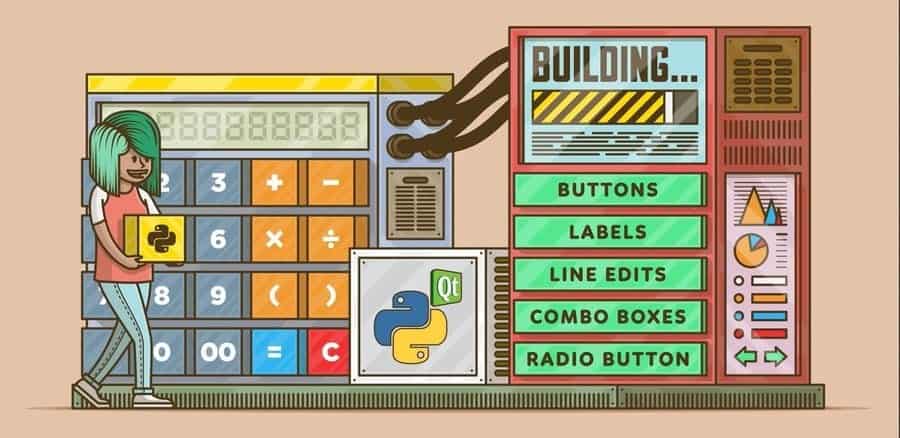
This Python interview question asks for making a user-friendly
application that is easy for the client to use. First, the purpose
of your client needs to be considered – if your client needs data
on electricity consumption, your GUI must be able to view a bar
chart, for example. Therefore, an appropriate GUI toolkit must be
used.
Secondly, an appropriate GUI package must be selected. For
instance, Kivy can be used for mobile applications. Thirdly, write
the required codes in order to make a colorful application, having
a table of menus to select from, user account to login, and other
features summarized in the picture below.
Q-27: What is a generator in Python?
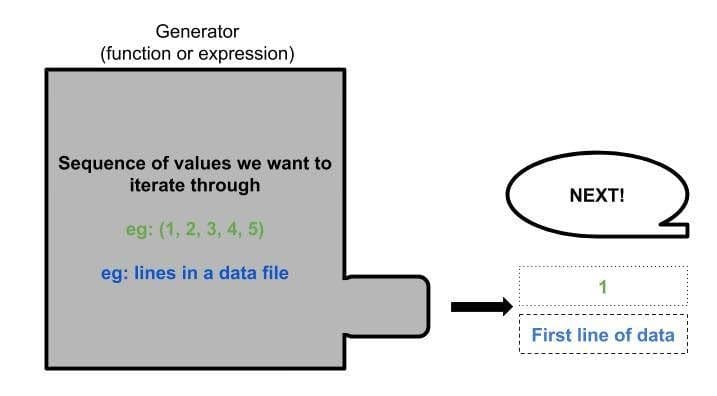
This is an often asked Python coding interview question.
Generators return a group of iteration-values in a for a loop upon
reaching the yield statement. The new values are then substituted
within a function, and the generator can run over and over
again.
Q-28: What is slicing in Python?
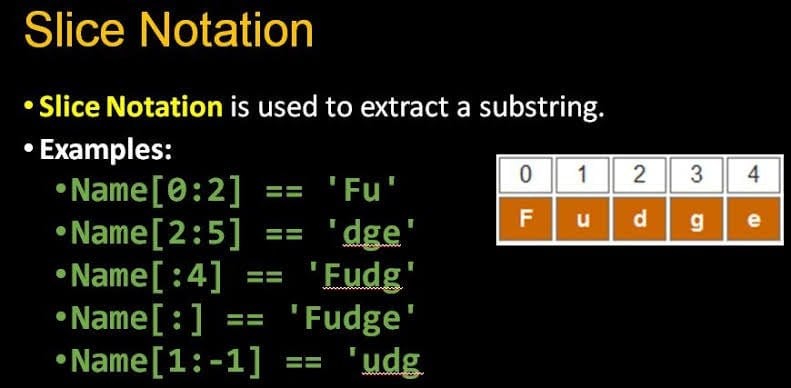
This is another most recent Python programming interview
question. slice( ) creates a slice object. The syntax of the slice
is:
slice(stop)
slice(start, stop, step)
Sequences that can be cut up incorporate range, tuple,
string, bytes, and rundown.
Q-29: What is a dictionary in Python?
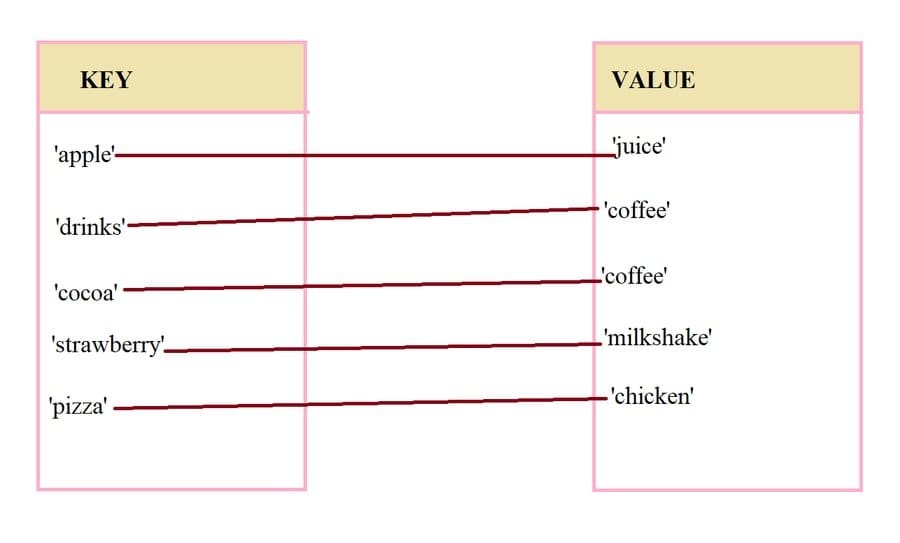
This is a Python interview question on different functions of
the Python library. Dictionary is a group of data values that are
not ordered. The dictionary stores a key-value pair rather than one
value. Any data type can be declared for the value, and the value
can also be repeated, but care must be taken to keep the key
unique.
Another method of forming a dictionary is by using dict( ).
The following diagram shows that value ‘coffee’ is repeated
for different keys, ‘drinks’ and ‘cocoa.’
Q-30: What is Pass in Python?
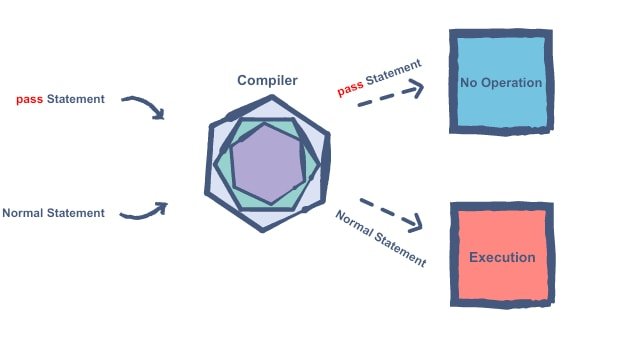
This is a basic Python interview question. Pass is a null
statement. Unlike a comment which is not run, the pass is run by
the compiler. Pass is a placeholder that creates an empty body so
that a loop or function can be written later on.
Q-31: What is a negative index in Python?
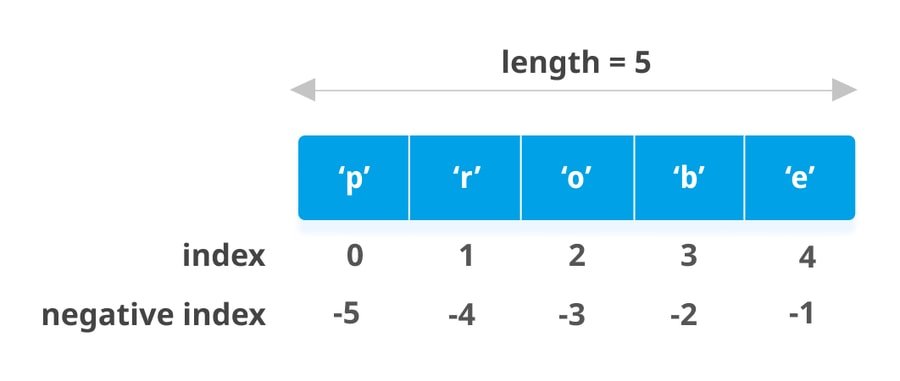
This is a Python interview question that asks to apply indices
suitably. A negative index assigns a value of -1 to the last
element in a list, array, or other container classes, a value of -2
to the second last element, and so on. This is a turn around
requesting a framework.
Q-32: What is pickling and unpickling in
Python?
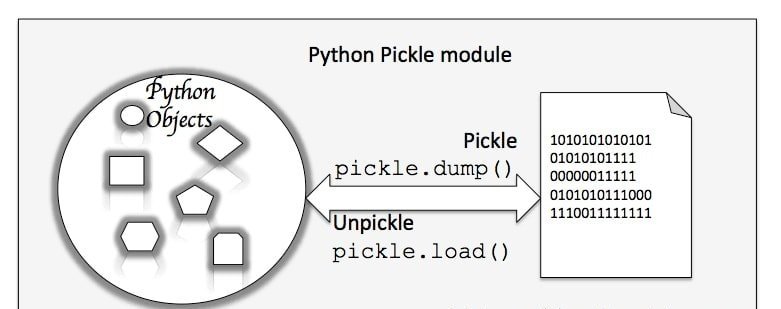
This is a habitually asked Python coding interview question.
Pickling is the method of transforming an object hierarchy into a
byte stream. Unpickling transforms byte stream back to an object
hierarchy.
Q-33: Which programming language is a good choice
between Java and Python?
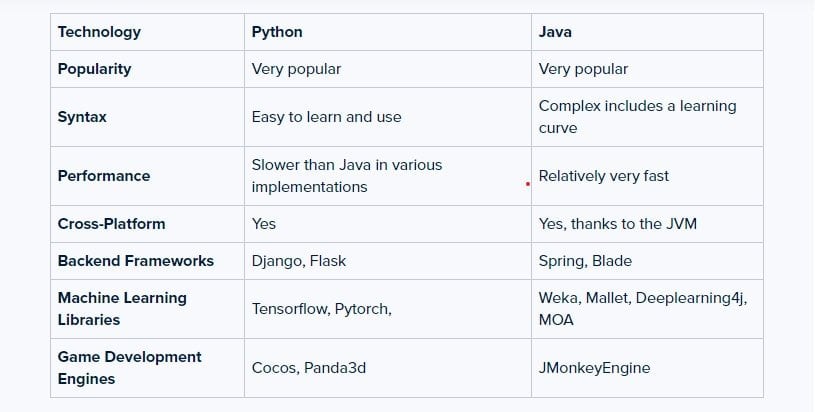
The Python programming interview question asks for a comparison
between the two. Variable types do not have to be declared because
the compiler can detect them. The syntax is similar to
pseudocoding, whereas Java has a too rigid syntax. Both Java and
Python have cross-platform, backend frameworks, machine learning
libraries, and game development engines. The only advantage Java
has over Python is speed; however, the advantage of easy learning
of Python far outweighs all the advantages of Java, so Python is a
good choice.
Q-34: What are the differences between Python2.x and
Python3.x?
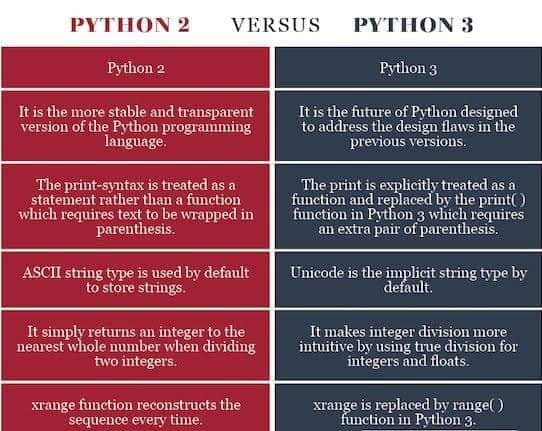
The Python basic interview question asks for the updates that
Python 3.x has, which Python 2.x does not have. Python 3.x has
addressed the flaws of the previous Python 2.x. In Python 3.x,
print( ) is a function, whereas in Python 2.x, print{ } is a
statement. Unicode is the implicit string type by default in Python
3.x, and ASCII string is used in Python 2.x. The actual float value
of division is returned for the input of integer or float in Python
3.x, but a rounded up division integer value in Python 2.x. xrange
function in Python 2.x is replaced by range( ) in Python 3.x.
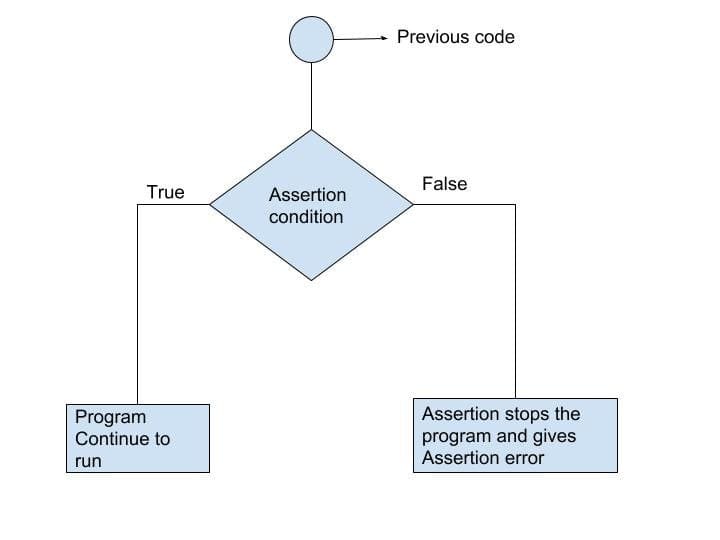
Q-35: What is the use of Assertions in
Python?
This is the highest asked Python interview question. An
assertion checks if the returned boolean value is 0 or 1. For 1,
the next code line is executed. For 0, an error message is
shown.
Q-36: What is the distance between ‘match’ and ‘search’
in Python?
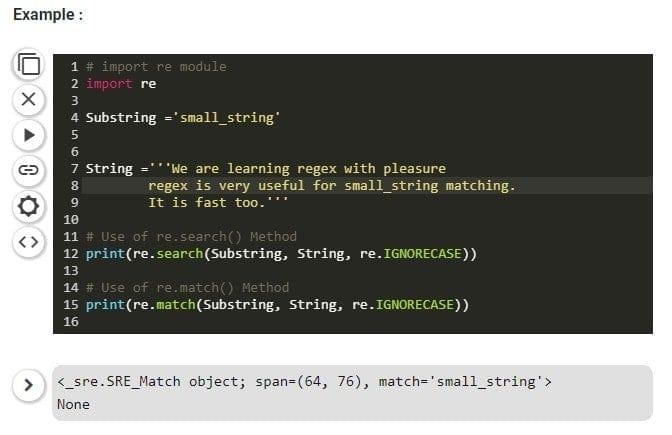
This Python programming question asks for the functionality of
match and searches that is part of the re-module in Python. Match
and search are functions that try to find a smaller string within a
larger string. Either the matched object is returned, or nothing is
returned. However, the two functions are very different from one
another. Match function looks for the object in the first line,
whereas the search function looks for the entire string, even if
the matched object gets repeated in several lines.
Q-37: What is the difference between a shallow copy and
a deep copy?
This Python coding interview question asks to differentiate
between deep copy and shallow copy, available under copy module in
Python. A deep copy or a profound duplicate duplicates an exhibit,
list, and so forth in a recursive way. A collection of objects is
created before cloning elements of the original collection. Any
element’s value altered in the new set does not alter the old
set.
Shallow copy produces a reference to the original collection, so
changes to one collection causes the other to change. In table 1,
the third element remains unchanged for deep copying, whereas in
table 2, both the collection’s third object changes due to shallow
copying.
Table 1
| List1 | List2
(Is A Deep Copy Of List1) |
Modified List2 | List1
(Unchanged) |
| Mina | Mina | Mina | Mina |
| Lina | Lina | Lina | Lina |
| Rina | Rina | Lina | Rina |
Table
2
| List1 | List2
(Is A Shallow Copy Of List1) |
Modified List2 | List1
(Changed) |
| Mina | Mina | Mina | Lina |
| Lina | Lina | Lina | Lina |
| Rina | Rina | Lina | Lina |
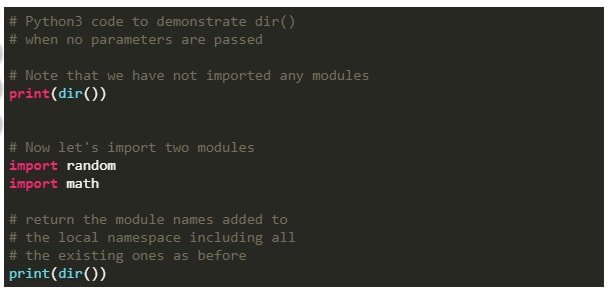
Q-38: What are help( ) and dir( ) in
Python?
This Python basic interview question asks to explain help( ) and
dir( ) in a manner that helps to understand that the two functions
are distinct and not the same. help( ) is used to get documentation
details on any Python object, such as module, class, etc. dir( )
returns qualities and techniques for a Python object. dir( ) is
also used to find coding errors.
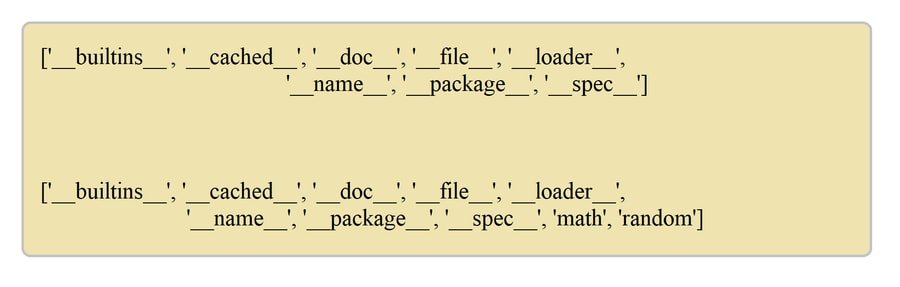
The following shows a code of dir( ) along with output.
Q-39:What is the difference between locals( ) and
globals()?
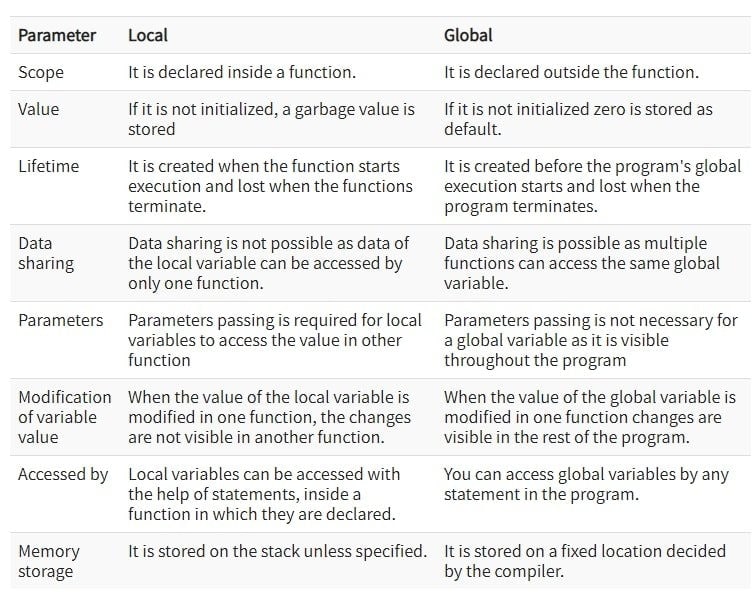
This is a Python coding interview question that asks to separate
the concept of the locals( ) and globals( ). Local variables are
declared inside a function body, so when the same variable’s name
is written inside another function, the variable has two different
values. Global variables are written outside all functions so that
when the variable name is written inside a function, the function
recognizes the variable.
If a local variable is not initialized, a garbage value is
stored. If a global variable is not initialized, zero is stored. A
local variable is created when a function starts and lost when the
function ends, whereas a global variable is created when the
program starts and lost when the program ends.
Only for local variables, parameter passing is essential. A
local variable is accessed inside a function with help( ), which is
not required in the case of the global variable. A local variable
is stored on a stack, and a global variable is stored on a fixed
location.
Q-40: What are Python decorators?
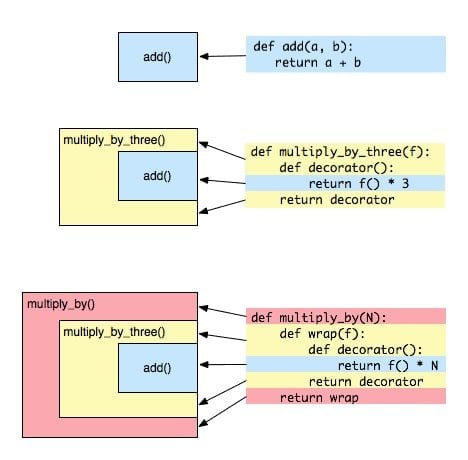
This Python coding interview question asks for how to create a
function within a function. A decorator is a Python function that
modifies the behavior of a higher-order function or class without
changing the function or class explicitly. In other words, new
functionality is provided to the function or class.
One function is passed into another function as an argument.
Accordingly, wrapper work is made. An example of three functions,
one wrapped in the other, is shown below.
Q-41: What is the purpose of the
_init_() function in Python?
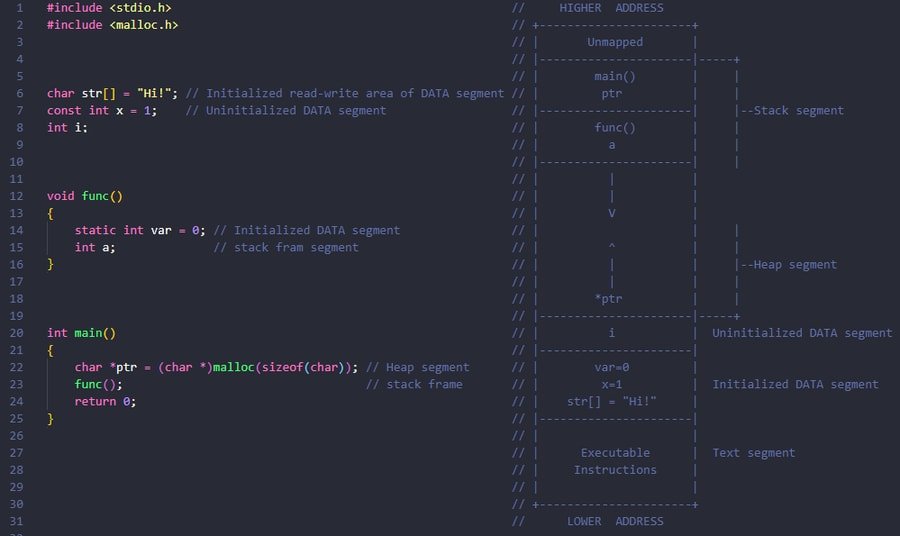
A very familiar python interview question is the purpose of
_int_() function in python. In python _int_() is such kind of
function that that is basically used as a constructor. This one is
a reserved method for python. As this is a constructor for an
object-oriented language, so when an object is created for a class,
it allows that class to initialize class along with its
attributes.
Not necessarily every time we have to use it at the initial
position of a class. We can use it wherever the position we want
for it, but the traditional way of using it is in the starting
position.
Q-42: Mention the significance of
the ‘self’ parameter in an object method?
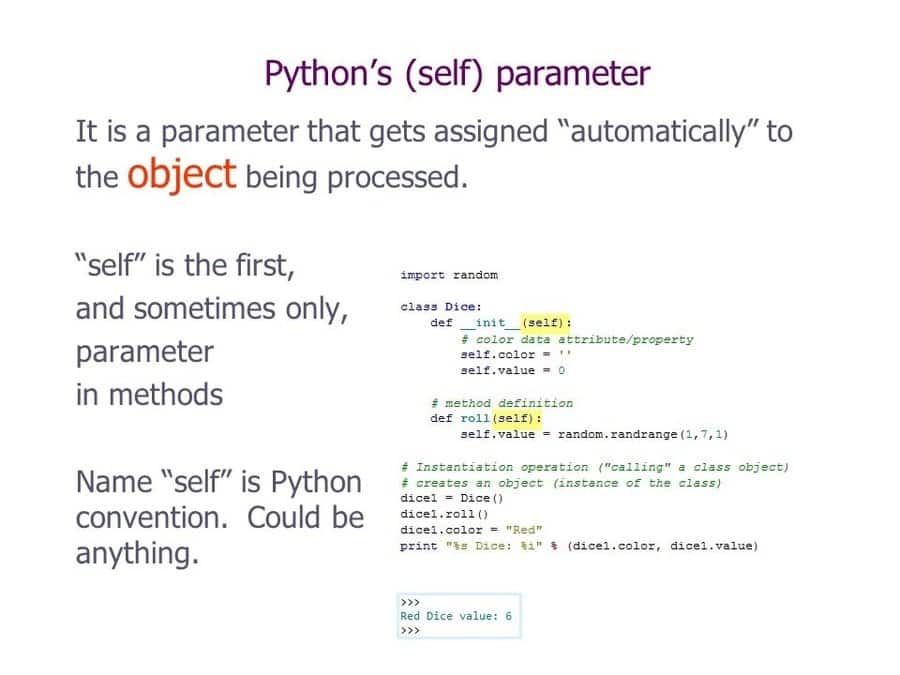
A very basic python coding interview question is the
significance of the ‘self’ parameter in an object method. Well,
‘self’ itself is an object reference, so object and ‘self’ are the
same.
‘self’ always points to the object that has been created from
that particular class. By the object self, we can get access to a
particular class’s method. In python, ‘self’ is a customary name.
We can generally use anything else in its place.
Q-43: How does Lambda function differ
from a normal function in Python?
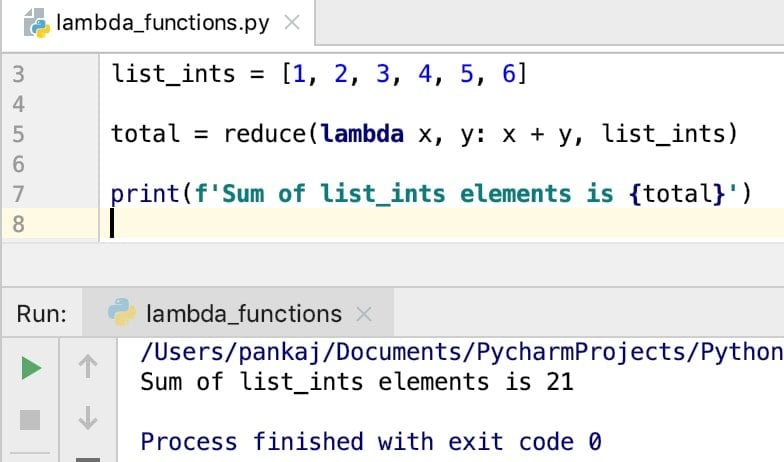
A very well known python basic interview question is how does
lambda function differ from normal python function. In python
language, a lambda function is used as data as the meaning of
lambda is the function that is used as data.
There is the main difference between lambda function and a
normal function in python, which is a lambda function’s body is
made of a single expression. And also, the outcome of this is
returned from the function that has been created. Lambda expression
creates a function object and also combined a function with a name
that doesn’t have any value.
Q-44: How is Exception Handling done
in Python?
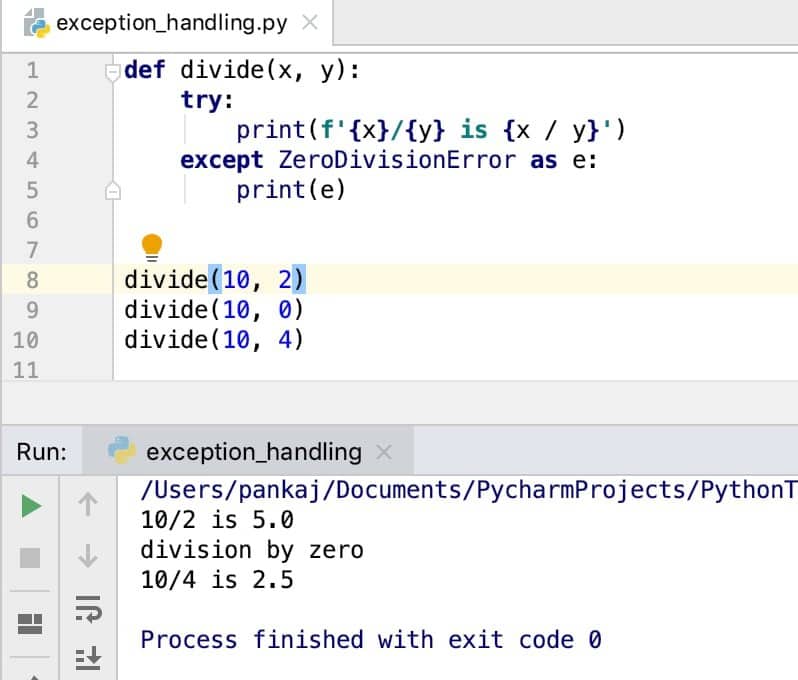
One very important python basic interview question is how
exception handling is done on python. The event exception happens
during the execution time of a program when something unusual or an
error occurs, and it can also be handled during that time.
Handling an exception means to act against the error or
exception that has been occurred. In python, ‘try’ and ‘except’ are
two keywords that are used to catch the unusual error whine running
any program.
Q-45: What is the starting point of
Python code execution?
A must ask python programming interview question is, which would
be the starting point of python code execution. For any kind of
function, no matter in which language ‘main’ is the entry point of
a program to be executed.
In python, the compiler or the interpreter executes the source
file in an ordered way, and it doesn’t read any method which is not
directly connected to the program. We can likewise execute the
record as content in python.
Q-46: Name some of the important
modules that are available in Python.
One of the very important python interview questions is the
important available modules in python. There are a few modules for
python. These modules are only python library.
Some very popular python modules are – Pandas, NumPy,
Scikit-Learn, PyTorch, MatPlotLib, SciPy, etc.
Q-47: What is namespace in Python?
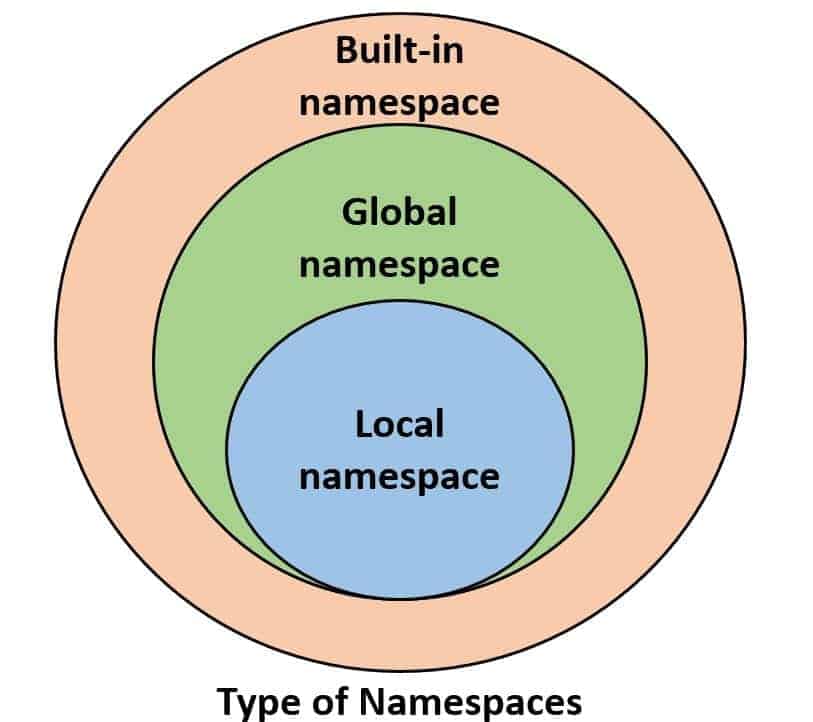
A very basic python interview question what namespace is. The
namespace is something that ensures the uniqueness of any object
from another object as well as gives us additional information
about that name like the names type, variable, function, etc.
A namespace is used in code for preventing the clash inside a
code, specifically when we use multiple libraries and also to
design the code in an organized way. In python, an object can be a
method or variable, so by using namespace; python keeps track of
that object so that the interpreter can identify it easily.
Q-48: How do you launch sub-processes within the main
process of a Python application?
An extremely commonplace python interview question is the means
by which to dispatch sub-forms inside the primary procedure in
python application. Propelling a sub-process is significant in
python since it permits running new applications or new code
utilizing python code by making another procedure.
In python subprocess module grants you to bring forth new
procedures that are associated with inputs, yields, mistake pipes,
and that is the manner by which to achieve their arrival code. This
module is likewise permitted to supplant a few more established
modules.
Q-49: Do we need to call the explicit methods to
destroy the memory allocated in Python?
A pretty famous python coding interview question is then whether
we need to call an explicit method to destroy the memory that has
already been allocated in python. Well, python doesn’t require to
call an explicit method to destroy the allocated memory.
In python, there are a total of three generations for garbage
collection for each time it endures a garbage collection session in
it. The user will not need to bother about memory management as
python itself removes the unnecessary objects from its memory.
Q-50: Does the same Python code work on multiple
platforms without any changes?
A must ask python coding interview question is to know if python
can be run in multiple platforms without changing. As Python is a
very convenient language, it can be run in multiple platforms
without changes or maybe with very little change.
Python is called a cross-platform language. The structure of
this language allows it to run any other operating system like
windows Linux etc. all it required is to have a python interpreter
to interpret the python code for the particular platform we want it
to run on.
Ending Thoughts
Python is now one of the most demanding languages,, and
therefore, we have gathered all the important and most asked
Python interview questions that will help you to brush up all the
crucial topics in depth. But in order to have a greater hand in
your interview, you should try to have a personal tutelage that
will make you practically skilled as well.
You also have to keep in mind that any tricky and complicated
Python interview questions can be asked to examine your knowledge
of Python. So, you always have to keep your skills up-to-date and
furnish them. You have to learn and practice Python scrupulously in
order to ace that interview.
Please leave a comment in our comment section for further
queries or problems. I hope that you liked this article and it was
beneficial to you. If it was, then please share this article with
your friends and family via Facebook, Twitter, Pinterest, and
LinkedIn.
References
- ^
Top 20
Most Popular Programming Languages To Learn For Your Open-source
Project (www.ubuntupit.com) - ^
random()
(www.w3schools.com) - ^
The 30
Best JavaScript Frameworks and Libraries in 2020
(www.ubuntupit.com) - ^
13 Best
Ubuntu Web Browsers: Which One is Right for You?
(www.ubuntupit.com) - ^
Linux
Text Editor: 20 Text and HTML Editors Reviewed for Linux Nerds
(www.ubuntupit.com) - ^
Top 20
Best Notepad++ Alternatives for Linux in 2020
(www.ubuntupit.com) - ^
JavaScript Object Notation
(www.json.org)
At present, Python is one of the most advanced and demanding programming languages[1] that let anyone work
more quickly and efficiently and helps to integrate the system more
effectively. The language formulates on an object-oriented
approach, that helps programmers to write readable and logical code
for any scaled (large or small) projects. A developer’s caliber
will be evaluated by his/her programming skills, analytical
ability, problem-solving capability in the shortest possible time,
and his vast knowledge on the tools and language that he will be
using to do so. To assist you with your upcoming interview, we have
short-listed the top 50 Python Interview Questions and Answers.
Python Interview Questions and Answers
With this
basic information on Python, let us move into the most popular
questions that you should expect to be asked during your
interview.
- Firstly, you will be assessed on your basic knowledge of
Python, which may include popular commands, key features, memory
management, etc. - Secondly, you will be judged on your knowledge of
object-oriented programming and Python libraries. - Finally, your problem-solving skills, using various algorithms
will be examined.
Here, we have outlined a few popular python interview questions
that will brush up your knowledge on Python, and get you ready for
the interview.
Q-1: What is Python?
The first entry in this list of Python interview questions is
one of the most basic ones. However, the majority of interviewers
never skip this basic question. Python is one of the most
progressive, elevated levels, broadly useful, powerful programming
dialects with objects, modules, strings, special cases, and
programmed memory management.
It is adaptable, simple to utilize, and quick to create.
Moreover, it has an open-source and vibrant community, and one can
get all the libraries that he/she can imagine. However, it has some
limitations with speed, few problems with threading, and the
harshest part that it is not native to a mobile environment.
Q-2: Explain Some Key Features of Python
Countless programming languages are famous because of their
specialties, but what makes a programming language unique is its
key features. The key features that you should remember are as
follows:
- Easy to Read and Code: Python is very
easy to code due to its easy syntaxes; as a result, it takes a few
hours to acquire them. Moreover, code readability is very simple,
and one can simply see the code and understand the functionality of
the code. - Interpreted Language: Python is an interpreted
language like PHP and Ruby, which means it does not need to compile
before it runs. - Dynamically Typed: Python is dynamically
typed, which means while writing code, you don’t need to declare or
set a type to a variable while assigning a value or task to
it. - Large Standard
Library: One of the best features of Python
that saves a lot of time while writing code is its available
standard library as one does not have to write a code for every
single thing. - High Level: Python is a high-level
language; as a result, programmers can code without worrying about
the system architecture, nor they have to think about the memory,
which makes Python a programmer-friendly language. - Object-Oriented Programming: Python supports
both procedure-oriented and object-oriented programming. In OOP, it
permits the meaning of classes alongside synthesis and legacy and
doesn’t have any specifiers (open, private).In OOP, it allows the
meaning of classes alongside creation and legacy and doesn’t have
any specifiers (open, private).
Q-3: How is Memory Managed in Python?
Memory management in Python, for the most part, includes a
private pile space, where every one of the information structures
and articles is found. Python additionally has an inbuilt city
worker that will reuse the unused memory and make it accessible to
the load space.
Q-4: What is the PYTHONPATH environment
variable?
PYTHONPATH is an environment variable that has a string value,
which is added in Python’s system directory list as it has a set of
directories. PYTHONPATH is generally used when we have not made any
installable Python package, but we want to import some code that we
have written in a program.
Q-5: What is the Difference Between List and Tuple in
Python?
The most applicable response to this python programming
interview question would be that List and Tuple behave almost the
same way, and any item stored in a List or Tuple can be accessed by
its index. Still, two major differences between them are that List
is mutable, but Tuple is immutable, which means, List can be
modified, but Tuple cannot be modified. Besides, Lists are slower
than Tuples.
Q-6: How is Python an Interpreted
Language?
An interpreted language is a language that is read in its raw
form, and the statements are executed without being first compiled.
Python is an interpreted language as it runs directly from the
source code. The source code written by the programmer is first
converted into an intermediate language and then to a machine
language that has to be executed.
Q-7: What are the tools that help to
find Bugs or Perform Static Analysis?
Pychecker and Pylint are the static analysis tools that help to
find bugs in Python. Pychecker is an open-source device that gets
bugs from the source code and shows cautioning about the style and
unpredictability of the code.
Pylint has a special purpose, and it controls warning and
errors. It searches for programming blunder and keeps up the
programming standard. It checks the length of each programming line
and whether the names of the variable are like the undertaking
style.
Q-8: What is PEP 8?
PEP represents the Python Enhancement Proposal. It is a set of
rules to allow maximum readability of Python code in terms of
formatting. The document describes new features for Python, which
includes design and style, suggested by the community.
Q-9: What is the Difference Between
remove() function and del statement?
The remove() function deletes the matching element/object,
whereas del removes the element at a specific index. This is one of
the basic Python programming interview questions that interviewers
never want to miss out on.
Record is the main capacity that searches an article (not
record). If we need to erase a particular item in the rundown, we
can utilize the evacuate strategy. If we need to erase the article
at a particular area (a record) on the rundown, we can either
utilize del or pop.
Q-10: What is the shuffle() Method in
Python?
The shuffle() method, for the most part, takes a succession
(rundown, string, or tuple) from the program and rearranges the
request for the things. Be that as it may, this technique changes
just the first rundown/tuple/string, it doesn’t restore another
rundown/tuple/string. This is a significant python inquiry
question.
Syntax
random.shuffle(sequence, function)
Parameter Values
| Parameter | Description |
| sequence | It is Required. A grouping. It very well may be a rundown, a tuple, or a string. |
| function | It is Optional. The name of a function that returns a number between 0.0 and 1.0. If it is not specified, the function random()[2] will be used |
Q-11: Why do we Use join() Function in
Python?
This is another asked python programming interview question
among the important python interview questions. The join() work is
a string method that profits a string linked with the components of
an iterable. This technique gives an adaptable method to connect
string. It links every component of an iterable, (for example,
rundown, string, and tuple) to the string and afterward restores
the connection string.
The syntax of join() is:
string.join(iterable)
Join() Parameters: Join() method takes an
iterable – objects capable of returning its members one at a
time.
Return Value: This technique restores a string
connected with the components of iterable.
Q-12: What is lstrip() Function in
Python?
The lstrip() is the strategy that profits a duplicate of the
string with driving characters expelled (because of the string
contention passed). It is a common Python coding interview question
often asked. It expels characters from the left, dependent on the
contention (a string determining the arrangement of characters to
be evacuated).
The syntax of lstrip() is:
string.lstrip([chars])
lstrip() Parameters: chars
Return Value: lstrip() will return a copy of
the string with leading characters stripped. Every one of the mixes
of characters in the singes contention is expelled from the left of
the string until the primary confound.
Q-13: What is swapcase() Function in
Python?
The string swapcase() strategy changes over every single
capitalized character to lowercase and do the other way around of
the given string, and returns it.
Syntax: string_name.swapcase()
Here the string name is the string whose cases are to be
swapped.
Parameter: The swapcase() technique, by and
large, doesn’t take any parameter.
Return value: The swapcase() technique will
restore a string with every one of the cases changed. That is to
say, swapcase() technique restores the string where every single
capitalized character is changed over to lowercase, and lowercase
characters are changed over to capitalized.
Q-14: Can Python be used for web
client and web server side programming?
This question is discussed in Python interview questions and
answers frequently by the interviewers. Python can be utilized to
fabricate web server-side programming and applications. Be that as
it may, the greater part of the Python engineers composes their web
applications utilizing a blend of Python and JavaScript. While
Python is executed on the server-side, JavaScript[3]
is downloaded to the customer and run by the internet browser[4].
Python is a high-level language with good package support and
several matured Web application frameworks. Writing a Web
application in Python is likely to produce results very rapidly
given the number of supporting libraries, examples, and code
snippets available to web developers.
Q-15: Mention the benefits of using
Python over Javascript
Python is contrasted with other deciphered dialects, for
example, Java, JavaScript, Perl, Tcl, or Smalltalk various
occasions. It is often asked in Python programming interview
question, why it is most preferable.
These comparisons are mainly concentrated on language issues
only. In the handy world, the decision of a programming language is
regularly directed by other certifiable limitations, for example,
cost, accessibility, preparing, and earlier speculation, or even
enthusiastic connection. Since these angles are exceptionally
factor, it normally appears to be an exercise in futility to think
of them as much for this examination.
Some of its benefits are-
- Extensive Support Libraries
- Integration Feature
- Improved Programmer’s Productivity
- Productivity of applications
- excellent support community
Q-16: Does Python allow you to program
in a structured style?
One of the key Python interview questions includes if we can
program in a structured style. As Python is a high-level
programming language, it supports both objects as well as
structured oriented language.
A structured style is used to reduce faults and
misinterpretation in a huge program by breaking it down into
smaller modules where each module uses structured codes, thus
making it a more well-organized program.
These include, if clauses, for/while loops, assignment
statements, sequences (such as strings, lists, and tuples), stacks
and queues, etc.
Q-17: What is PIP software in the
Python world?
Sometimes in Python interview questions, we are asked about PIP
software. PIP is nothing but a package manager (containing all the
records required for a module) or a standard package management
system that is used to install as well as manage software packages
written in Python.
This permits us to use other libraries that are not available in
the standard library. One of the greatest advantages of using PIP
is, how easily one can use a command-line-interface, thus making
life easier in installing Python software packages. Other features
of PIP also include the way we can manage the full lists of
packages and the numbers, respectively, through a “requirements”
file.
Q-18: What should be the typical build
environment for Python-based application development?
Python code needs to be written, implemented, and verified to
build applications. The two most basic things required to develop
Python-based applications are text editor[5]
and a terminal.
The text editor allows us to write the code, whereas the runtime
environment implementation such as CPython or PyPy delivers the
technique for executing the code. In this way, it tests the code
and checks if it works what we want by either manually or by unit
and functional tests. Text editors include Sublime, Notepad++[6], or even a complete IDE
such as PyCharm.
Q-19: What tools can be used to unit test a Python
code?
Python basic interview questions include the tools that can be
used to test the Python code. It is very important to test the code
that has been written as it checks if it runs the way we want it
to. It is a very tedious job to check the entire code manually, and
also increases the chance of error.
There are mainly four tools used to test the Python code. They
are Unittest (a Python module for creating tests), Nose (a test
runner for your tests), Coverage (measuring the code coverage), and
Mock (faking objects for unit tests).
Q-20: How does For loop and While loop differ in
Python?
Often in our Python coding interviews, we are asked questions
regarding loops. A loop can perform a block of code numerous times
until a particular condition is met. There are mainly 2 loops, for
loop and while loop.
A for loop is used when we know how many times the code should
run. That particular piece of code will iterate “n” number of
times.
Whereas, a while loop is used in code to repeat some statements,
and it runs until a condition is false. It is almost similar to “if
statement” except that it does not run only once.
Q-21: How are data types defined in
Python?
The coverage of the best Python interview questions would also
include this particular question. Usually, we know a data type
describes the format of the data that is to be input by the user,
so it can be used properly. In Python, a variable does not need to
be declared by mentioning its data type(also known as dynamic
typing) it determines the type of a literal straight from the
syntax at runtime.
Some important data types in Python are Booleans, Numbers,
Strings, Bytes, Lists, Tuples, Sets, and Dictionaries. Integer data
types hold 4 bytes, and Decimal data types hold 4 bytes.
Q-22: How do you make use of Arrays in
Python?
Python programming interview questions incorporate the
utilization of arrays. Arrays are special variables and are used to
store multiple values in one single variable, at continuous memory
locations, thus making it easier to calculate the position of each
element just by adding an offset to a base value. Not only this,
but they can also store elements of the different data types.
To create array we write :
array(data_type,
value_list). To add elements in the array, we
write: insert(). To remove array, we write:
remove(). We use slice operation to print a
particular scope of components from the exhibit.
Q-23: Given that Python is best suited for the
server-side application, how do you implement
JSON?
We are often asked about JSON in our Python coding interview
questions. JSON is the short type of JavaScript Object
Notation[7]. JSON is a powerful way
to allow transmission between client and server, and an easy to
read, adjustable text format used to store and communicate
information to other products.
To implement JSON, python has a JSON module that helps convert
data structures to JSON strings. We first need to import the
function to import the JSON module by writing: import
JSON. At that point, the JSON module is utilized to change
over the python lexicon into a JSON string that can be composed
into a record.
Q-24: What is the best way to parse strings and find
patterns in Python?
Often in Python interview questions and answers, we are asked
the way to parse strings. Parsing a string is to analyze a
particular string or text and convert that data into a more usable
format.
We can parse strings in a standard format by using an existing
package to read the data, or we can parse texts using string
methods by using the common string operations and extract data from
a string, or we can also parse in a complex format using regular
expressions. re.search() is commonly used to search for patterns in
a text in Python.
Q-25: Which databases are supported by
Python?
Several times we are asked this in Python interview questions,
and to answer this, we should explain what a database is. A
database is a structured set of data that is held in a computer and
is accessible in numerous ways. The two most common databases
supported by Python are PostgreSQL and MySQL.
The feature set, active development, and stability of PostgreSQL
are the main reason why we can find abundant live applications on
the Web today. MySQL, the most popular open-source database
management system, is a relational database that stores data in
distinct tables instead of putting all the data in one space.
Q-26: How can you create a GUI based application in
Python for client-side functionality?
This Python interview question asks for making a user-friendly
application that is easy for the client to use. First, the purpose
of your client needs to be considered – if your client needs data
on electricity consumption, your GUI must be able to view a bar
chart, for example. Therefore, an appropriate GUI toolkit must be
used.
Secondly, an appropriate GUI package must be selected. For
instance, Kivy can be used for mobile applications. Thirdly, write
the required codes in order to make a colorful application, having
a table of menus to select from, user account to login, and other
features summarized in the picture below.
Q-27: What is a generator in Python?
This is an often asked Python coding interview question.
Generators return a group of iteration-values in a for a loop upon
reaching the yield statement. The new values are then substituted
within a function, and the generator can run over and over
again.
Q-28: What is slicing in Python?
This is another most recent Python programming interview
question. slice( ) creates a slice object. The syntax of the slice
is:
slice(stop)
slice(start, stop, step)
Sequences that can be cut up incorporate range, tuple,
string, bytes, and rundown.
Q-29: What is a dictionary in Python?
This is a Python interview question on different functions of
the Python library. Dictionary is a group of data values that are
not ordered. The dictionary stores a key-value pair rather than one
value. Any data type can be declared for the value, and the value
can also be repeated, but care must be taken to keep the key
unique.
Another method of forming a dictionary is by using dict( ).
The following diagram shows that value ‘coffee’ is repeated
for different keys, ‘drinks’ and ‘cocoa.’
Q-30: What is Pass in Python?
This is a basic Python interview question. Pass is a null
statement. Unlike a comment which is not run, the pass is run by
the compiler. Pass is a placeholder that creates an empty body so
that a loop or function can be written later on.
Q-31: What is a negative index in Python?
This is a Python interview question that asks to apply indices
suitably. A negative index assigns a value of -1 to the last
element in a list, array, or other container classes, a value of -2
to the second last element, and so on. This is a turn around
requesting a framework.
Q-32: What is pickling and unpickling in
Python?
This is a habitually asked Python coding interview question.
Pickling is the method of transforming an object hierarchy into a
byte stream. Unpickling transforms byte stream back to an object
hierarchy.
Q-33: Which programming language is a good choice
between Java and Python?
The Python programming interview question asks for a comparison
between the two. Variable types do not have to be declared because
the compiler can detect them. The syntax is similar to
pseudocoding, whereas Java has a too rigid syntax. Both Java and
Python have cross-platform, backend frameworks, machine learning
libraries, and game development engines. The only advantage Java
has over Python is speed; however, the advantage of easy learning
of Python far outweighs all the advantages of Java, so Python is a
good choice.
Q-34: What are the differences between Python2.x and
Python3.x?
The Python basic interview question asks for the updates that
Python 3.x has, which Python 2.x does not have. Python 3.x has
addressed the flaws of the previous Python 2.x. In Python 3.x,
print( ) is a function, whereas in Python 2.x, print{ } is a
statement. Unicode is the implicit string type by default in Python
3.x, and ASCII string is used in Python 2.x. The actual float value
of division is returned for the input of integer or float in Python
3.x, but a rounded up division integer value in Python 2.x. xrange
function in Python 2.x is replaced by range( ) in Python 3.x.
Q-35: What is the use of Assertions in
Python?
This is the highest asked Python interview question. An
assertion checks if the returned boolean value is 0 or 1. For 1,
the next code line is executed. For 0, an error message is
shown.
Q-36: What is the distance between ‘match’ and ‘search’
in Python?
This Python programming question asks for the functionality of
match and searches that is part of the re-module in Python. Match
and search are functions that try to find a smaller string within a
larger string. Either the matched object is returned, or nothing is
returned. However, the two functions are very different from one
another. Match function looks for the object in the first line,
whereas the search function looks for the entire string, even if
the matched object gets repeated in several lines.
Q-37: What is the difference between a shallow copy and
a deep copy?
This Python coding interview question asks to differentiate
between deep copy and shallow copy, available under copy module in
Python. A deep copy or a profound duplicate duplicates an exhibit,
list, and so forth in a recursive way. A collection of objects is
created before cloning elements of the original collection. Any
element’s value altered in the new set does not alter the old
set.
Shallow copy produces a reference to the original collection, so
changes to one collection causes the other to change. In table 1,
the third element remains unchanged for deep copying, whereas in
table 2, both the collection’s third object changes due to shallow
copying.
Table 1
| List1 | List2
(Is A Deep Copy Of List1) |
Modified List2 | List1
(Unchanged) |
| Mina | Mina | Mina | Mina |
| Lina | Lina | Lina | Lina |
| Rina | Rina | Lina | Rina |
Table
2
| List1 | List2
(Is A Shallow Copy Of List1) |
Modified List2 | List1
(Changed) |
| Mina | Mina | Mina | Lina |
| Lina | Lina | Lina | Lina |
| Rina | Rina | Lina | Lina |
Q-38: What are help( ) and dir( ) in
Python?
This Python basic interview question asks to explain help( ) and
dir( ) in a manner that helps to understand that the two functions
are distinct and not the same. help( ) is used to get documentation
details on any Python object, such as module, class, etc. dir( )
returns qualities and techniques for a Python object. dir( ) is
also used to find coding errors.
The following shows a code of dir( ) along with output.
Q-39:What is the difference between locals( ) and
globals()?
This is a Python coding interview question that asks to separate
the concept of the locals( ) and globals( ). Local variables are
declared inside a function body, so when the same variable’s name
is written inside another function, the variable has two different
values. Global variables are written outside all functions so that
when the variable name is written inside a function, the function
recognizes the variable.
If a local variable is not initialized, a garbage value is
stored. If a global variable is not initialized, zero is stored. A
local variable is created when a function starts and lost when the
function ends, whereas a global variable is created when the
program starts and lost when the program ends.
Only for local variables, parameter passing is essential. A
local variable is accessed inside a function with help( ), which is
not required in the case of the global variable. A local variable
is stored on a stack, and a global variable is stored on a fixed
location.
Q-40: What are Python decorators?
This Python coding interview question asks for how to create a
function within a function. A decorator is a Python function that
modifies the behavior of a higher-order function or class without
changing the function or class explicitly. In other words, new
functionality is provided to the function or class.
One function is passed into another function as an argument.
Accordingly, wrapper work is made. An example of three functions,
one wrapped in the other, is shown below.
Q-41: What is the purpose of the
_init_() function in Python?
A very familiar python interview question is the purpose of
_int_() function in python. In python _int_() is such kind of
function that that is basically used as a constructor. This one is
a reserved method for python. As this is a constructor for an
object-oriented language, so when an object is created for a class,
it allows that class to initialize class along with its
attributes.
Not necessarily every time we have to use it at the initial
position of a class. We can use it wherever the position we want
for it, but the traditional way of using it is in the starting
position.
Q-42: Mention the significance of
the ‘self’ parameter in an object method?
A very basic python coding interview question is the
significance of the ‘self’ parameter in an object method. Well,
‘self’ itself is an object reference, so object and ‘self’ are the
same.
‘self’ always points to the object that has been created from
that particular class. By the object self, we can get access to a
particular class’s method. In python, ‘self’ is a customary name.
We can generally use anything else in its place.
Q-43: How does Lambda function differ
from a normal function in Python?
A very well known python basic interview question is how does
lambda function differ from normal python function. In python
language, a lambda function is used as data as the meaning of
lambda is the function that is used as data.
There is the main difference between lambda function and a
normal function in python, which is a lambda function’s body is
made of a single expression. And also, the outcome of this is
returned from the function that has been created. Lambda expression
creates a function object and also combined a function with a name
that doesn’t have any value.
Q-44: How is Exception Handling done
in Python?
One very important python basic interview question is how
exception handling is done on python. The event exception happens
during the execution time of a program when something unusual or an
error occurs, and it can also be handled during that time.
Handling an exception means to act against the error or
exception that has been occurred. In python, ‘try’ and ‘except’ are
two keywords that are used to catch the unusual error whine running
any program.
Q-45: What is the starting point of
Python code execution?
A must ask python programming interview question is, which would
be the starting point of python code execution. For any kind of
function, no matter in which language ‘main’ is the entry point of
a program to be executed.
In python, the compiler or the interpreter executes the source
file in an ordered way, and it doesn’t read any method which is not
directly connected to the program. We can likewise execute the
record as content in python.
Q-46: Name some of the important
modules that are available in Python.
One of the very important python interview questions is the
important available modules in python. There are a few modules for
python. These modules are only python library.
Some very popular python modules are – Pandas, NumPy,
Scikit-Learn, PyTorch, MatPlotLib, SciPy, etc.
Q-47: What is namespace in Python?
A very basic python interview question what namespace is. The
namespace is something that ensures the uniqueness of any object
from another object as well as gives us additional information
about that name like the names type, variable, function, etc.
A namespace is used in code for preventing the clash inside a
code, specifically when we use multiple libraries and also to
design the code in an organized way. In python, an object can be a
method or variable, so by using namespace; python keeps track of
that object so that the interpreter can identify it easily.
Q-48: How do you launch sub-processes within the main
process of a Python application?
An extremely commonplace python interview question is the means
by which to dispatch sub-forms inside the primary procedure in
python application. Propelling a sub-process is significant in
python since it permits running new applications or new code
utilizing python code by making another procedure.
In python subprocess module grants you to bring forth new
procedures that are associated with inputs, yields, mistake pipes,
and that is the manner by which to achieve their arrival code. This
module is likewise permitted to supplant a few more established
modules.
Q-49: Do we need to call the explicit methods to
destroy the memory allocated in Python?
A pretty famous python coding interview question is then whether
we need to call an explicit method to destroy the memory that has
already been allocated in python. Well, python doesn’t require to
call an explicit method to destroy the allocated memory.
In python, there are a total of three generations for garbage
collection for each time it endures a garbage collection session in
it. The user will not need to bother about memory management as
python itself removes the unnecessary objects from its memory.
Q-50: Does the same Python code work on multiple
platforms without any changes?
A must ask python coding interview question is to know if python
can be run in multiple platforms without changing. As Python is a
very convenient language, it can be run in multiple platforms
without changes or maybe with very little change.
Python is called a cross-platform language. The structure of
this language allows it to run any other operating system like
windows Linux etc. all it required is to have a python interpreter
to interpret the python code for the particular platform we want it
to run on.
Ending Thoughts
Python is now one of the most demanding languages,, and
therefore, we have gathered all the important and most asked
Python interview questions that will help you to brush up all the
crucial topics in depth. But in order to have a greater hand in
your interview, you should try to have a personal tutelage that
will make you practically skilled as well.
You also have to keep in mind that any tricky and complicated
Python interview questions can be asked to examine your knowledge
of Python. So, you always have to keep your skills up-to-date and
furnish them. You have to learn and practice Python scrupulously in
order to ace that interview.
Please leave a comment in our comment section for further
queries or problems. I hope that you liked this article and it was
beneficial to you. If it was, then please share this article with
your friends and family via Facebook, Twitter, Pinterest, and
LinkedIn.
References
- ^
Top 20
Most Popular Programming Languages To Learn For Your Open-source
Project (www.ubuntupit.com) - ^
random()
(www.w3schools.com) - ^
The 30
Best JavaScript Frameworks and Libraries in 2020
(www.ubuntupit.com) - ^
13 Best
Ubuntu Web Browsers: Which One is Right for You?
(www.ubuntupit.com) - ^
Linux
Text Editor: 20 Text and HTML Editors Reviewed for Linux Nerds
(www.ubuntupit.com) - ^
Top 20
Best Notepad++ Alternatives for Linux in 2020
(www.ubuntupit.com) - ^
JavaScript Object Notation
(www.json.org)
Read more https://www.ubuntupit.com/frequently-asked-python-interview-questions-and-answers/